Building a Trading Plan That Pays Bills: From Strategy Rules to a Monthly Withdrawal Policy
Most trading plans are built around one question: how do I grow the account?
That is different from asking how to trade in a way that can support controlled monthly withdrawals without damaging discipline.
Once trading income gets tied to rent, groceries, or debt payments, behavior changes. Traders force setups, increase size after slow weeks, cut winners early just to book something, or refuse to take valid stops. A trading plan for income has to reduce that pressure, not just chase returns.
That is why a cashflow-focused plan needs different rules. You need clear entries and exits, steadier position sizing, hard daily and weekly loss limits, and a withdrawal policy that separates profits from core trading capital. The goal is not to make trading feel like a salary. It is to build a process that can survive real financial pressure.
Start With a Different Goal

Why a cashflow objective changes the plan
A growth-focused plan can tolerate more volatility. You can reinvest profits, accept uneven returns, and let the account compound through long swings.
An income plan cannot rely on that logic alone. If money may be withdrawn, the account has to absorb two kinds of stress at once: market drawdowns and cash leaving the account.
That changes everything.
A strategy can be profitable and still be a poor fit for income. If returns are too uneven, drawdowns too deep, or trade frequency too inconsistent, it may look good on paper but break down when bills enter the picture.
Growth mindset vs. income mindset
A growth mindset says: maximize long-term return and keep profits in the account.
An income mindset says: protect a capital floor, manage variability, and pay yourself only from excess profits.
That difference matters. A trader focused on compounding may accept a 15% drawdown if the upside justifies it. A trader planning monthly withdrawals may find that same drawdown unacceptable because it creates immediate financial and psychological pressure.
The hidden risk of income pressure
Income pressure does not just cause overtrading. It also shows up in quieter ways:
- skipping stop losses
- taking weaker setups after a flat week
- increasing size to catch up
- moving targets too early
- breaking rules after a good streak because confidence gets too high
The real danger is that decision quality usually breaks down before account statistics clearly show the damage.
Protect Consistency First
What consistency actually means
Consistency does not mean making money every week.
It means trading a process with repeatable expectancy, manageable drawdowns, and behavior you can maintain during losing periods. In practice, that means knowing your setup frequency, average R-multiple, likely losing streaks, and historical drawdown range before you attach income expectations to the account.
A flat month is not proof the system is broken. It may be a normal business outcome.
Why stability matters more than chasing returns
For income traders, moderate but survivable returns are often more useful than high but unstable returns. A strategy that can produce 40% in a strong quarter but also suffer sharp drawdowns may be less practical than one that grows more slowly with steadier execution.
A better question is not, “How much can this strategy make?” but, “How much monthly variability can I handle without changing my behavior?”
A simple model: strategy, risk, withdrawals
Use this three-part model:
- Strategy engine: the setup that creates opportunity
- Risk firewall: the rules that stop bad periods from becoming account damage
- Withdrawal buffer: the system that keeps household expenses from feeding back into trade decisions
If one part is missing, the whole process becomes unstable.
Use Entry and Exit Rules You Can Audit
Why vague discretion breaks under pressure
Terms like “strong momentum” or “clean setup” sound fine until you need the money. Then vagueness turns into an excuse.
You do not need a fully mechanical system, but decisions must be reviewable. After any trade, you should be able to answer one question clearly: did this trade meet the plan or not?
Define entries clearly
A solid entry checklist usually includes:
- market and timeframe
- trend filter
- setup location
- trigger condition
- invalidation condition
- session or time filter
- news filter
For example, “long when price looks bullish” is too loose. “Long only when the 20 EMA is above the 50 EMA on the 1-hour chart, price pulls back into prior support, and a rejection candle closes in trend direction during London or New York session” is specific enough to test.
Define exits in advance
Exit rules need three parts:
- Stop loss: where the trade is proven wrong
- Target: where reward is taken
- Management: what can change after entry, if anything
If trade management is discretionary, define the triggers. For example, moving the stop to breakeven only after 1R is reached and market structure confirms continuation.
Example of an auditable rule set
Here is a portable example for forex, index, or futures traders:
- Chart: 1-hour trend context, 5-minute execution
- Trend filter: 20 EMA above 50 EMA on the 1-hour for longs
- Location: pullback into prior support aligned with trend
- Trigger: bullish rejection candle closes from the zone
- Invalidation: no trade if price closes below support before the trigger
- News rule: no entry within 15 minutes before major scheduled news
- Stop loss: below the swing low that formed the setup
- Target: 2R or next major resistance, whichever comes first
- Management: move stop to breakeven only after price reaches 1R and forms a higher low
This exact setup may not suit your style, but it is specific enough to test, journal, and improve.
Position Size for Stability, Not Ego
Why oversized risk creates unstable results
Oversized risk does more than increase losses. It changes behavior.
A trader risking too much per trade becomes less willing to take stops, more hesitant on the next setup, and more tempted to make losses back quickly. That is exactly what an income-focused plan cannot afford.
Fixed fractional sizing vs. variable sizing
Fixed fractional sizing means risking a constant percentage of current equity on each trade. After losses, size contracts naturally. After gains, it expands modestly.
Variable sizing often responds to confidence, recent results, or market mood. Skilled traders may handle that well, but for most income-focused traders it adds instability at the worst time.
Fixed fractional sizing is usually the better starting point.
Choose risk based on drawdown tolerance
Do not begin with return goals. Start with this question:
What losing streak can I tolerate without changing my behavior?
If your testing shows that 8 to 10 consecutive losses are possible, your risk per trade should make that streak painful but survivable.
Example: losing streaks at different risk levels
Over a 10-trade losing streak:
- 1% risk per trade leaves the account at about 90.4% of starting equity, a drawdown of roughly 9.6%
- 0.5% risk per trade leaves the account at about 95.1%, a drawdown of roughly 4.9%
- 0.25% risk per trade leaves the account at about 97.5%, a drawdown of roughly 2.5%
The math matters, but the psychological effect matters more. A 2.5% drawdown is easier to trade through than a near-10% slide, especially when withdrawals are part of the plan.
Also define max open risk. If you risk 0.5% on three correlated positions, your real exposure may be much larger than it looks.
Use Daily and Weekly Loss Limits
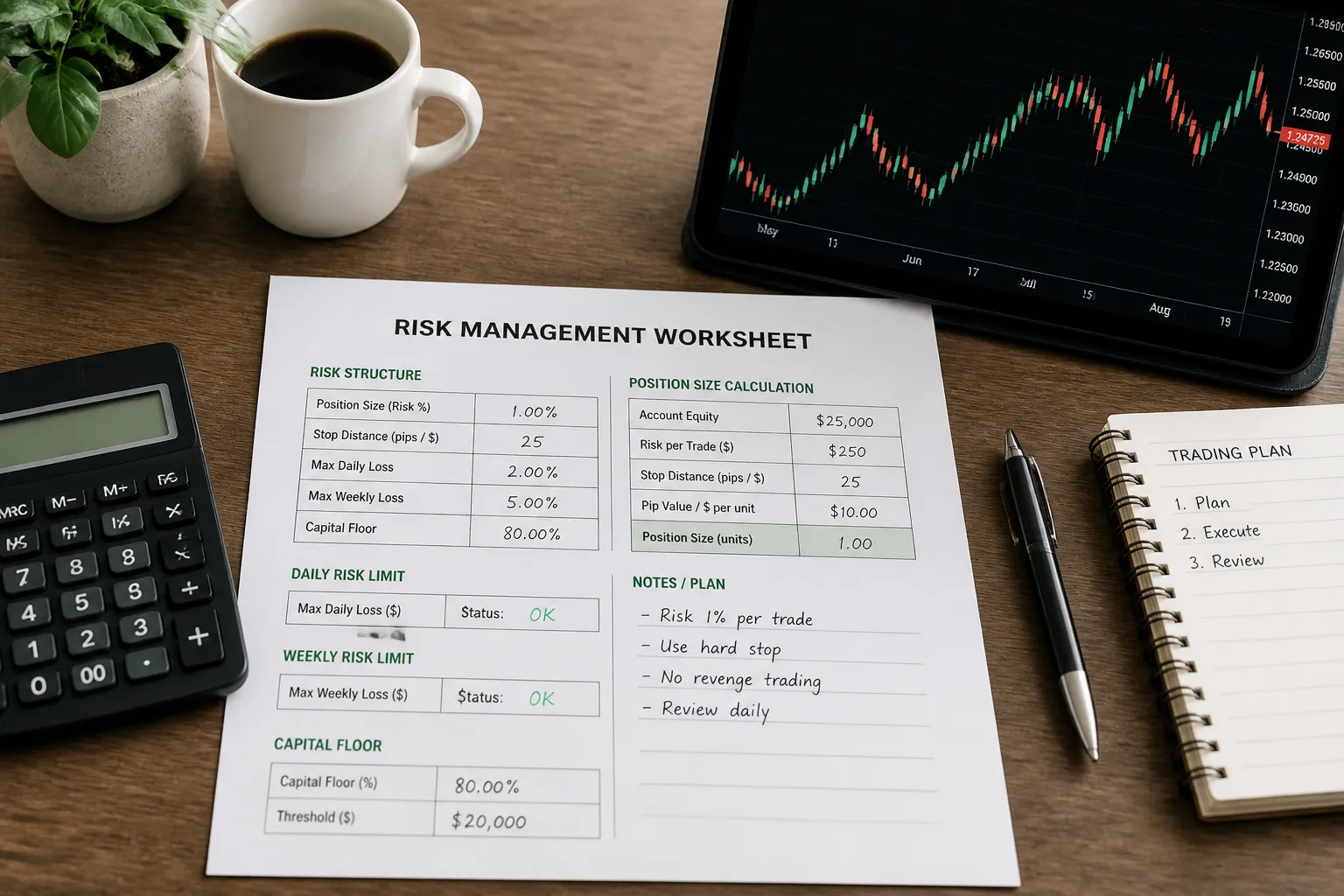
Why loss limits matter
Loss limits are not magic numbers that tell you when the strategy has failed.
They are behavior controls. They exist because traders often perform worse before the account data fully reflects the problem.
Set a daily loss limit
A practical daily limit could be:
- stop after 1R to 2R lost in a day, or
- stop after two full-loss trades
The exact number depends on your strategy frequency, but the rule should be set in advance.
Set a weekly loss limit
A weekly loss limit keeps one difficult week from turning into a destructive month.
A simple rule is to pause trading for the rest of the week after losing 3R to 5R. That creates space to review instead of forcing trades late in the week just to finish green.
What to do when a limit is hit
When a daily or weekly limit is triggered:
- Stop opening new trades.
- Save screenshots of all trades.
- Journal whether each trade followed the plan.
- Review execution quality, not just P&L.
- Resume only at the next scheduled reset.
That turns a loss limit into a real workflow.
Create a Withdrawal Policy
Why random withdrawals are a problem
Random withdrawals create two issues.
First, they blur performance tracking. You stop knowing whether the account is growing, shrinking, or just being drained.
Second, they create pressure to replace withdrawn money. That often leads to lower-quality trades after a payout.
Profits vs. risk capital
This distinction is critical.
Withdrawing profits means taking money only from gains above a predefined account floor.
Withdrawing capital means reducing the base your strategy needs to operate safely.
The second weakens the account and makes normal drawdowns feel more dangerous.
Build a monthly withdrawal policy
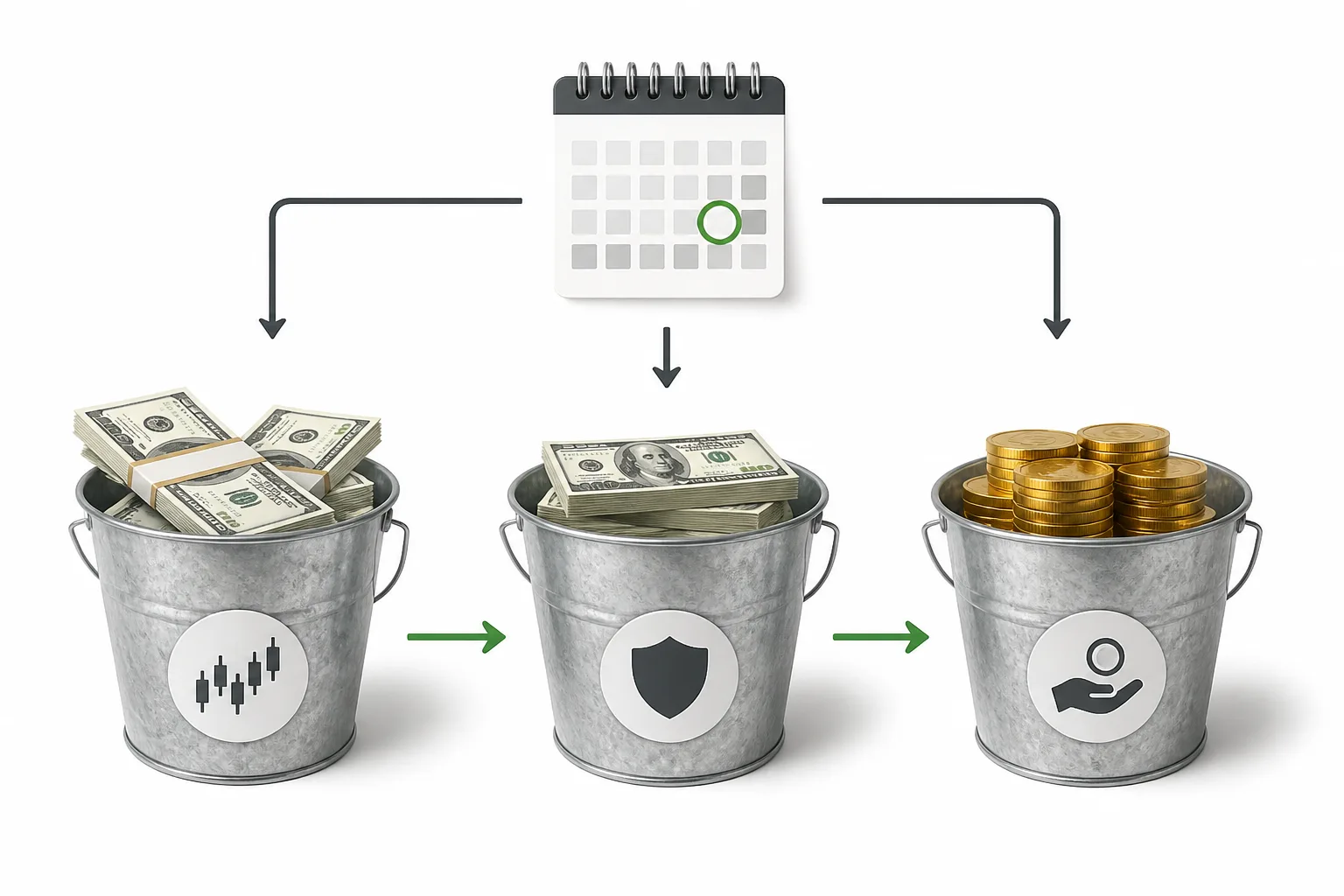
A practical policy should define:
- base capital floor
- reserve threshold before withdrawals begin
- payout date
- profit split
- payout cap
- conditions for no withdrawal
A strong default rule is simple: no withdrawals in any month that ends below the base capital floor.
Example framework
Suppose your plan looks like this:
- Base capital: $20,000
- Reserve threshold: $22,000
- Month-end equity: $24,000
- Excess above threshold: $2,000
- Profit split: 50% withdrawn, 50% retained
In that case, you withdraw $1,000 and leave $1,000 in the account. The account stays at $23,000, which helps build resilience for future drawdowns.
You can also cap the payout. For example, withdraw the lesser of 50% of excess profits or $1,500. That prevents one strong month from weakening the account or encouraging lifestyle inflation.
Separate Living Expenses From Trading Capital
Why this month’s trades should not fund this month’s bills
If this month’s trades have to cover this month’s bills, every losing day feels like an emergency. That changes trade selection, risk tolerance, and emotional stability.
A flat month should feel like something to review, not something to survive.
How much to keep outside the trading account
There is no universal number, but a practical range is 3 to 12 months of expenses held outside the trading account. The right amount depends on how volatile your results are and whether trading income is supplemental or primary.
The principle matters more than the exact number: create enough separation so short-term market variance does not become household stress.
A practical account structure
A simple two-account system:
- trading account
- personal reserve account
A cleaner three-account system:
- trading account
- tax/reserve account
- household spending account
This makes it easier to avoid judging every trade by immediate bill pressure.
Consider two traders. Trader A randomly withdraws from a $15,000 account after good weeks to cover expenses. Trader B keeps a $20,000 base, holds a six-month expense buffer outside the account, risks 0.5% per trade, and withdraws only part of month-end excess profits. Trader B may look less aggressive, but the process is far more sustainable.
Put the Plan Together
The four-part cashflow framework
A complete cashflow trading plan has four parts:
- Strategy rules — what qualifies as a trade
- Risk rules — how much is at risk per trade and across open positions
- Stop rules — when trading pauses after losses
- Payout rules — when and how profits are withdrawn
If one of these is missing, you are probably improvising where pressure is highest.
A one-page plan structure
Your plan can include:
- markets traded
- trading sessions and time windows
- setup checklist
- entry trigger
- invalidation rule
- stop placement rule
- target rule
- management rule
- risk per trade
- max open risk
- daily loss limit
- weekly loss limit
- monthly review date
- base capital floor
- reserve threshold
- profit split
- payout cap
- conditions for no withdrawal
Short, testable rules work better than motivational statements.
Review monthly, not emotionally
Review the plan once a month, not after every rough patch.
Look at:
- rule adherence
- expectancy and average R
- drawdown versus tested expectations
- whether withdrawals followed policy
- whether setup quality stayed consistent
Do not rewrite the plan because of one difficult week. Change it only when your data and execution history support the change.
Common Mistakes When Trading for Income
Increasing size after a slow week
This is usually pressure disguised as discipline. Catch-up sizing adds risk when emotions are already elevated.
Withdrawing too much after a good month
A strong month can tempt you to pull too much cash out. That leaves the account undercapitalized and makes the next normal drawdown feel worse than it is.
Taking weaker setups to hit a number
Once the target becomes “I need $1,500 this month,” edge-based execution often turns into need-based execution. That is where expectancy starts to decay.
Ignoring flat or negative months
No withdrawal policy can turn trading into a guaranteed paycheck. Some months will be flat. Some will be negative. If your plan assumes every month must pay, it is not realistic.
Final Takeaway
The first job of a cashflow trading plan is not to produce income.
It is to reduce pressure enough for you to keep executing a real edge without damaging capital or decision-making. That means defining trade rules, using position sizing that survives losing streaks, enforcing daily and weekly loss limits, and paying yourself only from excess profits.
If you are building this from scratch, start with four things:
- a rule-based setup checklist
- fixed fractional position sizing
- daily and weekly max loss rules
- a no-random-withdrawal policy
And be honest about readiness. If you do not have a tested strategy, a documented track record, stable execution, and an external expense buffer, you are probably not ready to rely on trading withdrawals. A few profitable months are not enough. Income expectations should come only after the process is already stable.
FAQ
Why does a trading plan for income need to be different from a growth-focused plan?
A growth-focused plan can tolerate more volatility, deeper drawdowns, and longer reinvestment periods. An income plan has a different job. It must protect capital, reduce emotional pressure, and make withdrawals possible without pushing you into bad trades.
What rules should be fixed before trying to withdraw income from trading?
At minimum, you need four rule sets: strategy rules for trade qualification, risk rules for position sizing and total exposure, stop rules for daily and weekly loss limits, and payout rules for when profits can be withdrawn.
How much can a trader withdraw without damaging the account?
There is no universal percentage. It depends on strategy expectancy, drawdown profile, account size, and the trader’s financial buffer outside the account. A safer approach is to withdraw only from profits above a predefined capital floor or reserve threshold.
Why are daily and weekly loss limits important for income traders?
They stop short-term losses from turning into emotional escalation. When trading profits are mentally assigned to bills, traders are more likely to revenge trade, increase size, or take weaker setups after a bad session or week.
What is a practical daily loss limit for a trader focused on cashflow?
A common rule is to stop after losing 1R to 2R in a day, or after two full-loss trades, depending on strategy frequency. The exact level should come from testing and from your ability to stay disciplined after losses.
How should position sizing change when the goal is monthly cashflow?
Position sizing should be based on drawdown tolerance and emotional stability, not ambition. Fixed fractional sizing is usually the better fit because it scales down after losses and keeps risk proportional to equity.
What happens during a losing streak at different risk levels?
A 10-trade losing streak at 1% risk per trade produces about a 9.6% drawdown. At 0.5% risk, the drawdown is roughly 4.9%. At 0.25% risk, it is about 2.5%. Lower risk reduces both financial damage and recovery pressure.
What is the difference between withdrawing profits and withdrawing trading capital?
Withdrawing profits means paying yourself only from gains above a predefined account floor or reserve threshold. Withdrawing trading capital means removing money from the base the strategy needs to operate safely. The second approach weakens the account.
Should traders use a monthly withdrawal policy instead of random withdrawals?
Yes. Random withdrawals blur performance tracking and create pressure to replace money taken out during the month. A monthly policy creates structure and reduces impulsive decisions.
How many months of living expenses should be kept outside the trading account?
There is no one-size-fits-all number, but 3 to 12 months of expenses is a practical range. The main goal is to avoid depending on this month’s trades to pay this month’s bills.
When is a trader not ready to withdraw income from trading?
Usually when they do not have a tested strategy, lack a documented track record, regularly break rules, cannot handle drawdowns calmly, or have no expense buffer outside the account. A profitable month or two is not enough.