Most people searching for “how to make money fast trading” are really asking a better question: how do I stop losing money to avoidable mistakes?
That is the right place to start. In trading, speed usually destroys accounts before it builds them. Bigger size, more trades, and random entries can create a brief burst of excitement, but they also amplify friction: spread, slippage, poor timing, and emotional decisions.
The realistic shortcut is less glamorous. Tighten execution. Avoid poor conditions. Take fewer impulsive trades. None of that is a secret hack, and it will not save a weak strategy. But for many retail forex and CFD traders, it can improve results faster than adding another indicator.
What follows are nine micro-edges: small operating rules that may help reduce unnecessary losses without forcing you to rebuild your whole system. Treat them as testable process improvements, not guarantees.
Best Trading Tricks to Make Money Faster — Realistically
Strip out the hype, and “make money fast” in trading usually means one of three things:
- improve faster
- lose less while learning
- preserve enough capital for a real edge to play out
That sounds less exciting than social media trading content, but it is much closer to how durable progress actually happens.
Many struggling traders assume the problem is always the strategy. Sometimes it is. Often, though, a decent setup becomes a bad trade because of poor execution. The entry comes during a spread spike. It happens in dead session hours. The wrong order type gets used. The trade is forced right before high-impact news. Or it is the eighth trade of the day, taken out of boredom or frustration.
A micro-edge is simply a small rule that reduces that kind of damage. On its own, it is not magic. In combination, it can make your trading cleaner, easier to review, and harder to sabotage.
What Actually Speeds Up Results in Trading
The difference between making money fast and improving faster
Fast profits are not fully under your control. Better execution is.
You cannot make the market trend after you enter. You can control whether you trade during liquid hours, skip ugly spreads, stop after hitting your daily loss limit, and only take setups that match your plan.
That shift matters. Traders who last long enough to improve usually stop chasing speed and start reducing waste.
Why execution costs quietly ruin good setups
Intraday traders operate close to the noise floor. When your average target is modest, small frictions matter more.
The bid-ask spread is an immediate cost. Slippage can turn a valid breakout into a poor entry. Thin liquidity can make normal movement messy. Around major news, spreads may widen sharply and technical levels can stop behaving the way your chart suggested five minutes earlier.[^1]
A setup can be right in theory and still be poor in practice.
Why small rule changes often beat strategy hopping
Strategy hopping feels productive because it is dramatic. Small rule changes feel boring because they are operational.
But boring is often where the improvement is. A trader who stops taking low-quality trades during bad hours may improve more than a trader who changes indicators every two weeks.
Subtraction is underrated.
1. Use a Spread Filter Before You Enter
What a spread filter is
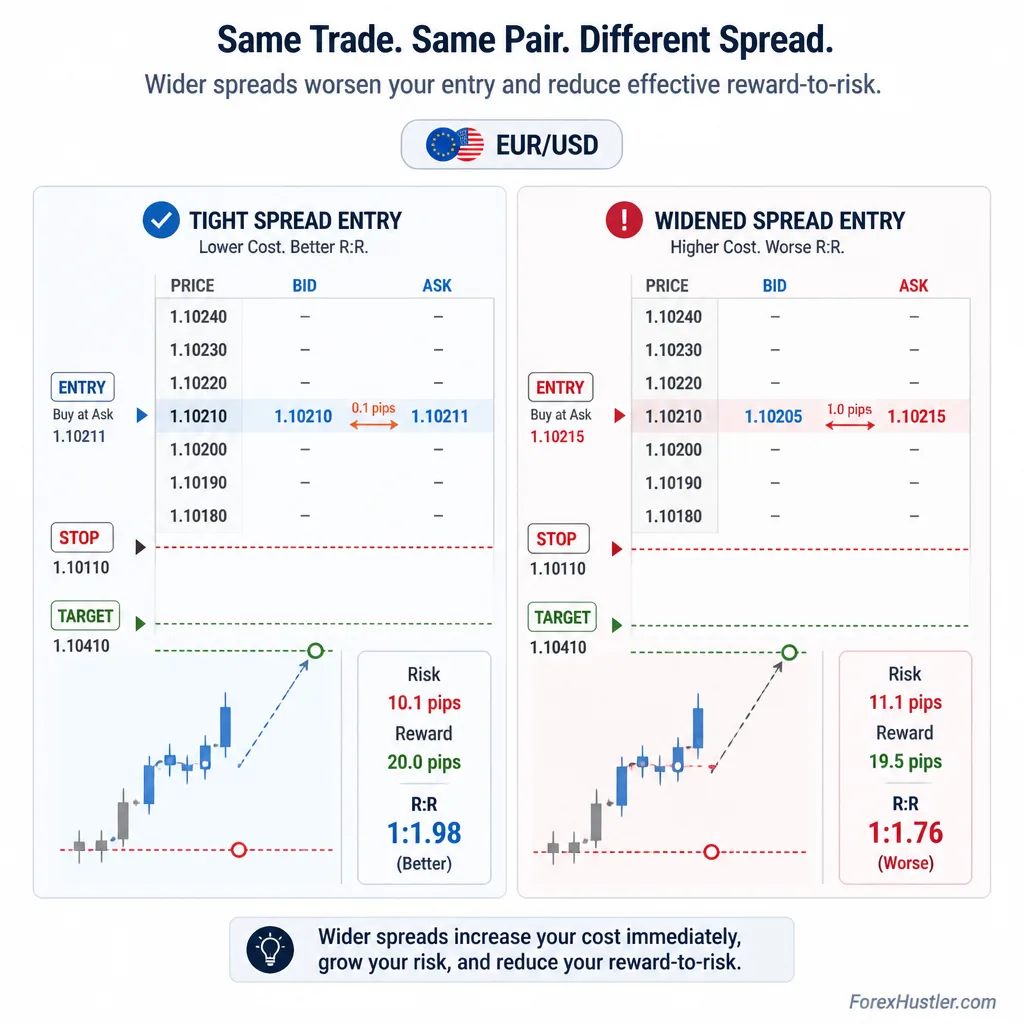
A spread filter is a simple rule: do not enter if the spread is wider than your maximum acceptable threshold.
That threshold should be pair-specific and strategy-specific. There is no universal number for EUR/USD or any other pair. Your broker, account type, volatility regime, and timeframe all matter.
A practical example: if you day trade EUR/USD during liquid London or New York hours, the spread may usually be tight enough to fit your plan. Near rollover or around major news, that same spread may widen enough to make the trade unattractive.
When it works best
This rule helps most when:
- you trade intraday
- your stops and targets are relatively tight
- you rely on clean execution
- you trade major pairs where spread changes are easy to observe
If your planned reward is small, paying extra spread matters immediately.
When it can fail or become too restrictive
A spread filter becomes a problem when it is too rigid. If you copy a threshold from another trader or build it around one broker’s pricing, you may skip valid trades for the wrong reason.
It also will not solve deeper issues. If your setup has no edge, a tighter spread will not rescue it.
Simple implementation on MT4, MT5, and TradingView
On MetaTrader 4 and MetaTrader 5, you can monitor spread in Market Watch or through custom indicators and panels, depending on your broker setup.[^2] On TradingView, bid/ask visibility depends on your broker or data connection, so many traders confirm execution-sensitive details on the broker platform itself.[^3]
A workable routine:
- Watch the normal spread on your main pair during your intended hours for a week.
- Note what “too wide” looks like for your setup.
- Write a max-spread rule before the session starts.
2. Trade Only During Your Best Session Window
Why London open and New York overlap matter
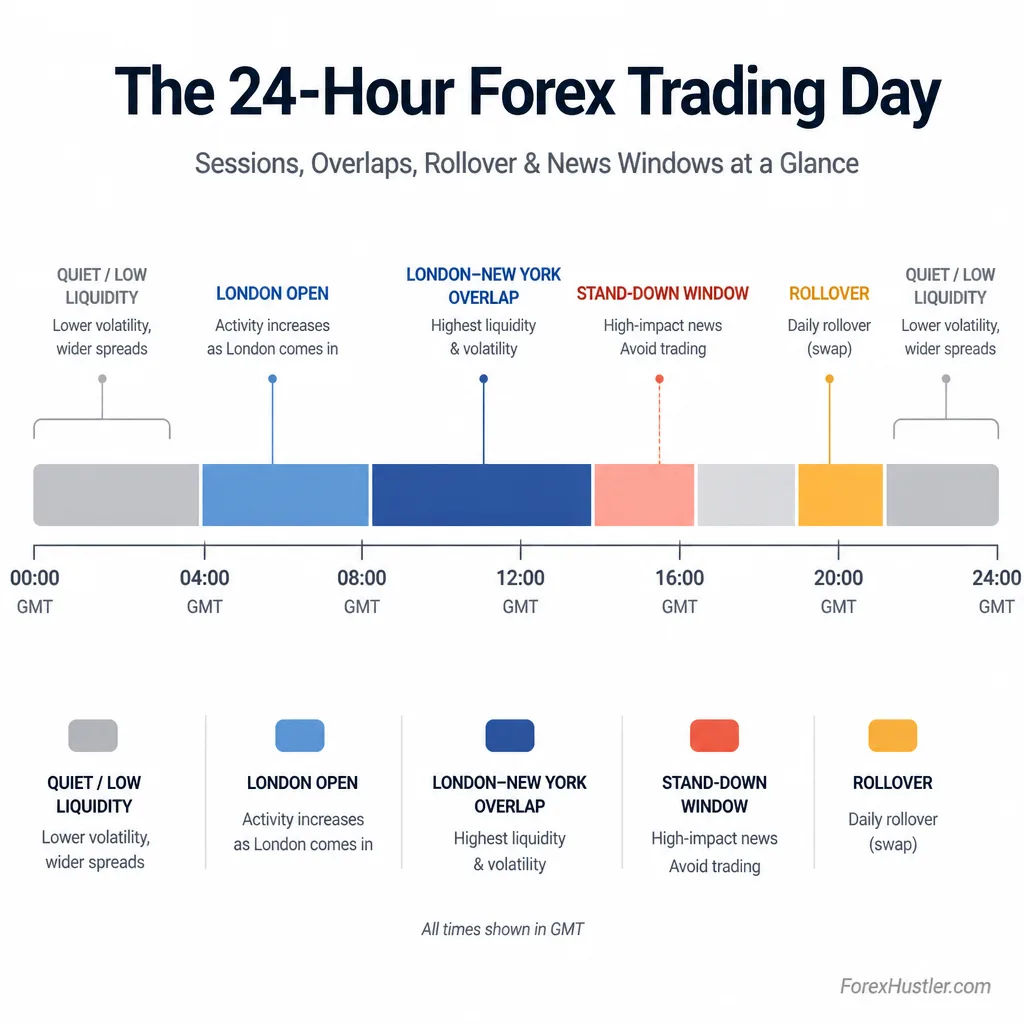
Forex liquidity is not evenly distributed through the day. London open and the London–New York overlap often bring tighter spreads and stronger participation than quieter hours.
For many intraday traders, that means cleaner movement and better fills. Not always, but often enough to matter.
When session filtering improves execution
This rule tends to help when your strategy needs:
- momentum
- follow-through
- tighter spreads
- more consistent participation
A beginner trading EUR/USD or GBP/USD will usually get better learning conditions in active sessions than in sleepy hours, when price drifts and spreads widen.
When this rule is less useful
Some methods work better after the initial open volatility settles. Others are built around slower mean-reversion behavior. So do not treat “London open only” as universal truth.
The point is not to copy a famous session. It is to identify the hours when your setup behaves best.
How to define your allowed trading hours
Define your trading window in broker-server time, not just local time. MT4 and MT5 server time may not match your timezone, and daylight saving shifts can quietly break your routine.
A simple rule might be: only take new trades during the first two hours of London and the first two hours of the London–New York overlap. Then test it.
3. Use a Time Stop for Dead Trades
Why price inactivity matters
If you trade momentum or breakouts, inactivity is information.
A setup that should move and does not move is not neutral. It may be weakening.
How a time stop reduces opportunity cost and emotional drift
Dead trades drain more than margin. They drain attention. Then comes the familiar spiral: you start reinterpreting the trade, mentally widening the stop, or waiting because you have “already sat through this much.”
A time stop cuts that drift.
When time stops can do more harm than good
This rule fits intraday momentum ideas far better than slow swing setups or some mean-reversion trades. If your method expects delayed movement, a rigid time stop may do more harm than good.
A practical example rule
Example: if a breakout trade has not moved meaningfully in your favor after three to five candles on your execution timeframe, close it and reassess.
Not because it must fail. Because your original reason for entry may no longer be valid.
4. Set a Hard Daily Loss Cap
Why daily damage control matters more than daily profit targets
A daily profit target can tempt traders to force trades. A daily loss cap does the opposite. It acts as a circuit breaker.
That is why many discretionary traders and prop-style evaluation rules focus heavily on daily drawdown control.[^4]
How to choose a realistic cap
Use R-multiples, not emotion.
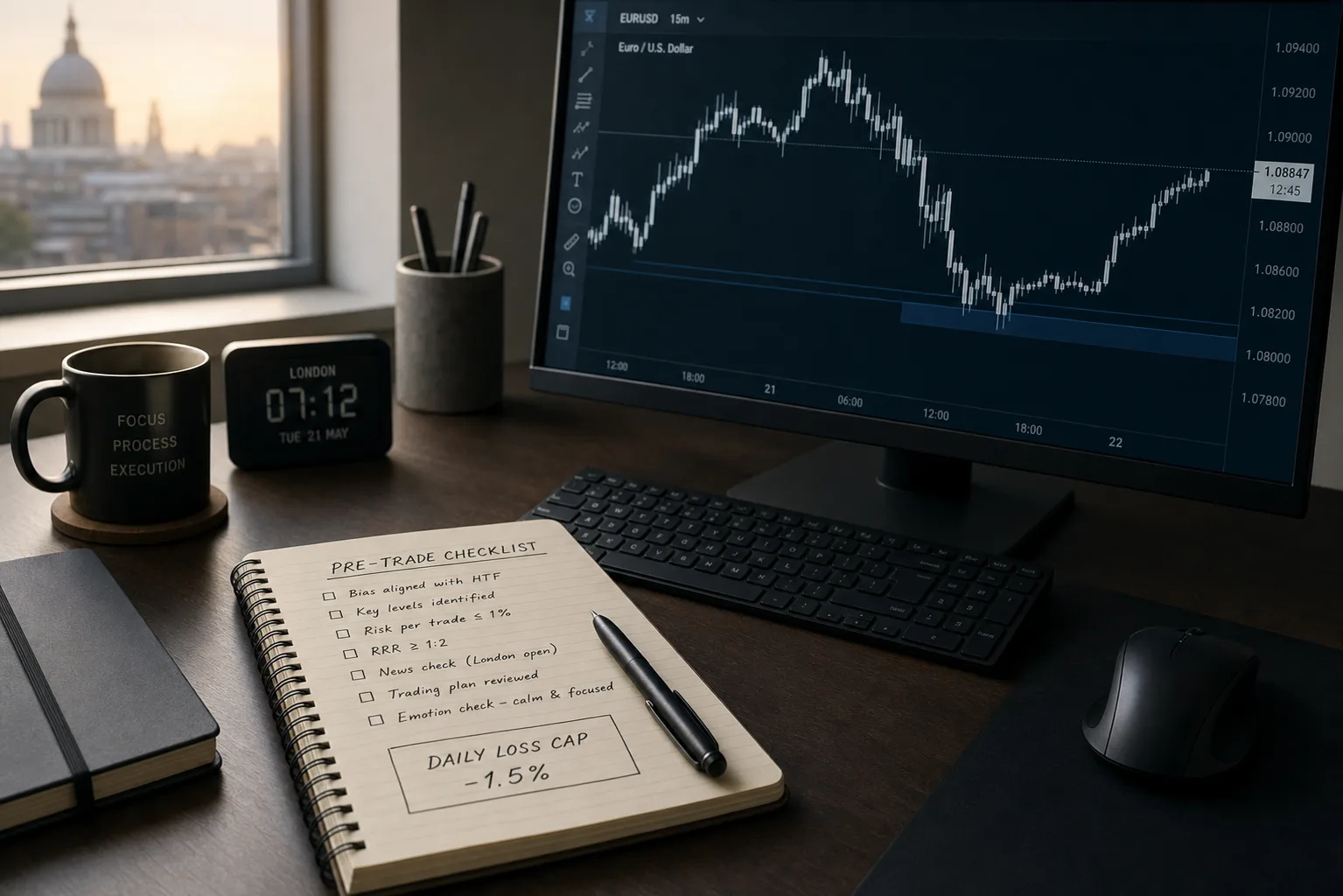
If 1R is your normal risk per trade, a common framework is to stop for the day at 2R or 3R down. The right number depends on your strategy’s normal loss clustering and your ability to stay disciplined after taking heat.
When traders misuse this rule
Two common mistakes:
- setting the cap so tight that normal variance ends the day too early
- ignoring it once emotions rise
A decorative rule is not a rule.
How to enforce it operationally
Make the process physical:
- write the cap down before the session
- set an alert
- record cumulative R after every trade
- close the platform when the cap is hit
If you tend to break rules, reduce the friction of obeying them and increase the friction of violating them.
5. Limit Your Number of Trades Per Day
How trade limits reduce revenge trading
Overtrading rarely starts as a strategy choice. It usually starts as emotion disguised as activity.
A trade cap forces selectivity. It makes you ask whether this setup is truly one of your best or whether you are clicking because you want action.
Why more trades rarely mean better results
More trades can mean more opportunity, but for most beginners it means more random exposure. The edge often degrades after the first few clean setups, especially once frustration or boredom enters the picture.
When active strategies need a different cap
A scalper and a slower intraday trader should not use the same number. The cap should match your strategy’s natural signal frequency.
A simple cap framework
Start with your journal. Find the point where trade quality drops.
For many discretionary beginners, a cap of two to four trades per day is enough to reveal whether they are trading their plan or their impulses.
6. Decide in Advance: Partial Exits or Full Exits
Why exit inconsistency distorts results
If you scale out on one trade, hold full size on the next, and panic-close the third, you are not gathering useful data. You are changing the payoff distribution every session.
That makes it hard to know whether the strategy works.
The case for partials
Partials can reduce emotional pressure. Locking in some profit may help you hold the rest of the trade more calmly.
That can make sense on trend continuation setups where runners matter.
The case for full exits
Full exits are cleaner. They simplify review, reduce decision noise, and make performance easier to measure.
That can work well for range trades or fixed-target intraday setups.
How to choose one rule per setup type
Do not choose one exit style based on your feelings. Choose one per setup category.
For example:
- range scalp = full exit at planned target
- trend continuation = partial at first target, trail the rest
Consistency first. Optimization later.
7. Use Clear Rules for Limit Orders vs. Market Orders
When limit orders improve price quality
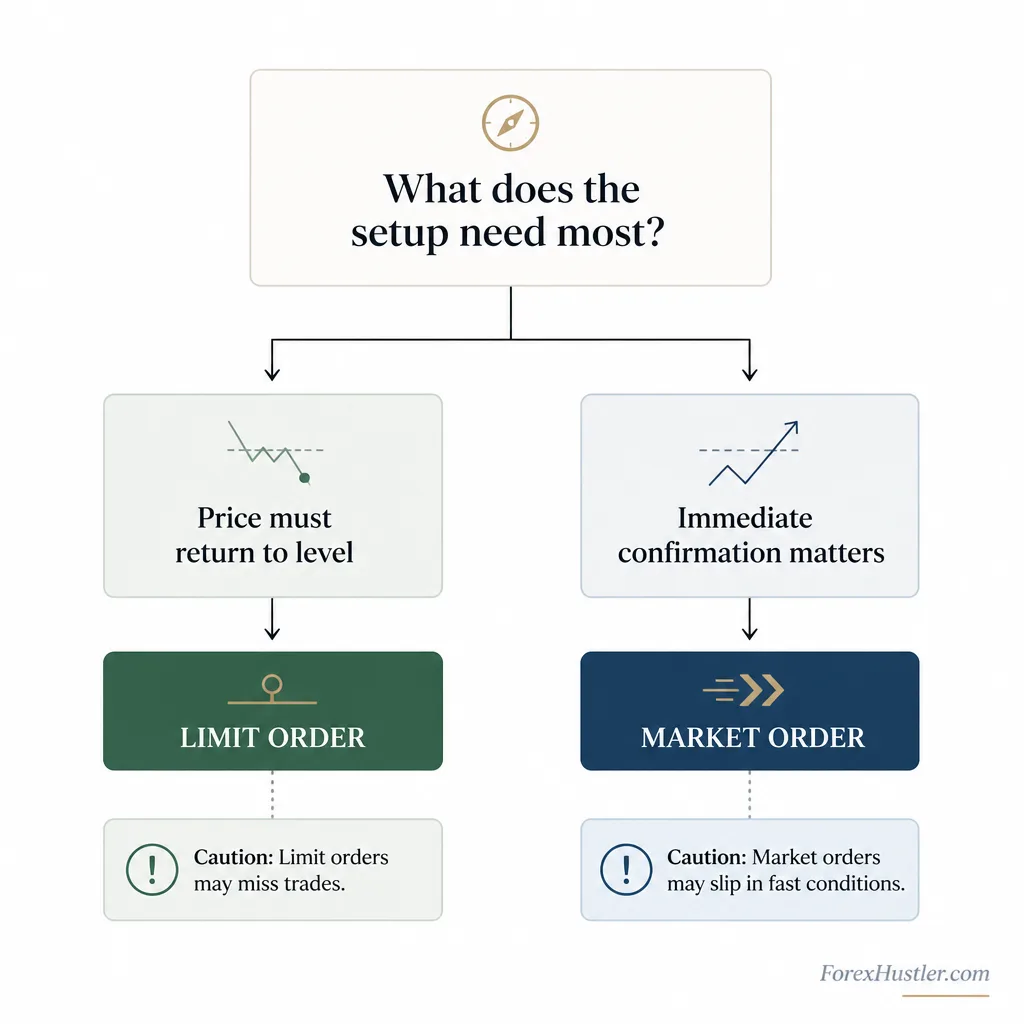
A limit order makes sense when the setup depends on price coming back to your level. If chasing ruins the trade, a limit can improve the average entry.
A classic example is a pullback entry in a trend. If EUR/USD is trending up and your plan is to buy a retest of support, a limit order may fit.
When market orders are the better choice
A market order makes sense when participation matters more than perfect price.
Example: price breaks a major intraday high with volume and momentum, and your setup requires immediate entry. In that case, missing the move may be worse than paying a slightly worse fill.
How each order type fails in real conditions
Market orders can suffer slippage in fast conditions. Limit orders can miss winning trades or fill only when the pullback is happening for a reason you should respect.
Neither order type is better in general. Each solves a different problem.
A simple order-selection rule
Use a limit order when your edge depends on price returning to a level.
Use a market order when your edge depends on immediate confirmation and you are still early, not late.
That last part matters. A market order is for execution, not chasing.
8. Stand Down Around High-Impact News
Why news can destroy otherwise good setups
High-impact releases can widen spreads, increase slippage, and create violent whipsaw movement that has little respect for normal technical structure.[^1]
For beginners, this is where many good-looking charts go bad very quickly.
How long to avoid trading before and after releases
There is no universal stand-down window. Many intraday traders avoid opening new positions shortly before and after major events such as CPI, Non-Farm Payrolls, or central bank rate decisions.[^5]
Use examples, not dogma. You might test a buffer around top-tier events and adjust based on the pair and strategy.
When news trading is a separate skill, not a shortcut
Some traders specialize in event-driven trading. That is real. It is also not beginner-friendly.
News trading is not a shortcut. It is its own execution problem.
How to build a news stand-down habit
Check an economic calendar before every session. Forex Factory’s calendar and the Investing.com economic calendar are widely used references. For major central bank events, verify timing on the central bank’s official site when possible.[^5]
If a release matters to your pair, write “no new trades” beside the event time before the session begins.
9. Use a Simple A/B Setup Rule to Avoid Random Entries
Why most bad trades are neither A nor B setups
Many losing trades are not failed good trades. They are unplanned trades that never belonged in the journal.
That distinction matters.
What an A setup looks like
An A setup should meet your best conditions:
- clear context
- known level
- allowed session
- acceptable spread
- planned stop
- valid trigger
- no nearby high-impact news
What a B setup looks like
A B setup is still tradable if your plan allows it, but something is slightly less clean: weaker location, worse timing, or less attractive structure.
Some traders take B setups at smaller size. Some skip them entirely. Either approach is better than pretending every impulse trade is an A.
What to do with everything else
No trade.
That is the value of the framework. It gives you a pre-trade filter that blocks random entries before they become expensive.
How to Test These Micro-Edges Without Fooling Yourself
Change one rule at a time
If you add a spread filter, session filter, time stop, and new exit model all at once, you will not know what actually changed.
Test one rule over a meaningful sample.
Track execution metrics, not just P&L
Profit and loss is too blunt on its own. Also track:
- spread at entry
- session or time of day
- order type
- hold time
- setup grade
- news proximity
- rule violations
That is how you find out whether you are improving the process or just getting lucky.
What to log in your journal
Keep it simple:
- pair
- date and time
- setup type
- A or B grade
- spread at entry
- order type
- stop size in R
- exit style
- whether news was nearby
- whether the trade followed your written rules
A journal should help you spot patterns, not impress you with detail.
The Real Shortcut Is Trading Fewer Bad Conditions
There is no safe trick that makes money arrive quickly in trading. There are only better and worse ways to operate.
The most useful micro-edges are not glamorous. They filter out wide spreads, dead session hours, low-quality setups, revenge trades, and inconsistent execution. That will not guarantee profits, and it may not change your results immediately. What it does is give a real strategy a better environment to work in.
If you use this article well, do not adopt all nine rules tomorrow. Start with two or three that target your biggest leaks. Test them. Review them. Then add the next layer.
In trading, the first real speed advantage is not making more. It is losing less stupidly.
FAQ
What does making money fast in trading realistically mean?
Realistically, it does not mean instant profits or doubling an account quickly. It means improving faster by cutting avoidable losses, reducing execution mistakes, and protecting capital so a decent strategy has a chance to work.
Can small trading tricks actually improve results?
They can help as process improvements. Spread filters, session rules, time stops, and trade caps may reduce bad trades and improve consistency, but they do not guarantee profitability or fix a weak strategy.
What is a spread filter in forex trading?
A spread filter is a rule that blocks entries when the bid-ask spread is wider than your acceptable threshold. It helps you avoid paying too much to enter, especially during illiquid hours, rollover, or major news.
What spread is too wide for EUR/USD?
There is no universal number. A workable threshold depends on your broker, account type, timeframe, and setup. In liquid hours, EUR/USD is usually tighter than during rollover or news periods, so many traders define a pair-specific maximum based on recent normal conditions.
Why do London open and New York overlap matter?
Those periods often bring better liquidity, tighter spreads, and stronger follow-through than quiet hours. That can improve execution for many intraday forex traders, although some strategies work better outside the initial open.
What is a time stop in trading?
A time stop exits a trade if price does not start moving as expected within a set number of minutes or candles. It is most useful for momentum and breakout trades, where slow price action often means the setup is weakening.
How do I set a daily loss cap?
A common approach is to define the cap in R, such as stopping for the day after losing 2R or 3R. The exact level should reflect your strategy’s normal drawdown and your ability to stay disciplined after losses.
How many trades per day is too many?
It depends on the strategy, but for many beginners the problem starts when the trade count rises beyond the number of real setups the plan actually produces. A trade cap works best when it is tied to your journal and signal frequency, not guesswork.
Should I use market orders or limit orders?
Use market orders when execution certainty matters more than perfect price, such as on a valid breakout. Use limit orders when the setup depends on price returning to a level and chasing would worsen the trade. Both need clear rules because each fails in different ways.
How long should I avoid trading around high-impact news?
There is no universal stand-down window, but many intraday traders avoid opening new positions shortly before and after major releases such as CPI, NFP, or central bank decisions. The right buffer depends on the pair, volatility, and strategy.
What is an A or B setup rule?
It is a simple pre-trade grading system. An A setup meets your best conditions, a B setup is acceptable but less clean, and anything else is a no-trade. Its main benefit is blocking random entries that were never part of the plan.
How should beginners test these trading micro-edges?
Test one rule at a time over a meaningful sample. Track not just profit and loss, but also spread at entry, session, setup grade, order type, news proximity, hold time, and rule violations so you can see what actually changed.