Most traders who get interested in AI start in the wrong place
They ask whether it can predict price, find entries, or identify the “best” setup of the day. That is usually where the risk begins.
A better question is simpler: can AI help you prepare better, think more clearly, and review your behavior more honestly without becoming part of your market conviction? In many cases, yes.
For discretionary traders, AI is usually more useful as a process tool than a prediction tool. It can compress macro information, draft event checklists, and turn messy journal notes into something you can learn from. What it should not do is tell you what to buy, where to place a stop, or how much confidence to assign to a trade.
AI is more useful as a process tool than a prediction tool
Why “AI for signals” is the wrong framing for most discretionary traders
Large language models are good at language. They are not inherently good at market judgment.
That distinction matters more than it first appears. Markets are noisy, reflexive, and heavy with context. A central bank statement does not matter on its own. It matters relative to expectations, positioning, prior pricing, revisions, liquidity, and how other assets respond. Turning all of that into “buy” or “sell” is not a summarization task. It is a judgment task.
That is why polished AI output can be dangerous in trading. A model may sound precise even when the answer is unsupported, outdated, or simply guessed. Hallucinations are a known limitation of LLMs, especially when they are asked for factual answers without tight source grounding.[^1]
The thesis: use AI to reduce noise, not to outsource judgment
For most traders, the best use of AI is not edge creation. It is friction reduction.
Used well, AI can help you:
- organize macro information before the week starts
- build conditional event checklists
- structure post-trade reviews
- spot recurring mistakes in your behavior
That matters because many traders do not have an idea problem first. They have an overload problem, a consistency problem, or a feedback problem.
Where AI actually helps a trader
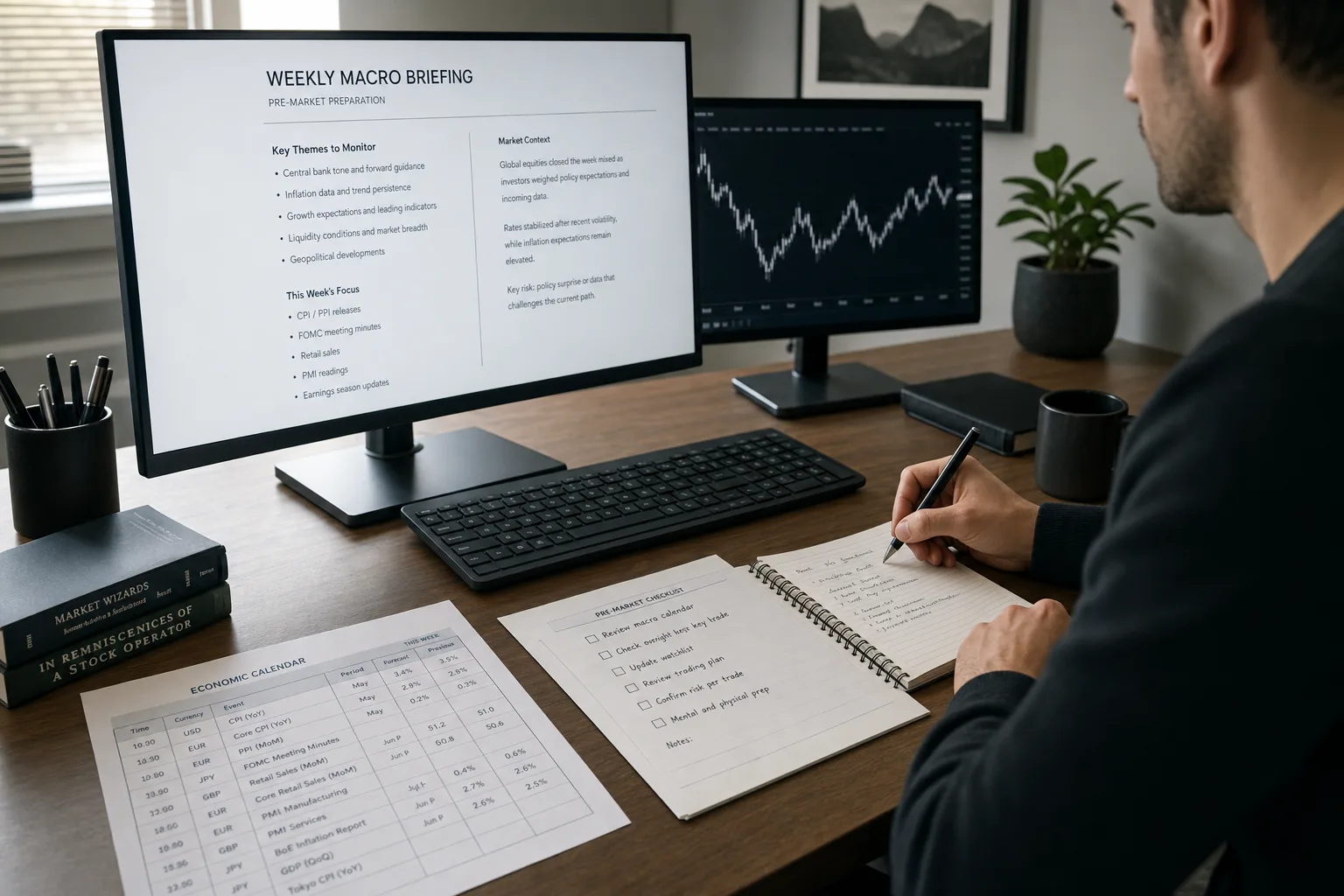
Weekly macro briefings: compressing information before the week starts
A weekly macro briefing is one of the cleanest use cases.
Suppose you trade major FX pairs and index-related flows. On Sunday, you collect a small packet of approved materials:
- the week’s economic calendar
- the latest Federal Reserve communication
- recent European Central Bank remarks
- relevant Bank of England or Bank of Japan updates
- official releases from the Bureau of Labor Statistics or Bureau of Economic Analysis when relevant
Then you ask the model to condense that material into a one-page brief: key events, current policy themes, open questions, and which instruments deserve attention.
That is a much safer task than asking, “What will EUR/USD do this week?”
Event scenario checklists: planning for CPI, NFP, central bank decisions, and similar releases
AI also works well for conditional planning around known events.
Take U.S. CPI. A useful output is not a forecast. It is a checklist:
- what the market is focused on
- what would count as a meaningful upside or downside surprise
- what needs to happen after the release before a trade is valid
- when “no trade” is the right call
The same logic applies to Non-Farm Payrolls, FOMC decisions, ECB meetings, and rate statements.
Trade journaling: turning messy notes into structured review data
This may be the highest-value use case of all.
A lot of traders journal badly, not because they do not care, but because the process is tedious. Their notes are scattered, emotional, inconsistent, and difficult to review later.
AI can help turn raw notes like this:
Long EUR/USD after London open. Felt late but took it anyway. Entry was before candle close. News still close. Cut early, then it ran. Annoyed. Took another trade later that was not in plan.
Into tags like:
- setup type: London continuation
- mistake type: early entry
- rule violation: entered before confirmation
- context: event risk nearby
- emotional state: frustration after missed move
- secondary issue: revenge trade / off-plan re-entry
That is not glamorous. It is useful.
The safe workflow: three jobs, clear boundaries
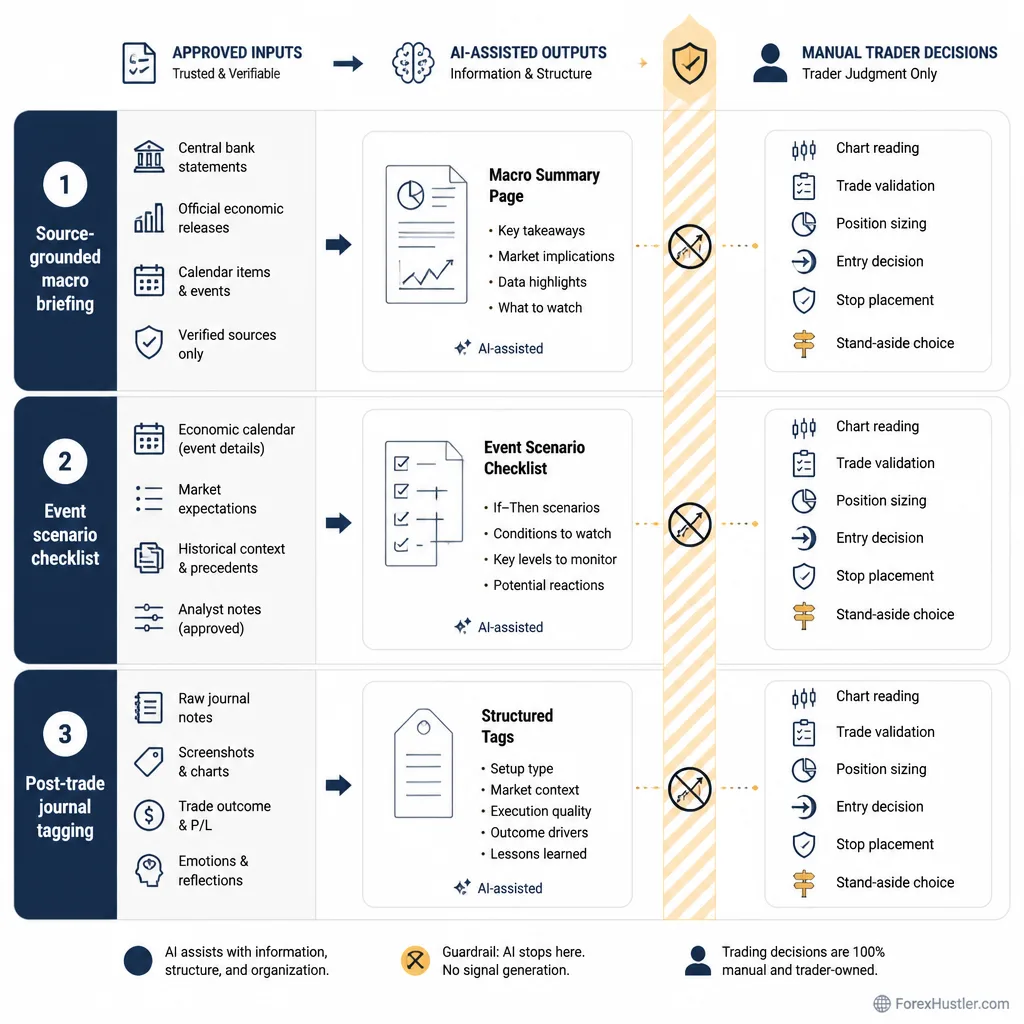
Step 1: Build a source-grounded weekly macro briefing
Keep this narrow.
Your input should be a source packet, not an open-ended web query. That packet can include pasted excerpts, uploaded notes, or links to official material. Ask the model to do three things only:
- summarize what the sources say
- list the week’s major scheduled risks
- identify open questions without answering them
A simple structure:
- key events this week
- central bank themes
- growth and inflation signals
- assets on watch
- invalidation or stand-aside conditions
The separation matters. First summarize. Then decide what matters. The model can help with the first part. The second part is still yours.
Step 2: Generate scenario checklists for key events
For each top-tier event, ask for conditional scenarios.
A CPI checklist, for example, might include:
- event and release time
- which component the market is watching most
- upside surprise scenario
- downside surprise scenario
- mixed or unclear reaction scenario
- confirmation criteria from price action
- spread and liquidity warning
- explicit no-trade triggers
A “no trade” condition is not optional. It is often the most useful line on the page.
Step 3: Convert post-trade notes into tags and decision-audit fields
After each trade, or at least after each session, feed the model:
- instrument
- date and time
- setup name
- screenshot notes
- pre-trade idea
- trigger
- invalidation rule
- result
- emotional state
- raw comments
Then ask it to return:
- setup classification
- rule violations
- execution quality
- emotional tags
- whether the trade matched the plan
- one repeat lesson
- one correction for next time
This works because the source material is your own. The model is structuring it, not inventing market facts.
Guardrails that keep AI from becoming a hidden signal generator
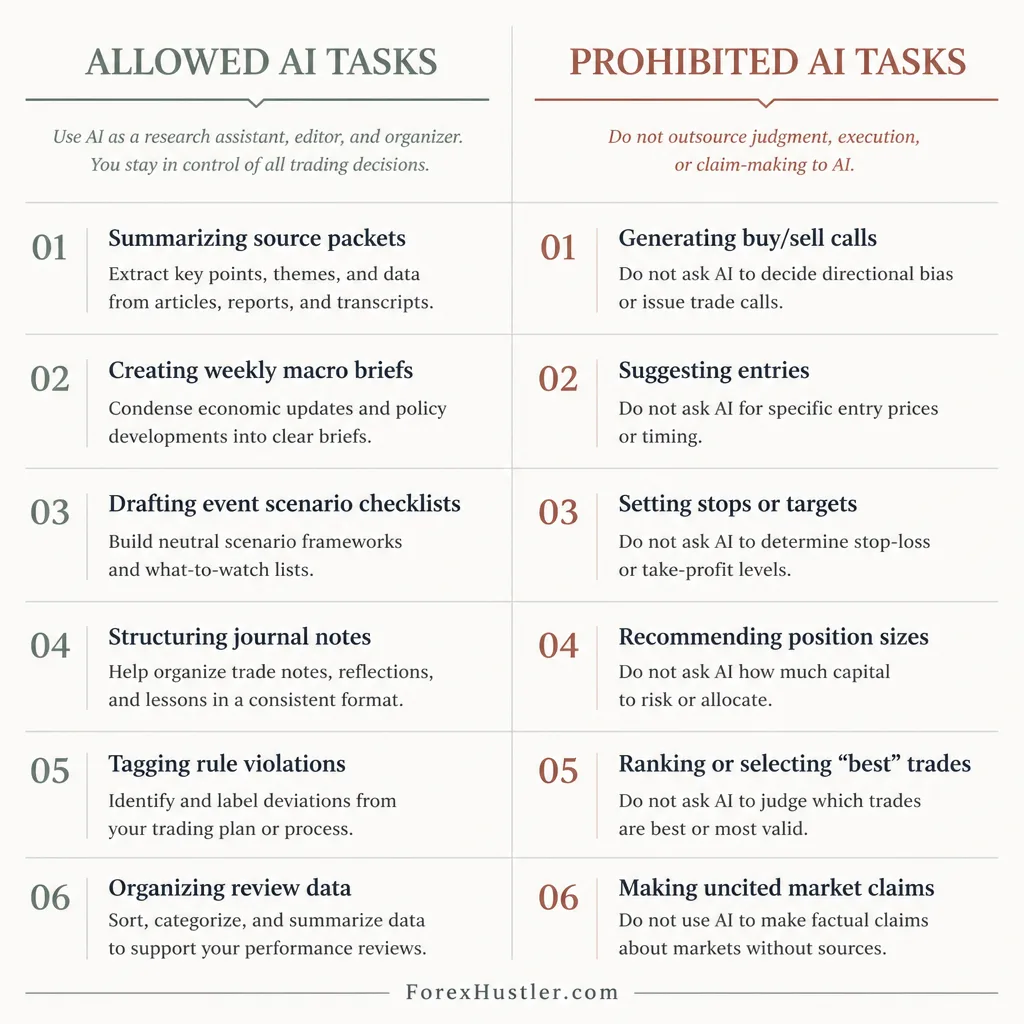
Use approved source types only
For macro prep, keep the source list narrow:
- official central bank statements
- official statistical releases
- official event calendars where available
- trusted calendar aggregators for convenience, followed by official verification
- your own journal exports and trading notes
The closer the task gets to an actual trading decision, the stricter your sourcing should be.
No numbers without citations
This rule should be non-negotiable.
If the model mentions an inflation figure, payrolls number, rate expectation, or policy quote, it must point to the source. If it cannot, the number should not enter your plan.
“Sounds right” is not good enough in a high-stakes domain.
Separate summarization from interpretation
This is one of the most useful habits you can build.
Bad workflow:
- summarize the Fed statement
- tell me what USD will do
- rank the highest-probability trade
Better workflow:
- summarize the Fed statement using only the pasted text
- extract the main policy themes
- list unresolved questions
- stop there
Interpretation belongs in your own process notes, not in an AI-generated forecast.
Never let AI produce entry, stop, or target recommendations
If a prompt asks for:
- entry price
- stop loss
- take profit
- position size
- directional trade call
- highest-probability setup ranking
you are already drifting into hidden signal generation.
A good test: if a risk manager would object to the prompt, the prompt is too aggressive.
Verify every market-relevant claim before it reaches your plan
Nothing market-relevant should move from AI output into your trade plan unless you can trace it back to an approved source.
Browsing tools and retrieval can help, but they do not remove this responsibility.[^2]
Prompt templates you can actually use
Pre-trade plan prompt template
Use only the source packet I provide. Do not add outside facts.

Task:
1. Summarize the key macro events and policy themes for this trading week.
2. List the top 3 scheduled events most likely to affect [instrument/market].
3. For each event, create a conditional checklist with:
   - what the market appears focused on from the source material
   - upside surprise scenario
   - downside surprise scenario
   - mixed/unclear scenario
   - no-trade conditions
   - price-action confirmation criteria to review manually

Rules:
- No trade recommendations
- No entries, stops, or targets
- No uncited numbers
- If a fact is missing, say “not confirmed in source packet”
Post-trade decision audit prompt template
Use only my trade notes and journal fields below.

Task:
Convert this trade into a decision audit with these headings:
- Setup validity
- Trigger validity
- Risk validity
- Execution quality
- Rule violations
- Emotional interference
- What should be repeated
- What should be corrected next time

Rules:
- Be descriptive, not predictive
- Do not justify the trade outcome
- Do not infer facts I did not provide
- If evidence is unclear, mark it as “uncertain”
Journal tagging prompt
Read the raw journal note and return structured tags only.

Required fields:
- setup_type
- market_context
- session
- mistake_type
- rule_violation
- emotional_state
- execution_issue
- plan_adherence
- review_priority

Allowed tag behavior:
- Use short standardized labels
- If no violation is visible, write “none observed”
- If data is missing, write “not enough information”

Do not:
- explain market direction
- defend the trade
- generate new facts
How to measure whether this workflow is helping
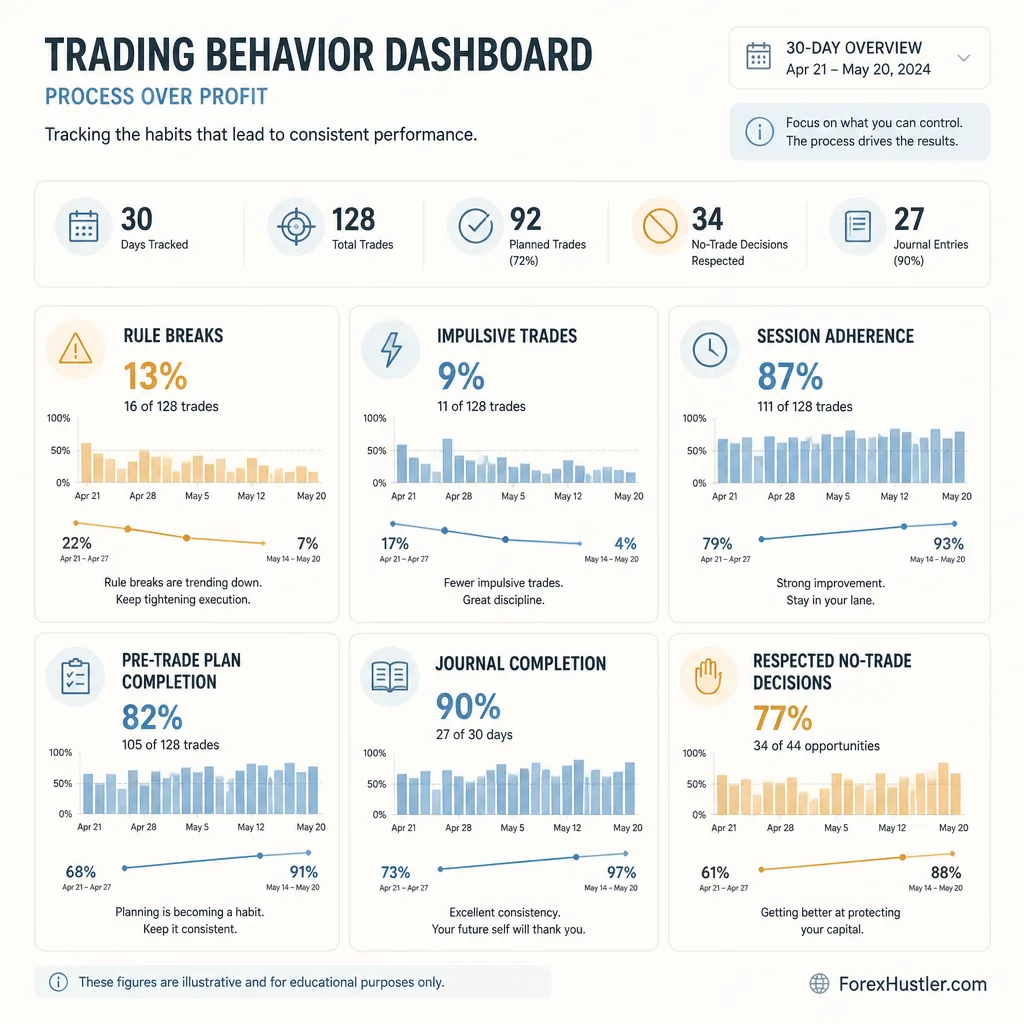
Track behavior before performance
The biggest mistake here is judging the workflow by short-term P&L.
That sounds sensible, but it is usually the wrong test. Trading outcomes swing for many reasons: variance, market regime, setup distribution, and sample size. Better process can exist before better returns show up. It can also improve decision quality without changing profits right away.
Useful metrics: rule breaks, impulsive trades, session adherence, and plan completion
Start with process metrics you can observe each week:
- percentage of trades with a completed pre-trade plan
- number of impulsive trades per week
- number of entries taken before confirmation
- percentage of trades taken only during approved sessions
- journal completion rate within 30 minutes or the same day
- frequency of respected “no trade” decisions
- discrepancy rate between raw notes and AI tags after review
Those numbers tell you whether the workflow is improving discipline.
Why P&L alone is a poor short-term test of process improvement
P&L is an output. Process quality is the cause you are trying to strengthen.
If you took fewer off-plan trades this month but made less money, that does not automatically mean the workflow failed. You may have traded less in a choppy period. Or the process may have improved before the edge had time to show up.
The better question is not, “Did AI make me more profitable this week?” It is, “Did AI help me follow my process with less noise and less self-deception?”
Common failure modes
The model starts sounding smarter than your process
This happens quickly. The writing is polished. The explanations feel coherent. You start trusting tone instead of evidence.
That is when the workflow becomes dangerous.
You quietly let summaries become forecasts
It usually starts with one harmless-looking prompt: “Which scenario is most likely?”
At that point, the model is no longer organizing information. It is pretending to assign market judgment.
You use AI to rationalize bad trades after the fact
This one is subtle. A losing trade goes into the journal, and instead of asking what rule broke, you ask the model to explain why the trade still “made sense.”
That turns review into self-defense.
Your journal gets cleaner, but your behavior does not
Better formatting is not the same as better trading.
If your notes look great but you are still overtrading, still entering before confirmation, and still ignoring session rules, the workflow is producing polished noise.
A practical starting version for the next 30 days
A minimal weekly routine
Do not overhaul everything at once. Test one simple routine:
- Sunday: create one AI-assisted weekly macro brief from approved sources
- Before each top-tier event: generate one scenario checklist
- After each trade or session: run one post-trade audit and tagging pass
That is enough to tell whether the workflow reduces friction or adds to it.
What to keep manual
Keep these manual on purpose:
- final trade decision
- source verification
- chart reading
- risk sizing
- judgment about whether conditions fit your playbook
That is not inefficiency. It is control.
What success should look like after one month
After 30 days, success should look boring in the best way:
- fewer off-plan trades
- more complete pre-trade notes
- faster review turnaround
- clearer patterns in your mistakes
- less impulse around major events
- more willingness to stand aside
If you become more confident but not more disciplined, the workflow is failing.
Conclusion
AI can be useful in trading, but not for the reason most people hope.
Its best role is not market prediction. It is process support. A good workflow uses AI to summarize approved sources, structure event planning, and clean up journaling so your decisions become easier to audit. A bad workflow lets polished language turn into conviction.
If AI is making your process cleaner, calmer, and more falsifiable, it is helping. If it is making you more certain without stronger evidence, it is already too involved.
FAQ
What is the safest way to use AI in trading?
The safest use is operational, not predictive. AI can help summarize approved macro sources, draft event scenario checklists, and structure journal notes for review. It should not be used to generate entries, exits, stop losses, targets, or directional trade calls.
Can AI help with macro briefings for traders?
Yes, if the workflow is source-grounded. A trader can provide official or primary materials such as central bank statements, economic releases, and calendar items, then use AI to condense them into a weekly briefing. The key is verification: no market-relevant claim or number should enter the plan without a traceable source.
Should traders use AI as a signal generator?
For most discretionary retail traders, that is the wrong use case. Large language models can sound confident without being reliable, especially in fast-changing market conditions. AI is better used as a process aid and organizer than as a source of market conviction.
How can AI improve trade journaling?
AI can turn messy notes into structured tags and review fields. Useful outputs include setup type, mistake type, rule violations, emotional state, session mismatch, and execution errors. That makes recurring patterns easier to spot without pretending the model understands the market better than the trader does.
What guardrails should an AI trading workflow include?
Use approved source types only, require citations for numbers and factual claims, separate summarization from interpretation, ban prompts for entries and exits, and manually verify any market-relevant statement before it reaches a trade plan.
What metrics show whether AI is actually helping a trader?
Behavioral metrics are more useful than short-term P&L. Good measures include fewer rule breaks, fewer impulsive trades, better adherence to session rules, more completed pre-trade plans, and faster post-trade journal completion. The point is to judge process quality before judging returns.
Why is P&L a weak short-term test of an AI workflow?
Because trading results can vary for reasons that have little to do with process changes. Small samples, market conditions, and normal variance can hide whether discipline actually improved. A cleaner workflow may improve decision quality without producing immediate profit changes.
What should stay manual even in an AI-assisted trading routine?
Final trade decisions, source verification, chart reading, risk sizing, and judgment about whether conditions fit your playbook should remain manual. Keeping those steps human is not inefficiency. It is a control measure.