Can You Really Make Money Trading Forex? A Reality-Check Framework
The honest answer is yes, some people do make money trading forex. But that answer becomes misleading if it ends there.
The real question is not whether profit is possible. It is whether your approach has a net edge after costs, whether you can survive the losing streaks that come with leverage, and whether you can execute under pressure the same way you do in theory. That is usually where the dream breaks down.
A lot of forex content sells possibility. This article is about viability. If you want a sober way to judge whether forex is a realistic path for you, start with the math, then the costs, then the behavior.
Can you really make money trading forex?
Yes, in principle, but only if your edge survives real-world costs and your execution holds up under pressure.
That distinction matters. A trader can have a few winning weeks, post attractive screenshots, or build a strategy that looks strong in a clean backtest. None of that proves they can make money consistently.
The better question is not “Can money be made?” It is:
- Can your average trade stay profitable after spread, commission, swaps, and slippage?
- Can you sit through normal drawdowns without blowing up your account?
- Can you repeat your process over dozens or hundreds of trades rather than five lucky ones?
Regulated brokers indirectly show how difficult this is. Many retail broker disclosures state that a large share of retail CFD accounts lose money.[^1][^2] Those figures vary by broker, product mix, and jurisdiction, so they are not a universal law. Still, they are a useful reality check: market access is easy; consistent extraction is not.
Most people measure the wrong thing: gross P&L is not net profitability
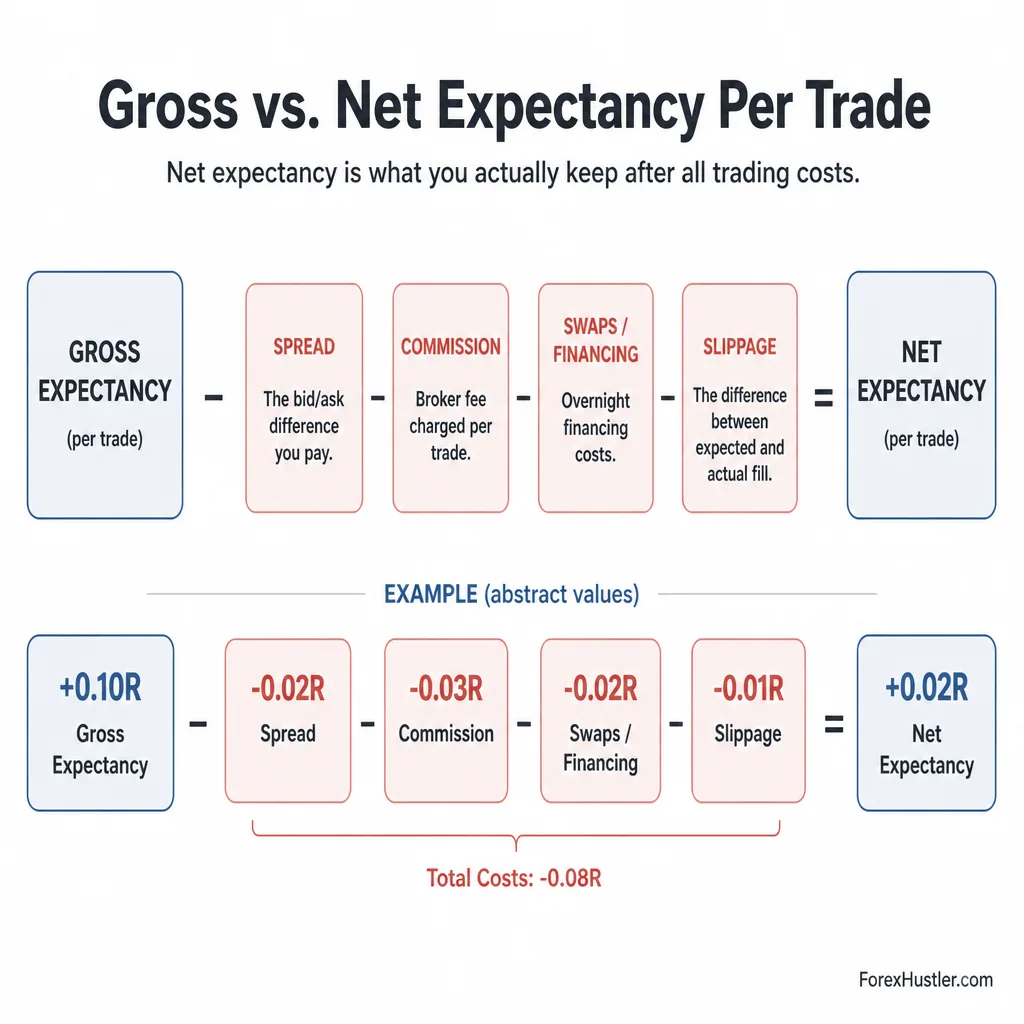
Beginners often think in terms of wins and losses on the chart. The market moved, the target hit, money was made. But trading does not happen on a frictionless chart.
Your actual result is shaped by four common costs.
The hidden drag from spread, commission, swaps or financing, and slippage
- Spread is the difference between bid and ask. You pay it as soon as you enter.
- Commission is an explicit fee on some account types, especially raw-spread models.
- Swap or rollover is the financing adjustment for holding positions overnight. Depending on the pair and broker structure, it can help or hurt, but it should never be ignored.
- Slippage is the gap between the price you expected and the price you actually got, especially in fast markets, thin liquidity, or stop execution.[^3][^4]
Why costs matter more for short-term and high-frequency approaches
Costs do not hurt every style equally.
If your stop is 100 pips away and your round-trip friction is 2 pips, that cost is only 0.02R. Annoying, but manageable.
If your stop is 10 pips and your total friction is still 2 pips, the cost becomes 0.2R. That is substantial. A meaningful part of each trade is gone before the idea has much room to work.
That is why scalping and very short-term trading often look better on paper than in reality. Small targets leave less room for error, less room for slippage, and less room for poor execution.
A simple example: profitable before costs, mediocre after
Suppose a trader has a short-term setup with this profile:
- Win rate: 55%
- Average win: 1R
- Average loss: 1R
Before costs, expectancy looks fine:
(0.55 × 1R) - (0.45 × 1R) = +0.10R per trade
Now add transaction friction. If spread, commission, and average slippage amount to 0.08R per trade, net expectancy falls to:
+0.10R - 0.08R = +0.02R per trade
That is no longer a comfortable edge. It is fragile. Slightly worse execution, a wider spread during volatility, or a few emotional mistakes can erase it.
Gross P&L flatters weak systems. Net profitability tells the truth.
Win rate means very little without payoff ratio
Beginners love high win rates because they feel reassuring. The problem is that win rate alone tells you almost nothing.
The expectancy idea in plain English
Expectancy is the average amount a strategy tends to make or lose per trade over a large sample.
In simple terms:
Expectancy = (Win rate × average win) - (Loss rate × average loss)
If your average loss is defined as 1R, then your strategy only works if your wins are large enough, frequent enough, or both.
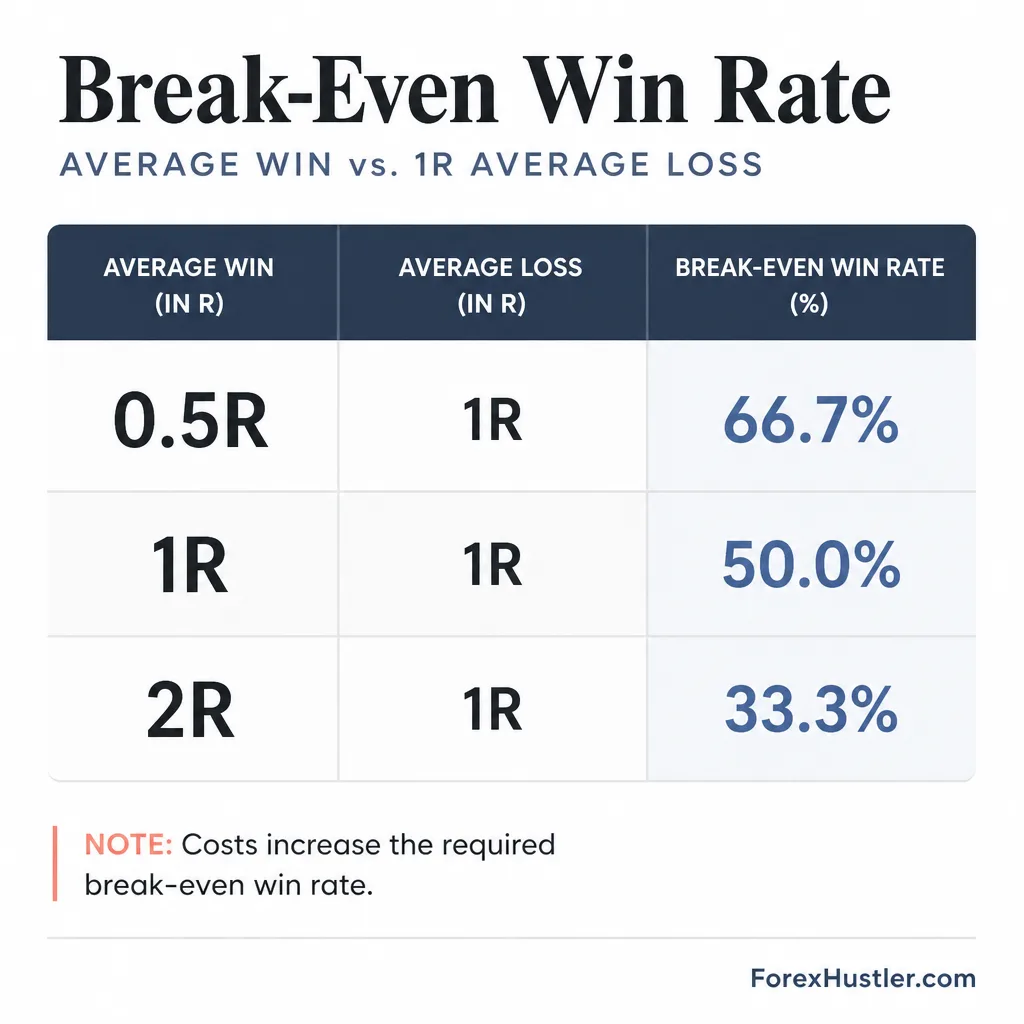
Break-even win rates for 0.5R, 1R, and 2R reward-to-risk profiles
Before costs, the break-even win rate looks like this:
| Average Win | Average Loss | Break-Even Win Rate |
|---|---|---|
| 0.5R | 1R | 66.7% |
| 1R | 1R | 50.0% |
| 2R | 1R | 33.3% |
This simple table clears up a lot of bad thinking.
A trader taking quick profits at 0.5R needs to win about two-thirds of the time just to break even before costs. Once costs are added, the required win rate rises.
Why a 70% win rate can still lose money and a 40% win rate can still work
Here is a high-win-rate loser:
- Win rate: 70%
- Average win: 0.4R
- Average loss: 1R
Expectancy:
(0.70 × 0.4R) - (0.30 × 1R) = 0.28R - 0.30R = -0.02R
It looks impressive. It still loses.
Now a lower-win-rate winner:
- Win rate: 40%
- Average win: 2R
- Average loss: 1R
Expectancy:
(0.40 × 2R) - (0.60 × 1R) = 0.80R - 0.60R = +0.20R
Less comfortable emotionally. Better mathematically.
The market does not pay you for being right often. It pays you for having positive expectancy.
A simple break-even framework you can actually use
If you want a practical filter, use this.
The core formula: expectancy before and after costs
Gross expectancy = (Win rate × average win) - (Loss rate × average loss)
Net expectancy = Gross expectancy - average cost per trade
The easiest way to think about cost is to convert it into R.
If 1R on your trade equals 20 pips, and your average round-trip cost is 2 pips, then:
Cost per trade = 2 / 20 = 0.1R
That is a meaningful drag.
Example scenario: 0.5R system
- Average win: 0.5R
- Average loss: 1R
- Win rate: 70%
Gross expectancy:
(0.70 × 0.5) - (0.30 × 1) = 0.35 - 0.30 = +0.05R
Looks positive. But if average cost per trade is 0.08R, then:
Net expectancy = +0.05R - 0.08R = -0.03R
A thin edge disappears.
Example scenario: 1R system
- Average win: 1R
- Average loss: 1R
- Win rate: 55%
Gross expectancy:
0.55 - 0.45 = +0.10R
After 0.05R in average costs:
Net expectancy = +0.05R
Still viable, but not by much.
Example scenario: 2R system
- Average win: 2R
- Average loss: 1R
- Win rate: 40%
Gross expectancy:
0.80 - 0.60 = +0.20R
After 0.05R in average costs:
Net expectancy = +0.15R
This system has more room to breathe. It can absorb friction better.
How to adjust the math for trading costs per trade
The habit is simple:
- Define your average stop size in pips.
- Estimate your average total round-trip cost in pips.
- Convert that cost into R.
- Subtract it from gross expectancy.
That one adjustment saves a lot of traders from fooling themselves.
Leverage does not create edge. It changes the distribution of outcomes
Leverage is one of the most misunderstood parts of forex.
Why leverage amplifies both variance and behavioral mistakes
Leverage can increase returns. That part is obvious.
What it cannot do is turn a bad system into a good one. If your expectancy is negative, leverage just gets you to the same destination faster.
Even with a positive expectancy system, leverage can make normal drawdowns emotionally or financially unbearable. Regulators such as the FCA, ESMA, CFTC, and ASIC all emphasize leverage risk in retail trading rules and warnings.[^5][^6]
The difference between being right eventually and surviving long enough to matter
A strategy may work over 200 trades and still destroy a trader who risks too much per position.
That is the survival problem.
A 50% drawdown needs a 100% gain just to recover. That is why aggressive sizing is so dangerous. It does not just increase volatility. It changes the recovery math.
How small sizing can keep a learning trader in the game
There is no universal correct number, but many conservative traders and educators frame roughly 0.25% to 1% risk per trade as a common learning range, not a law.[^7]
The point is not precision. The point is survival.
A learning trader needs enough room to be wrong repeatedly without ending the game. Small size buys time. Time is what allows a real edge to show itself, if one exists at all.
What a real trading edge looks like in practice
“Edge” gets used as if it were something mystical. In practice, it is much less glamorous.
A repeatable setup with a clear reason for entry
A real edge usually starts with a setup you can define clearly enough to recognize again. Not “I felt bullish.” More like: trend condition, pullback condition, trigger condition, and context.
If you cannot explain why the trade exists, you probably do not have a setup. You have a hunch.
Defined invalidation and position sizing before the trade is placed
Before entering, you should know:
- Where the trade is wrong
- How much you will lose if that happens
- What size fits that risk
- What exit logic you are using
If those decisions happen after entry, the market is already making them for you.
Execution discipline and enough sample size to judge results
Five trades prove nothing. Ten trades prove very little.
A real edge needs repetition and review. That usually means some combination of backtesting, forward testing, journaling, and live execution review. The goal is not perfection. It is evidence that the setup behaves well enough, often enough, to justify risk.
Why “feel” and intuition are usually just untested pattern recognition
Experienced traders may develop useful intuition. Beginners usually overestimate theirs.
Most “feel” is either:
- pattern recognition that has never been tested, or
- emotion disguised as conviction
That does not mean discretion can never work. It means discretion without evidence is usually just a cleaner-looking version of guessing.
How long does it realistically take to become competent?
Usually longer than beginners expect.
That is not a scientific law. It is a practical observation. Trading demands several skills at once: market understanding, process design, risk control, recordkeeping, and emotional regulation.
Why profitability usually takes longer than beginners expect
Many people assume the hard part is finding a setup. Often the harder part is executing the same setup consistently when real money is involved.
A demo account can make a trader feel disciplined. A live account often reveals the truth.
The difference between understanding a setup and executing it consistently
It is one thing to say, “I know where my stop should go.”
It is another thing to leave that stop where it belongs after the market moves against you.
This gap between knowledge and behavior is where many would-be traders stall.
A realistic progression: study, paper trade, small live trading, review
A sensible path looks like this:
- Study one framework deeply enough to define a setup.
- Paper trade to test the process and record data.
- Trade small live size to expose emotional weak points.
- Review relentlessly to see whether the problem is the system, the execution, or both.
Paper trading helps, but it does not fully simulate slippage, spread changes, hesitation, or fear. It is practice, not proof.
Signs you are gambling, not trading
Some behaviors are less “bad habits” than flashing warning lights.
Overtrading
If you feel compelled to always be in the market, that is usually not opportunity. It is impatience.
Revenge trades after losses
Trying to win it back quickly is one of the fastest ways to turn a manageable loss into serious account damage.
No defined invalidation or stop logic
If you do not know where the trade is wrong, you do not know your risk.
Risking too much on one idea
Oversized positions distort judgment. Once the risk feels too large, decision quality usually collapses.
Changing the plan mid-trade to avoid taking a loss
Moving the stop, widening the invalidation, or adding to a loser without a tested plan is usually not adaptation. It is denial.
A practical decision framework: proceed, paper trade, or walk away
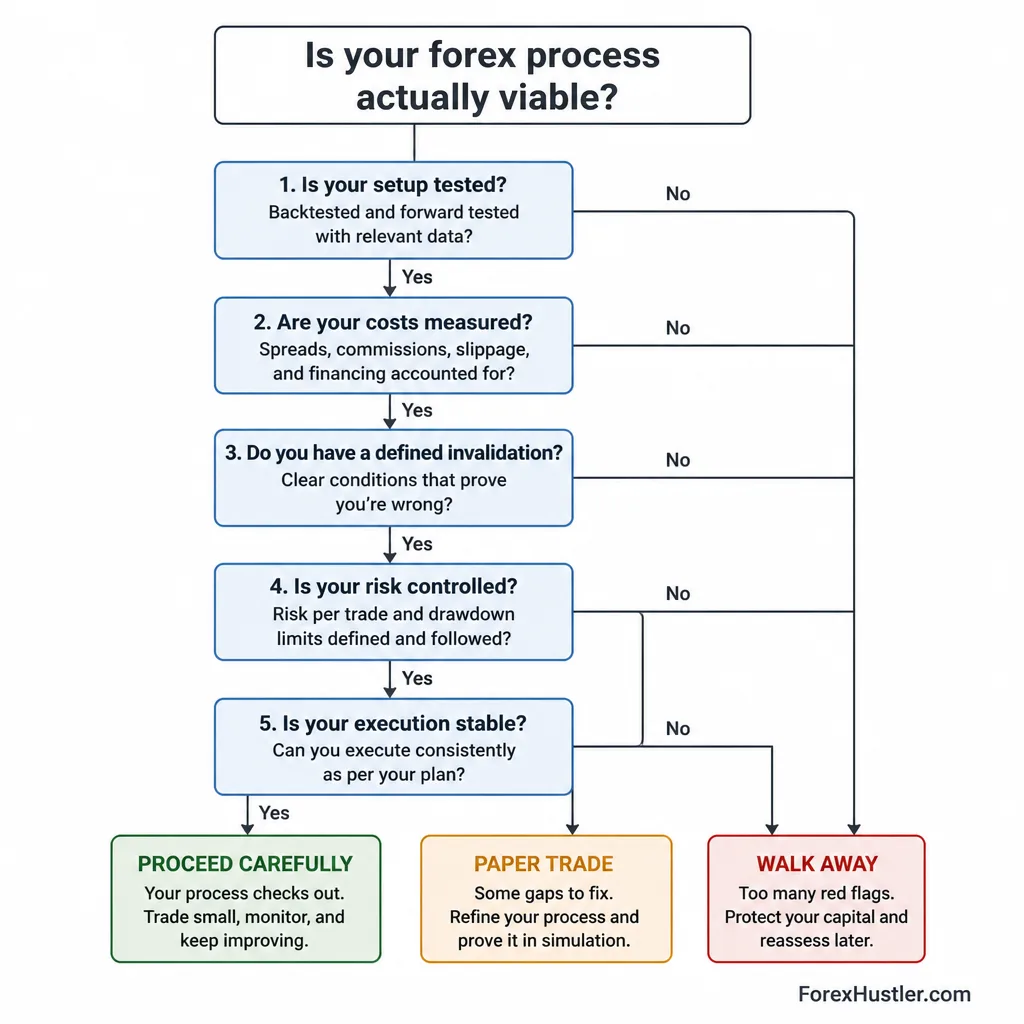
Not everyone should move forward, and that is a healthy conclusion.
Proceed if you have a tested process, cost awareness, and controlled risk
Move forward carefully if you can say yes to these:
- I know my average win, average loss, and win rate.
- I account for spread, commission, and likely slippage.
- I define invalidation before entry.
- I risk small enough that a losing streak will not knock me out.
- I have enough recorded trades to judge the process, not just recent outcomes.
If that describes you, small live trading may be reasonable.
Paper trade if your setup is still vague or your execution is unstable
Stay in simulation if:
- your rules are inconsistent,
- your journal is thin,
- your costs are unmeasured, or
- your behavior changes every time you lose.
That is not failure. It just means it is too early to pay tuition with real money.
Avoid forex as a primary vehicle if you want passive wealth-building, fast income, or emotional certainty
Forex is usually a poor fit if your real goal is:
- passive long-term wealth building,
- quick replacement income, or
- financially meaningful results without emotional strain
Those goals are often better served by long-term investing, career skill development, or business building. Forex is not passive. It is a high-feedback performance activity with uncertain payoff.
The honest bottom line
Forex can pay skilled, disciplined traders.
But the market does not pay for enthusiasm, screen time, or confidence. It pays for a repeatable edge, cost control, risk discipline, and the ability to survive long enough for that edge to play out.
So, can you really make money trading forex? Yes. The harder answer is that, for most people, the challenge is not access to the market. It is becoming the kind of trader whose edge is real, whose costs are understood, and whose behavior does not sabotage the math.
If you are not there yet, that is not a verdict. It is a decision point.
FAQ
Can you really make money trading forex?
Yes, in principle. But the useful question is whether you can do it consistently after spreads, commissions, swaps, slippage, and execution mistakes. Profitability is possible, but much harder in practice than promotional content suggests.
Is forex trading profitable for most people?
Not necessarily. Many retail traders lose money, and regulated brokers often disclose that a large share of retail CFD and forex accounts are unprofitable. That does not make success impossible, but it does show that profitability is difficult and far from automatic.
Why is win rate not enough to judge a forex strategy?
Because win rate tells you how often you win, not how much you make when you win compared with how much you lose when you are wrong. A strategy with a 70% win rate can still lose money if the average loss is much larger than the average gain or if trading costs are high.
What is expectancy in forex trading?
Expectancy is the average amount a trading system tends to make or lose per trade over a large sample. In plain English, it tells you whether your strategy has a real edge. Positive expectancy after costs matters far more than a few recent winning trades.
How do spreads, commissions, and slippage affect profitability?
They reduce net profitability on every trade. For short-term strategies with small targets, these costs can consume a meaningful share of expected gains. A system that looks profitable before costs can become flat or unprofitable after them.
Does leverage help you make money faster in forex?
Leverage increases both upside and downside, but it does not create edge. It changes the distribution of outcomes by making drawdowns steeper and mistakes more expensive. A weak system with leverage usually fails faster, not better.
What does a real edge in forex look like?
A real edge is not a vague feeling about the market. It usually means a repeatable setup, clear entry conditions, defined invalidation, consistent position sizing, and enough tested evidence to justify taking the trade repeatedly.
How long does it take to become profitable in forex?
There is no universal timeline. For many traders, it takes much longer than expected because knowing a setup is not the same as executing it consistently under real pressure. Competence usually develops through study, paper trading, small live trading, and detailed review.
When should you paper trade instead of going live?
Paper trading makes sense when your setup is still vague, your rules are inconsistent, or you have not tracked enough trades to judge whether you have any edge. It is useful for process-building, but it does not fully simulate live execution and emotional pressure.
How do you know if you are gambling instead of trading?
Common signs include overtrading, revenge trading after losses, moving stops to avoid taking a loss, risking too much on one idea, and entering trades without a defined invalidation point. Those behaviors usually reflect emotional impulse, not a tested process.