The Forex Trader’s Research Stack: 15 Official Sources for Economic Calendars, Rates, and Market News
Many forex traders make the same mistake when markets get busy: they see a CPI screenshot on X, a broker alert, or a fast headline in a chat room, and place a trade before checking the original release.
In slow conditions, that may only lead to weak analysis. In fast conditions, it can mean trading the wrong number, the wrong time, or the wrong interpretation.
That is why official sources matter. They do not remove uncertainty or replace risk management. What they do is reduce source risk. They let you confirm what was released, when it was released, whether earlier data was revised, and how the central bank or statistical agency presented it.[^1][^2]
This guide gives you a practical research stack built around 15 high-trust official sources. More importantly, it shows you how to use them: how to verify macro events, avoid common interpretation errors, and turn a release into a clear bias and risk plan.
Why official data matters more than fast opinions
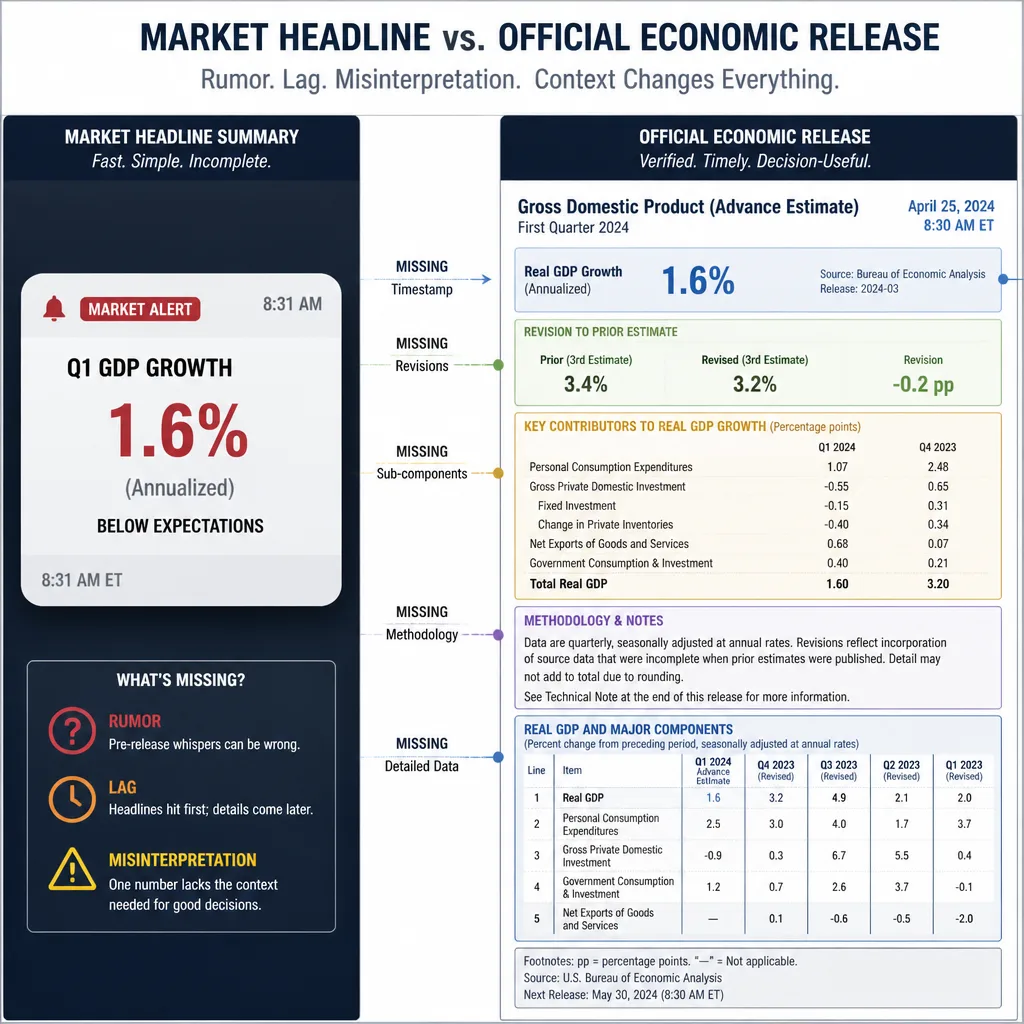
The real problem: rumor, lag, and misreading
Retail traders rarely lose because information is unavailable. They lose because they act on compressed information.
A broker headline might say U.S. payrolls beat expectations. What it may not show right away is that prior months were revised lower, wage growth softened, or unemployment ticked higher. The headline is fast, but incomplete.
That difference matters. A “strong” release can be less bullish than it first appears. A “weak” print can be offset by stronger internals. If you trade the first impression instead of the full release, you are often trading noise.
What official sources give you
Official releases usually provide the full package:
- Exact publication page
- Official release time
- Local time-zone context
- Actual figures
- Historical revisions
- Data tables
- Methodology notes
- Full policy language
Aggregators are useful for discovery. They are not enough for verification.
Key Insight: Official sources improve decision quality because they show the full context, not just the loudest number.
What official data does not solve
Official data reduces factual error. It does not remove interpretation risk.
Currencies react to data versus expectations, policy implications, and market positioning. A hotter CPI print may support USD if it raises expectations for tighter policy. But if that outcome is already priced in, the move can fade quickly.[^3]
Bottom Line: Use official sources to verify facts. Use your trading plan to decide whether those facts create an edge.
What to verify before a macro-driven trade
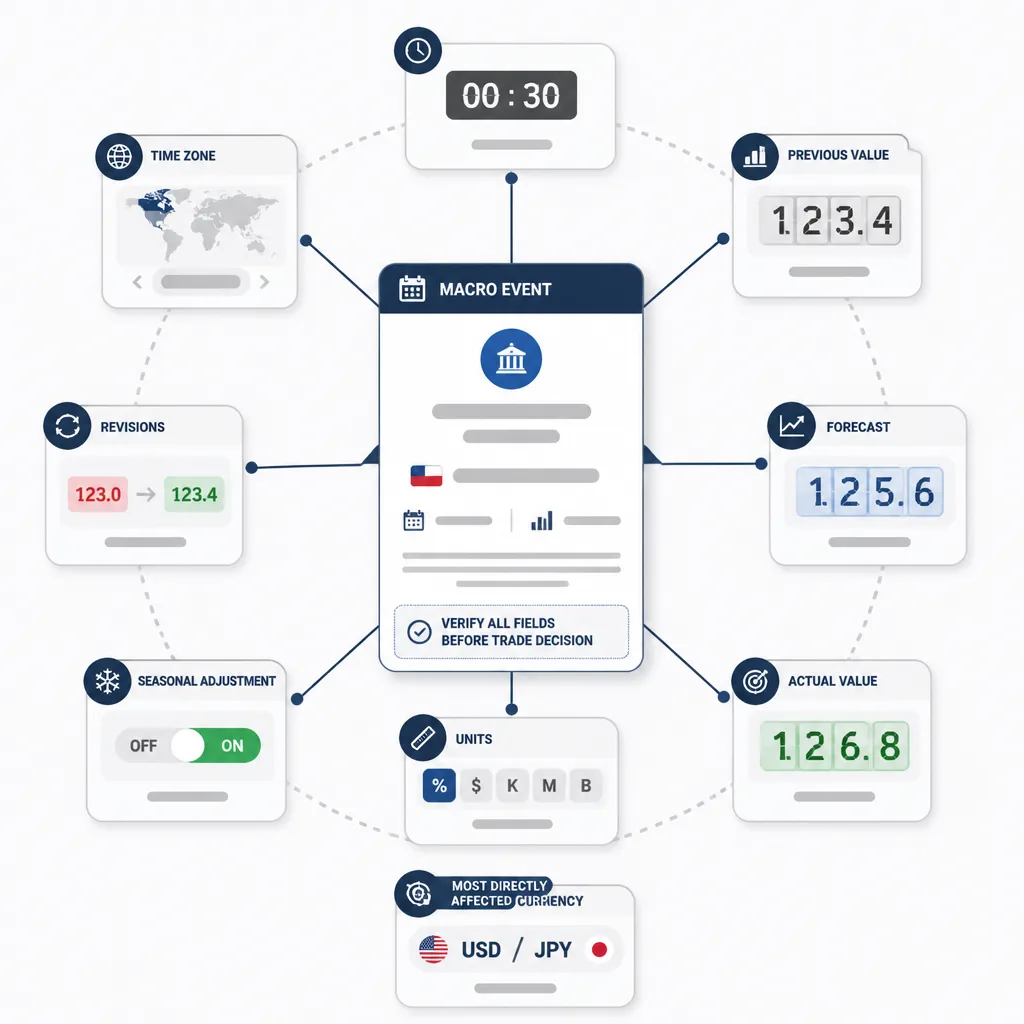
Release time and time zone
This matters more than many traders think. Official pages often publish in local time, and daylight-saving changes can create easy mistakes.
A U.K. release, for example, can catch traders out if they confuse GMT with BST. The same issue appears with ET versus EDT in U.S. data.
Previous, forecast, and actual values
The actual number comes from the official release. The forecast usually comes from market surveys or third-party calendars, not the agency itself. The previous number may also have been revised since the last release.
So if your calendar says “previous 3.2%,” check whether the official page now shows 3.1%.
Units, revisions, and seasonal adjustments
A month-over-month reading and a year-over-year reading can tell very different stories. The same is true for seasonally adjusted versus unadjusted data.
GDP is a good example. In the U.S., BEA publishes several estimate rounds. “Advance” GDP is not the final word.[^4]
Which currency is directly affected
This sounds obvious, but traders often generalize too much.
- BLS CPI mainly affects USD
- Eurostat HICP mainly affects EUR
- BoE rate decisions mainly affect GBP
Spillovers still matter. A major USD release can move most major pairs because the dollar sits on one side of so many trades.
Decision Rule: If you cannot identify the official source, the release unit, and your invalidation level, do not trade the event impulsively.
The 15 official data sources every forex trader should know
This list mixes central banks and statistical agencies because forex traders need both policy and economic data.
| Source | Region / Currency | Best For | What to Verify |
|---|---|---|---|
| Federal Reserve | U.S. / USD | FOMC decisions, statements, projections, minutes, speeches | Rate decision, policy language, meeting calendar |
| FOMC calendar | U.S. / USD | Scheduled policy meetings | Exact decision date and official materials |
| BLS | U.S. / USD | CPI, Nonfarm Payrolls, unemployment, wages, PPI | Release time, revisions, tables, headline vs internals |
| BEA | U.S. / USD | GDP, PCE, personal income and outlays | Advance/second/third estimate, core vs headline |
| ECB | Eurozone / EUR | Policy rates, statements, press conferences, projections | Deposit facility rate, wording shifts, guidance |
| Eurostat | Eurozone / EUR | HICP, GDP, industrial production | Flash vs final, country breakdowns, methodology |
| Bank of England | U.K. / GBP | Bank Rate, MPC statements, vote split, reports | Rate decision, vote split, report language |
| ONS | U.K. / GBP | CPI, labor data, GDP, retail sales | Release calendar, revisions, monthly vs quarterly format |
| Bank of Japan | Japan / JPY | Policy decisions, outlook reports, policy communication | Meeting statement, outlook changes, policy tools |
| Statistics Bureau of Japan | Japan / JPY | CPI-related and domestic macro data | Definitions, data tables, publication timing |
| RBA | Australia / AUD | Cash rate decisions, statements, minutes, speeches | Cash rate target, inflation and labor framing |
| ABS | Australia / AUD | CPI, labor force, retail sales | Seasonal adjustment, trend series, revisions |
| Bank of Canada | Canada / CAD | Overnight rate, statements, Monetary Policy Report | Decision date, policy tone, inflation framing |
| Statistics Canada | Canada / CAD | CPI, GDP, labor force, trade | Key tables, release notes, schedules |
| RBNZ | New Zealand / NZD | OCR decisions, Monetary Policy Statement | OCR decision, forward guidance |
| SNB | Switzerland / CHF | Policy rate decisions, quarterly assessments | Policy assessment, inflation outlook, CHF commentary |
Quick mapping by event type
If you want the shortest lookup:
- NFP, CPI, PPI, unemployment (USD): BLS
- GDP, PCE (USD): BEA
- FOMC decisions (USD): Federal Reserve
- Euro-area inflation and GDP: Eurostat
- ECB decisions: ECB
- U.K. CPI and labor data: ONS
- BoE decisions: Bank of England
- Japan policy: BoJ
- Australia CPI and labor: ABS
- RBA decisions: RBA
- Canada CPI, GDP, labor: Statistics Canada
- BoC decisions: BoC
- NZD policy: RBNZ
- CHF policy: SNB
Bottom Line: Use calendars to find events. Use official pages to confirm them.
How to use the stack: a simple verification framework
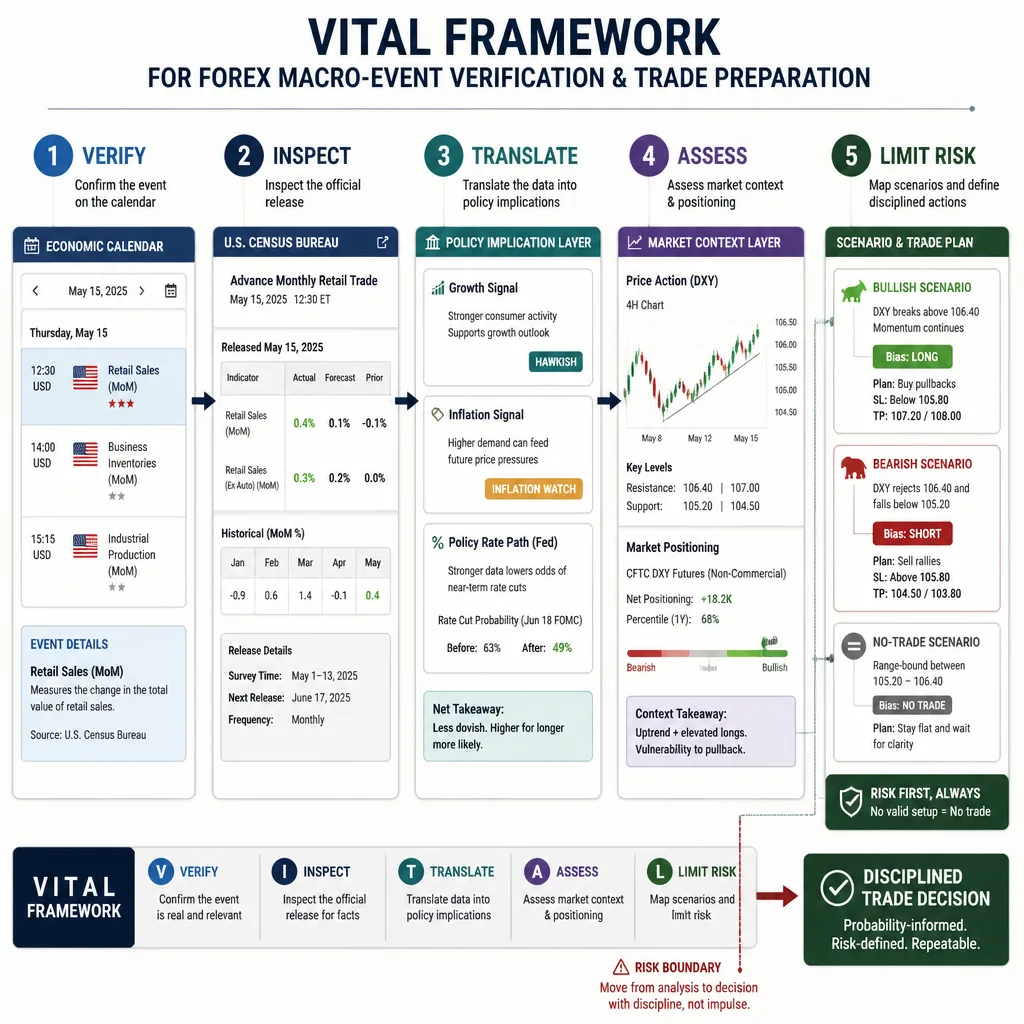
The VITAL Framework
| Step | Meaning | What to do |
|---|---|---|
| V | Verify the event | Find the exact official release or policy page |
| I | Inspect the details | Check timing, units, revisions, and release format |
| T | Translate the macro meaning | Ask what it means for policy expectations |
| A | Assess market context | Consider expectations, positioning, and trend |
| L | Limit risk with scenarios | Define bullish, bearish, and no-trade outcomes |
Step 1: Start with your calendar
Use your usual calendar for discovery. That is efficient. Just do not treat it as final truth.
Step 2: Confirm the event on the official source
If the event is U.S. CPI, go to BLS. If it is an ECB rate decision, go to the ECB. Open the source page before the release, not at the last second.
Step 3: Check format, units, and revision policy
Ask:
- Is it month-over-month or year-over-year?
- Is it seasonally adjusted?
- Is it flash, preliminary, final, or revised?
These details change interpretation.
Step 4: Read beyond the headline
For central banks, the number alone is not enough. An unchanged rate can still move markets if the language turns more hawkish or dovish.
For economic releases, read the summary note and key tables. A strong payroll headline with weak wages may not support the same conclusion as a broad-based labor beat.
Step 5: Translate the release into a trade decision
Use a simple chain:
Data surprise -> policy implication -> rate differential effect -> volatility profile -> trade or no-trade
Common Mistake: Treating official releases as direct signals. They are inputs, not orders.
A practical pre-trade workflow
Before the event: map scenarios
Build three paths in advance:
- Bullish currency scenario
- Bearish currency scenario
- No-trade scenario
For example, before U.S. CPI:
- Bullish USD: headline and core both come in hot, the details support sticky inflation, and the market reprices Fed expectations higher
- Bearish USD: inflation softens and the internals reduce pressure on rates
- No-trade: the release is mixed, the internals conflict, or price action turns disorderly
At release: verify before reacting
Do not rely on the first screenshot. Check the official page for the actual print and at least one important internal detail.
For BLS payrolls, that could include:
- Headline payrolls
- Unemployment rate
- Average hourly earnings
- Revisions to prior months
After release: separate the first move from the usable move
The first move is often emotional. The usable move is the one that still makes sense after the details are clear and price has settled enough for risk to be defined.
Bottom Line: Use calendars to find events, official sources to verify them, and a scenario plan to decide whether the event is worth trading.
Example: using official sources before trading a USD event
Scenario setup with BLS and Federal Reserve data
Suppose you plan to trade Nonfarm Payrolls.
Before the release, you check the BLS Employment Situation page for the schedule and format.[^5] Then you review recent Federal Reserve communication to understand the policy backdrop: is the Fed more concerned about inflation, labor cooling, or both?[^1]
That context matters. A strong labor number in a hawkish Fed environment may support USD more than the same number in a market already convinced the Fed is done tightening.
Building bullish, bearish, and no-trade outcomes
A simple setup might look like this:
| Scenario | Data read | Likely macro interpretation | Trading bias |
|---|---|---|---|
| Bullish USD | Payrolls beat, wages firm, unemployment steady or lower, revisions supportive | Labor remains tight; hawkish policy expectations may hold | Look for USD strength if price confirms |
| Bearish USD | Payrolls miss, wages soften, unemployment rises, revisions weaken | Labor cooling may reduce hawkish pressure | Look for USD weakness if repricing is clear |
| No-trade | Headline beats but wages soften and revisions disappoint | Mixed message; high interpretation risk | Stay flat or wait |
When the result conflicts with positioning
Suppose payrolls beat expectations, but the dollar barely rises. That may mean the market already priced in a strong number. Or another theme is dominating, such as falling yields or broader risk sentiment.
This is where many traders force a narrative. A better response is to reduce size, wait for structure, or skip the trade.
A strong number does not guarantee a stronger currency. It only improves the odds of a policy-relevant interpretation if the broader context supports it.
Common mistakes with macro data
Trading the headline alone
This is the most common mistake, and usually the most expensive.
Ignoring revisions and base effects
A fresh release can look strong until prior months are revised lower. Inflation can look dramatic because of a weak comparison base from last year.
Getting the release time wrong
A solid plan still fails if you show up at the wrong time.
Assuming every strong number is currency-positive
Currencies move on expectations and policy implications, not raw strength alone.
Treating official data as a signal instead of an input
Official sources are the foundation of a research stack. They are not a substitute for execution rules or risk management.
Decision Rule: If the release is mixed, the policy link is unclear, and the market response is disorderly, skipping the trade is a valid professional decision.
How to build your weekly research routine
A minimal stack for most retail traders
You do not need all 15 sources every day.
For most traders, a practical setup is:
- One reliable calendar for event discovery
- Official central bank pages for the 2–4 currencies you trade
- Official statistical agency pages for those same currencies
If you trade EUR/USD and GBP/USD, you mainly need:
- Federal Reserve
- BLS
- BEA
- ECB
- Eurostat
- BoE
- ONS
A deeper stack for macro-focused traders
If you trade news regularly or hold swing positions through macro events, go deeper:
- Policy calendars
- Statement archives
- Speech calendars
- Inflation and labor release pages
- GDP and growth release pages
- Monetary policy reports
Weekly checklist
- Mark high-impact events for your pairs
- Open official source links in advance
- Confirm release time and time zone
- Note whether the release can be revised
- Identify the key internal details to watch
- Map bullish, bearish, and no-trade scenarios
- Decide whether the event is tradable or observation-only
- Define risk limit and invalidation before the release
Bottom Line: The best sources are the ones tied directly to the pairs you trade, not the ones that make your dashboard look impressive.
Bottom line: trust the source, then build the trade
The main benefit of using official sources is not speed. It is clarity.
They help you verify the release, understand the details, and avoid acting on secondhand noise. That alone can save you from poor trades around central bank decisions, CPI releases, payrolls, and GDP prints.
But the real edge comes from what you do next. Confirm the facts first. Then ask whether the release changes policy expectations, supports a directional bias, or simply adds enough uncertainty to stay out.
That is the right order: trust the source, interpret the context, then decide whether there is a trade.
FAQ
What are the best official data sources for forex traders?
The best official sources are central bank websites and national statistical agencies. Core examples include the Federal Reserve, BLS, BEA, ECB, Eurostat, Bank of England, ONS, Bank of Japan, RBA, BoC, Statistics Canada, RBNZ, and SNB. Central banks are the primary source for rates and policy statements, while statistical agencies are the primary source for inflation, labor, GDP, and activity data.
Where can I verify economic calendar events directly from the source?
Use your regular economic calendar to discover the event, then confirm it on the official publication page. For example, check U.S. CPI or Nonfarm Payrolls on the BLS website, GDP and PCE on the BEA website, and rate decisions on the relevant central bank site such as the Federal Reserve or ECB.
Why use official sources instead of broker headlines or social media posts?
Official sources reduce source risk because they show the exact release, publication time, revisions, methodology notes, and full policy language. Broker headlines and social posts are useful for speed, but they often compress the story and leave out details that change the market meaning of the release.
Do official sources provide forecasts and trade signals?
Usually not. Official pages provide the release and its context, not a retail-friendly forecast dashboard or direct trading signal. Forecasts usually come from third-party calendars or market surveys.
What should I verify before trading a macro event?
At minimum, verify the release time, time zone, source page, previous value, actual value, unit of measurement, revision policy, and whether the data is seasonally adjusted, preliminary, flash, final, or revised. You should also know which currency is most directly affected and what result would invalidate your trade idea.
How do I use official macro data to build a trade plan?
A practical process is to start with the event on your calendar, confirm it on the official source, read the release beyond the headline, and translate the outcome into three scenarios: bullish, bearish, or no-trade. Then define expected volatility, key levels, and a risk limit before entering any position.
Which official site should I check first for major USD events?
For major USD data, start with the BLS for CPI, Nonfarm Payrolls, unemployment, wages, and PPI. Use the BEA for GDP, Personal Income and Outlays, and PCE inflation. Use the Federal Reserve for FOMC decisions, policy statements, minutes, projections, and speeches.
Why can a strong economic number fail to support a currency?
A strong number may already be priced in, may conflict with weaker details inside the report, or may fail to change policy expectations. Currency reactions depend on the data relative to expectations, the central bank context, market positioning, and how the release affects rate differentials.
Are official sources enough for a complete research process?
They are the foundation for verification, but not the whole process. Official sources help you confirm facts and understand context. Traders still need a calendar for discovery, price action context, risk management rules, and awareness of broader positioning and expectations.
How many official sources does a retail forex trader really need?
Most retail traders only need a small, focused stack. If you trade a few major pairs, one reliable economic calendar plus the official central bank and statistical agency pages for those currencies is usually enough. You do not need to monitor all 15 sources every day unless you trade a broad macro portfolio.