How to Build a Forex Trading Plan That Doesn’t Collapse Under Stress (A One-Page Template + Examples)
Most trading plans look sensible when the market is closed. The trouble starts when price is moving, spreads widen, a setup almost fits, and you are already down two trades on the day.
That is where vague plans fail. “Trade with the trend” is not a rule. “Be patient” is not a rule. Under pressure, broad intentions turn into discretionary mistakes.
A useful trading plan does something both simpler and harder: it removes decisions in real time. It tells you what you trade, when you trade, what must be true, what must not be true, how much you risk, when you stop, and how you review your execution afterward. It will not guarantee profits. It will give you a structure that can survive contact with live markets.
Why most trading plans break under pressure
The real problem usually is not discipline. It is vague rules.
Many traders call themselves undisciplined when the deeper issue is that their rules are too loose to follow consistently.
Consider the difference:
- Weak rule: trade strong trends
- Usable rule: only go long if the 1H trend is up, London session is active, price pulls back to the prior breakout area, and the entry candle closes back above that level
The second version can be checked. The first one can be argued with.
That matters because leveraged forex trading already carries meaningful risk, especially when position sizing, margin, and volatility are not well controlled.[^1] A plan cannot remove market risk. It can reduce self-inflicted damage.
A plan should remove decisions, not record intentions
A blunt but fair test: can you use the plan in under a minute before entering a trade?
If not, it is probably a reference document rather than an execution document.
For many beginner and early intermediate traders, a one-page plan works well because brevity forces specificity. You do not need a manifesto. You need a checklist that still makes sense when you are tired, rushed, or frustrated.
Why copying someone else’s plan usually fails
A trading plan has to fit the trader, not just the setup.
A full-time trader who watches the London open for three hours can build around short-lived momentum. A part-time trader with 45 minutes before work cannot. A trader who overtrades needs fewer pairs and tighter stop rules than someone who hesitates and misses entries.
Copied plans usually fail for ordinary reasons:
- the session does not match your schedule
- the trade frequency does not match your temperament
- the account size does not support the same stop structure
- the original trader uses discretion you cannot see in the written rules
What looks like a strategy problem is often a fit problem.
The one-page trading plan template
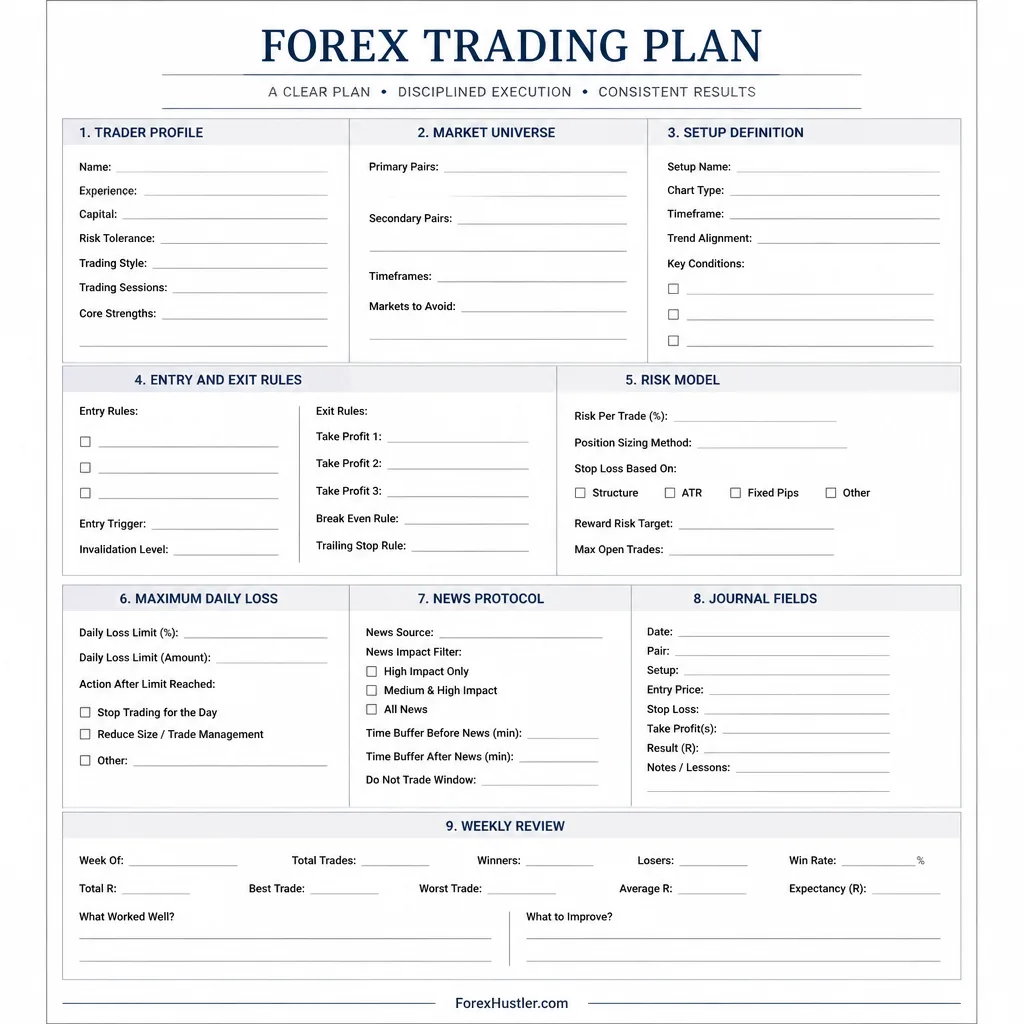
Keep it short enough to use and specific enough that two people reading it would spot the same trade.
1. Trader profile: time, temperament, and account constraints
- Available trading hours:
- Max screen time per session:
- Temperament risks: overtrading / hesitation / revenge trading / moving stops
- Account size:
- Max risk per trade:
- Max leverage allowed:
- Overnight holding allowed: yes / no
2. Market universe: what you trade, when you trade, what you ignore
- Allowed pairs:
- Allowed sessions:
- Avoid these pairs:
- Do not trade outside these hours:
- Do not trade if spread exceeds:
Majors such as EUR/USD, GBP/USD, and USD/JPY often have tighter spreads than many exotic pairs, which matters if your stops are small or your account is small.[^2]
3. Setup definition: what must be true and what must not be true
Must be true
- Trend or range condition:
- Price location:
- Confirmation trigger:
- Session condition:
Must not be true
- High-impact news within X minutes
- Spread above threshold
- Setup formed outside session window
- Market condition conflicts with strategy
4. Entry, stop-loss, and take-profit rules
- Entry type: market / limit / stop
- Entry trigger:
- Stop-loss placement:
- Take-profit method: fixed R / structure / partials / trail
- Max trades per setup:
5. Risk model: fixed fractional vs fixed dollar vs volatility-based sizing
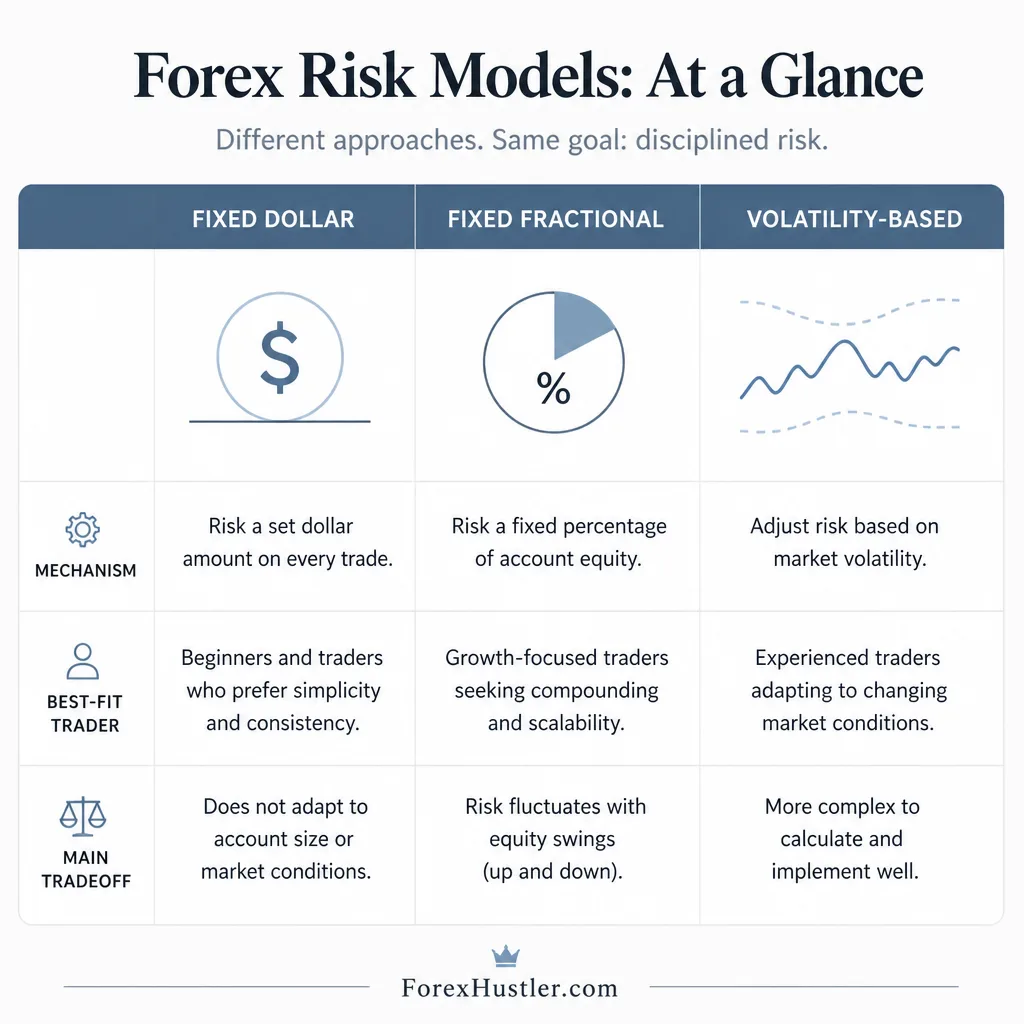
| Risk model | How it works | Best fit | Main tradeoff |
|---|---|---|---|
| Fixed dollar | Risk the same cash amount each trade | Beginners, small accounts, simpler execution | Does not adapt automatically as equity changes |
| Fixed fractional | Risk a fixed % of equity | Traders with stable execution | Can still be too aggressive if the % is too high |
| Volatility-based | Size changes with ATR or similar volatility measure | More advanced, rules-driven traders | Better market fit, more complexity |
There is no universal best model. Fixed dollar risk is often the easiest to execute consistently. Fixed fractional sizing is common once execution is stable. Volatility-based sizing can make sense, but it adds moving parts.
6. Maximum daily loss and stop-trading rules
- Max daily loss:
- Stop after consecutive losses:
- Stop if a major rule is broken:
- Stop if emotional state degrades:
- Stop if market no longer matches setup conditions:
This is a behavioral circuit breaker, not a profit tool.
7. News handling protocol
- Calendar checked before session: yes / no
- High-impact events that matter: central bank decisions, CPI, NFP, GDP, labor data, major speeches
- No new trades within ___ minutes before news on either currency
- Reassess ___ minutes after release when spreads and direction normalize
For operational use, many traders rely on economic calendars such as Forex Factory, Investing.com, or broker calendars, while the underlying releases come from central banks and statistical agencies.[^3]
8. Journaling fields that actually help
- Date and time
- Pair and session
- Setup type
- Screenshot
- Entry reason
- Stop distance
- Position size
- Spread at entry
- News proximity
- Rule adherence score
- Emotional state
- Outcome in R
- Mistake tags
- One lesson
Mistake tags are where the journal becomes useful. Examples: early entry, moved stop, traded outside hours, news violation, oversized risk, boredom trade.
9. Weekly review loop
- How many valid setups appeared?
- How many valid setups did I take?
- How many invalid trades did I take?
- Which losses were normal variance?
- Which losses came from rule breaks?
- Which mistake tags repeated?
- Did I follow stop-trading rules?
- Do I need a rule change, or better adherence?
How to write each section so it still works live
Use observable conditions, not subjective language
“Clean chart,” “good structure,” and “strong momentum” sound smart and review badly.
Use conditions you can point to:
- candle close above level
- 1H trend aligned with direction
- retest of prior breakout zone
- spread under 1.5 pips
- no entry after the first two hours of the session
If you cannot observe it clearly, you cannot enforce it.
Define exclusion rules as clearly as entry rules
A lot of damage comes from trades that were never supposed to be taken.
Exclusion rules often do more work than entry rules because they filter out low-quality variations. For example:
- no trade within 30 minutes of high-impact news
- no range-reversion trade if price is breaking session highs with expansion
- no trend-continuation trade after the move is already near average daily range
- no new trade after two consecutive losses
Build around your actual schedule, not your ideal one
This matters more than traders like to admit.
If you can only trade the last hour of New York, do not build a plan around the London open. If you cannot monitor intrabar price action, require candle-close entries. If your job interrupts you, avoid setups that need constant management.
A realistic plan is better than an impressive plan you cannot execute.
Keep it short enough to use, detailed enough to constrain you
One page is usually enough if you are trading one setup in one environment.
Once a plan gets too long, it stops being a live tool. But if it is too short, it becomes vague again. The balance is simple: enough detail to reduce discretion, not so much that it becomes unreadable.
Example 1: London session trend-continuation plan
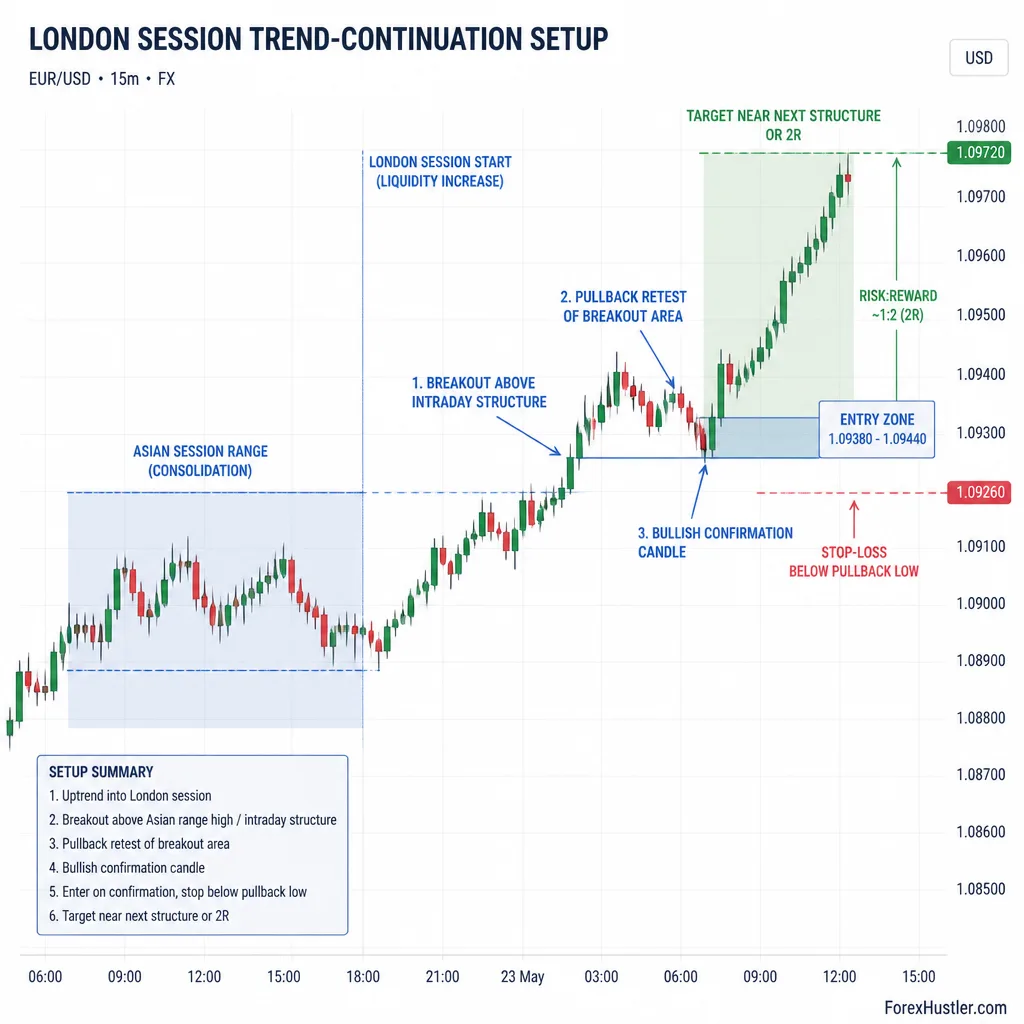
Market and session focus
- Pairs: EUR/USD, GBP/USD
- Session: London open to first 3 hours
- Environment: active day, clear directional bias on 1H
- Avoid: exotic pairs, post-news chaos, spread above 1.5 pips
Setup rules
Must be true
- 1H trend is up for longs or down for shorts
- Price broke an Asian session level or prior intraday structure
- Pullback retests breakout area without full failure
- 5M candle closes back in trend direction from the retest
- Entry occurs within session window
Must not be true
- High-impact news within 30 minutes on either currency
- Entry is too close to major daily resistance or support
- Price has already extended unusually far for the session
- Spread exceeds threshold
This is the kind of setup many traders describe as “buy the pullback.” It only becomes tradable once that phrase is narrowed.
Risk and stop rules
- Risk model: fixed dollar risk
- Risk per trade: 0.5% account equivalent or less
- Stop: beyond the pullback low for longs or high for shorts
- Target: 2R or next clear structure level, whichever is closer
- Stop trading after 2 losses or daily loss cap reached
News and journaling rules
- Check calendar before London open
- No new entries 30 minutes before red-folder events
- Journal tags: late chase, early entry, news violation, oversized stop, skipped valid setup
Example 2: Quiet-session range-reversion plan
When this environment makes sense
This only works when the market is actually ranging.
That means quieter conditions, clear intraday boundaries, and no obvious catalyst pushing a trend. Range-reversion plans tend to fail fast on real breakout days. That failure mode should be written into the plan, not discovered emotionally.
Setup rules
- Pairs: EUR/USD, USD/CHF
- Session: late Asia or quiet pre-London period
- Environment: no major scheduled news nearby, no strong 1H trend expansion
Must be true
- Price has respected range boundaries at least twice
- Range width is large enough relative to spread to justify the trade
- Entry occurs near a boundary, not in the middle
- Rejection candle closes back inside the range
- Target is the opposite side of the range or a conservative midpoint exit
Must not be true
- Strong breakout candle closing beyond the range
- News within 30 minutes
- Spread widened materially
- Price action shows one-way directional expansion
Risk and stop rules
- Risk model: fixed dollar risk
- Stop: several pips beyond the range boundary and rejection failure point
- Target: midpoint for partial, opposite boundary for final target
- Stop trading after one breakout loss and, at most, one additional failed re-entry
News and journaling rules
- If a range breaks during scheduled news, stand aside
- Journal tags: middle-of-range entry, fading real trend, impatience, exit too early, ignored breakout signal
Common mistakes that make a trading plan useless
Too many setups
Every added setup increases interpretation load. For newer traders, one good setup is usually enough.
No stop-trading rule
A daily loss cap or consecutive-loss rule will not eliminate drawdowns. It can stop one bad session from turning into revenge trading.
Risk sizing that changes with emotion
“High-confidence” trades are where many traders size too large. Confidence is not a risk model.
Journaling without mistake tags or rule adherence
If your journal only records entry and exit, it tells you what happened, not why.
Reviewing results without reviewing execution quality
A profitable week with bad execution is more dangerous than a losing week with good execution. One is luck hiding a problem. The other may simply be variance.
Build the plan, then stress-test it before you trust it
Use replay or demo testing first
Before risking real money, run the plan through bar replay, demo trading, or structured forward testing. Backtesting can show whether the setup had historical logic. Forward testing shows whether you can execute it under live conditions.
Check whether the rules are easy to follow at speed
Ask two questions:
- Would two different traders reading this plan identify the same setup?
- After a loss, can I immediately tell whether the trade was valid according to plan?
If the answer is no, the rules are still too subjective.
Refine only after a meaningful sample of trades
Do not rewrite the plan after three losses. Small samples are noisy. Look for patterns across a meaningful batch of trades, and separate normal losing trades from broken execution before changing anything.
Conclusion
A trading plan is not supposed to predict the market. It is supposed to keep your behavior stable when the market is unstable.
That is why specificity matters more than inspiration. A good plan tells you when to trade, what qualifies, what disqualifies, how much to risk, when to stop, and how to review your own behavior honestly.
If you finish this article with a one-page draft, that is a good start. If you test that draft before scaling risk, it becomes something better: a process you can actually trust under pressure.
FAQ
What should a forex trading plan include?
A usable trading plan should define your market universe, trading session, setup rules, entry and exit criteria, risk model, daily loss limits, news protocol, journaling fields, and weekly review process. The key is specificity. If a rule cannot be checked quickly before a trade, it is probably too vague.
Why do most trading plans fail in live markets?
Most plans fail because they are written as intentions rather than execution rules. Phrases such as “trade with the trend” or “be patient” sound sensible, but they do not tell you exactly what is allowed or forbidden when price is moving fast and emotions are elevated.
How long should a trading plan be?
For many beginner and early intermediate traders, one page is enough if it covers the core decisions clearly. A plan should be short enough to use in real time but detailed enough to reduce discretion.
What is the best risk model for a trading plan?
There is no universal best model. Fixed dollar risk is often easiest for newer traders because it is simple and psychologically stable. Fixed fractional sizing adapts as account equity changes. Volatility-based sizing can fit changing market conditions better, but it is more complex and usually better suited to traders with a more established process.
What is a maximum daily loss rule in forex trading?
A maximum daily loss rule is a stop-trading limit for the day, based on either a fixed dollar amount, a percentage of account equity, or a set number of consecutive losses. Its purpose is behavioral control. It helps prevent drawdowns from turning into revenge trading or emotionally degraded decisions.
How should a trading plan handle high-impact news?
A practical plan should define what counts as high-impact news and state when trading is not allowed around those events. Many traders use a conservative rule such as no new trades 15 to 30 minutes before high-impact news affecting either currency in the pair, then reassess after spreads and volatility normalize.
What journal fields actually improve trading performance?
The most useful journal fields go beyond entry and exit price. Include setup type, session, screenshot, market context, spread at entry, rule adherence score, emotional state, outcome in R, and mistake tags such as early entry, moved stop, or traded outside plan hours. These fields help separate bad execution from normal variance.
Why does copying someone else’s trading plan usually fail?
A trading plan has to fit your time availability, temperament, account size, and decision speed. A plan that works for a full-time trader during the London session may be impossible for a part-time trader with limited screen time. Copied rules often break because the trader is trying to execute in conditions the original plan was never built for.
How do I know if my trading plan is too subjective?
A good test is whether two different people reading the plan would identify the same trade. If terms like “strong momentum,” “clean setup,” or “good structure” are not defined with observable conditions, the plan is still too subjective to review properly.
Should I change my trading plan after a few losses?
Usually not. A small sample of trades tells you very little in markets with natural variance. Review whether the losses came from valid execution or broken rules first. Rule changes should come after a meaningful sample and a clear pattern, not a short emotional reaction.