How Much Capital Do You Need to Make a Living Trading? Real Income Math With 3 Scenarios
Most traders frame this question the wrong way. They ask, “Can you make a living trading?” A more useful question is: how much income do you need, and what account size can support it without forcing reckless returns?
That distinction matters. Earning $3,000 to $5,000 per month from trading is not just a return problem. It is also a capital problem, a drawdown problem, and a withdrawal problem.
If you want a realistic answer, you need to separate theory from practice. This article breaks down the math, shows where it fails, and gives you a framework you can apply to your own numbers.
The real question is not “Can you make a living trading?”
The better question: what income do you need, and what account size can support it?
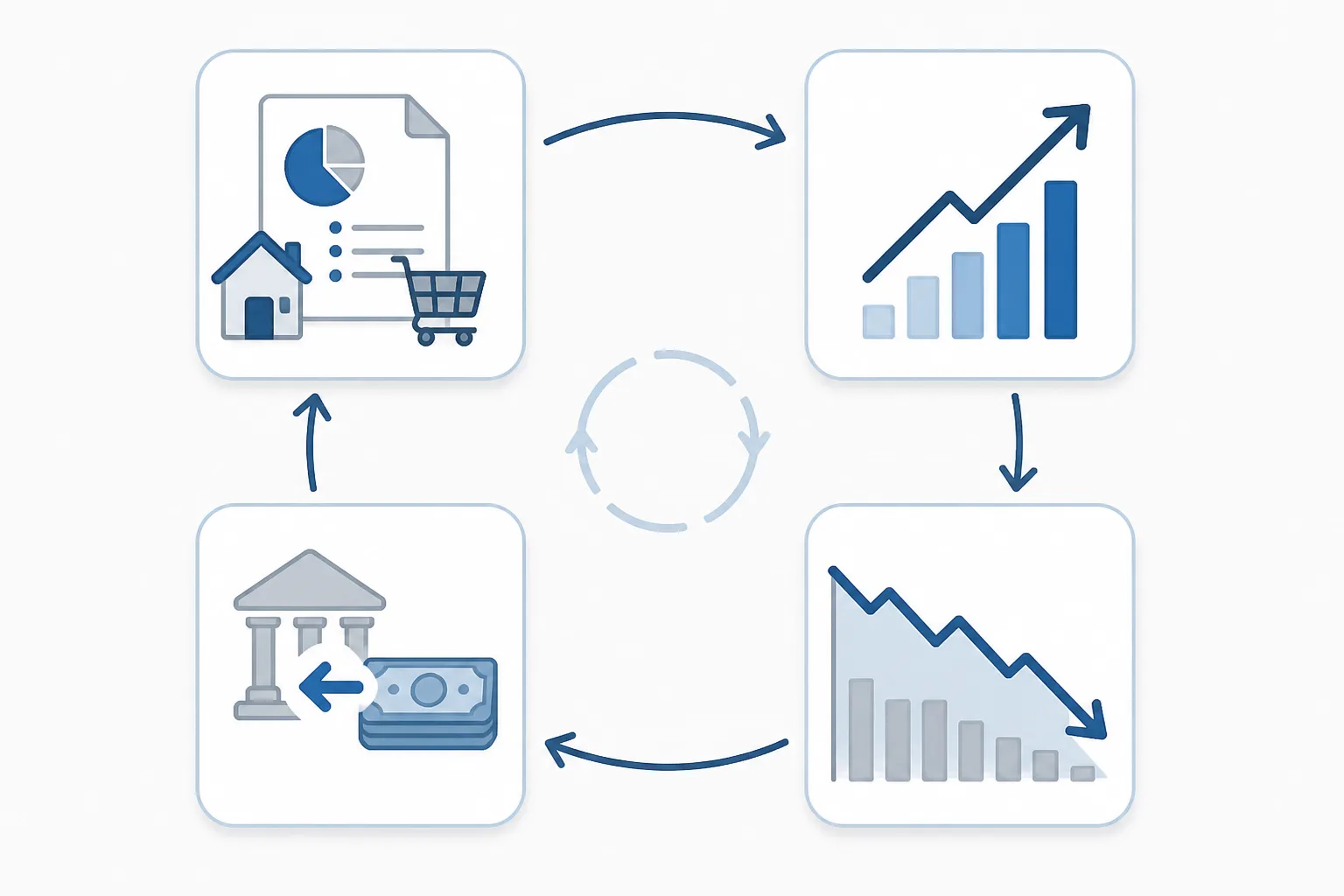
In theory, yes, you can make a living trading.
In practice, the answer depends on four connected variables:
- your annual living expenses
- your realistic return expectations
- your likely drawdown
- your withdrawal needs
That is why there is no universal “you need $X” number. A trader who needs $30,000 per year is solving a very different problem from someone who needs $90,000 to support a family.
A better way to think about it is this: your trading account is a business asset base. The income it produces is not a salary. It is uneven cash flow. Some months will be strong, some flat, and some negative. If your lifestyle depends on steady monthly income but your strategy produces lumpy returns, pressure builds quickly.
Why most trading income math breaks before the first trade
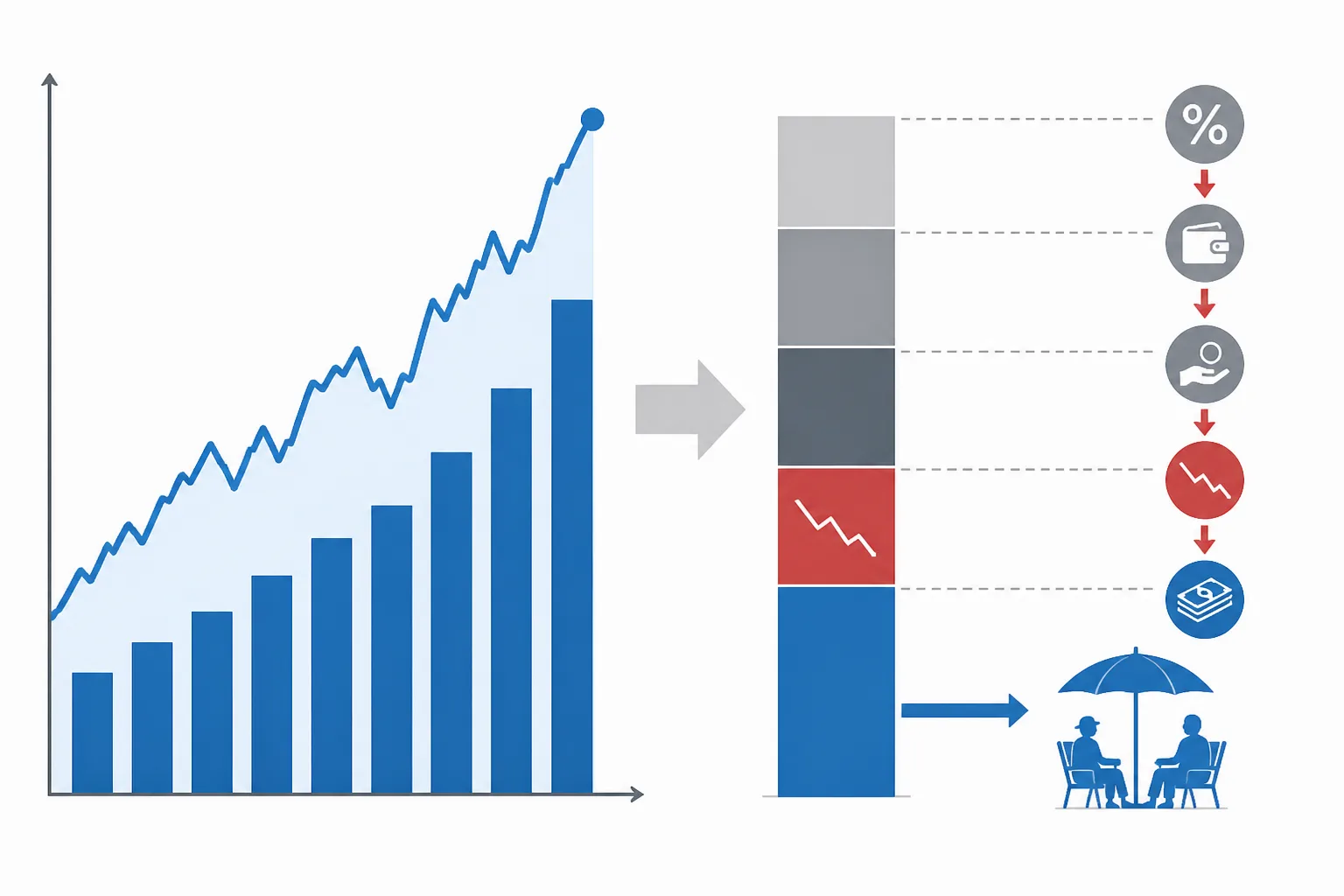
Most bad income plans fail at the first assumption.
A trader has one strong month and annualizes it. If they make 8% in a good month, they start thinking in terms of “8% per month.” That is where the math becomes dangerous.
Even with a profitable strategy, gross return is not the same as spendable income. A $100,000 account earning 20% gross produces $20,000 before taxes, slippage, commissions, and reserve needs. It also tells you nothing about how smooth or volatile that path was.
An account that can occasionally produce your target income is not the same as an account that can reliably support your life.
A simple framework for trading income math
Step 1: Define your required annual living income
Start with what you actually need to live, not what you hope to make.
Include:
- housing
- food
- utilities
- insurance
- debt payments
- transportation
- healthcare
- irregular expenses
- taxes
If your true annual spending need is $48,000, that is your starting point. Not a round number. Not an aspirational one. Your real number.
This shift alone improves the question. It turns “How much can I make?” into “What does my account need to support?”
Step 2: Separate gross return from spendable income
This is one of the most common mistakes.
If you need $48,000 to live, you do not automatically need an account that makes $48,000 gross. You likely need more, because part of gross return will disappear into taxes, trading costs, and retained capital.
For example, suppose your account earns $60,000 gross in a year. That does not mean the full $60,000 is available to spend. Some of it may need to stay in the account to preserve trading size and absorb future volatility.
Spendable income is always less than headline return.
Step 3: Account for drawdowns, taxes, and bad months
Average annual return hides path risk.
Two traders can both finish the year up 15%, but one may have a smooth equity curve while the other suffers a 25% drawdown before recovering late in the year. If both need monthly withdrawals for rent, those are completely different situations.
Here is a simple example.
A $100,000 account falls 20%, dropping to $80,000. If the trader then withdraws $10,000 for living expenses, the account falls to $70,000. Recovery becomes much harder.
- A 20% drawdown alone needs a 25% gain to recover.
- If you withdraw during that drawdown and cut capital to $70,000, you need a much larger gain on a smaller base.
That is sequence risk in plain English: losses and withdrawals hitting in the wrong order can do more damage than average return suggests.
Step 4: Estimate a realistic withdrawal rate from trading capital
This is where most plans become honest.
Instead of asking, “What annual return can I make?” ask, “What withdrawal rate can my account support without becoming fragile?”
There is no universal safe withdrawal rate for trading, and trading is usually less stable than long-term investing. But one practical rule is useful:
If your planned withdrawals are too close to your expected annual return, the setup is fragile.
If you expect 15% gross annually and need to withdraw 12% to live, you have very little room for taxes, underperformance, or a bad year.
That does not mean it cannot work. It means the margin for error is thin.
The three numbers that determine whether trading income is realistic
Expected return: what a realistic range looks like
Return assumptions need to be conservative enough to survive real conditions.
For planning, it is more useful to think in ranges than promises. A trader might model scenarios around 10%, 15%, and 20% gross annual returns. These are not guarantees. They are planning cases.
The exact number matters less than the tradeoff behind it.
Higher target returns usually require one or more of the following:
- more leverage
- larger position concentration
- looser risk limits
- greater emotional pressure
That usually means deeper drawdowns.
Maximum drawdown: why survival matters more than average return
Drawdown matters because it determines whether you can keep operating.
A trader who compounds at a moderate pace and survives rough periods can stay in the game. A trader who pushes too hard for income often finds that one bad stretch leads to overtrading, revenge trading, or abandoned risk rules.
Recovery math is unforgiving:
- 10% drawdown needs about 11.1% to recover
- 20% drawdown needs 25%
- 30% drawdown needs about 42.9%
- 50% drawdown needs 100%
When you are living off the account, this matters more than average return.
Withdrawals: how taking money out changes compounding
Compounding works best when capital stays in the account.
Once you start withdrawing income, you interrupt that process. That is not inherently bad. It simply means your objective has changed. You are no longer optimizing for growth alone. You are balancing growth, survival, and cash extraction.
A backtest that looks excellent when all profits stay in the account may look much weaker once regular withdrawals are added. This is especially true for strategies with uneven returns.
In other words: a strategy can be good for growth and still be poor for income.
A practical rule of thumb: the Trading Income Buffer
Why you need more than the minimum capital number
A bare-minimum estimate usually assumes too much goes right.
It assumes returns arrive on time, drawdowns stay manageable, and you do not need emergency cash. Real life rarely works that neatly.
That is why minimum viable trading capital should be treated as a floor, not a plan.
A simple buffer model: income target + drawdown tolerance + cash reserve
Use this three-layer framework:
1. Required annual spending
This is what your life actually costs.
2. Capital buffer for drawdowns and underperformance
This is the gap between a theoretical minimum and a workable account size.
3. Separate cash reserve outside the trading account
This is your personal runway, so you do not have to pull money from the account at the worst possible time.
You can think of it like this:
Minimum Viable Trading Capital ≈ Annual Spending Need / Conservative Withdrawal Rate
Then add a buffer for drawdown risk and keep a separate cash reserve of at least several months of expenses outside the account. Many traders should think in terms of 6 to 12 months minimum, and more if trading will be the only income source.
This is the Trading Income Buffer. It turns a theoretical number into a practical one.
Scenario 1: Small account — when the math usually breaks
Example: trying to generate full-time income from a small account
Let’s say you have a $20,000 account and want to make $48,000 per year.
That requires a 240% gross annual return before taxes and costs.
This is the core problem with small-account income plans. The math is not just aggressive. It demands extreme performance.
What return would be required, and why that usually implies unsustainable risk
To aim for that kind of return, most traders would need substantial leverage, aggressive sizing, or loose risk controls. That may work for a short period, but it is not a sound basis for paying rent, bills, and food.
A trader might double a small account once. That does not mean the process is repeatable enough to support living income.
What a small account is actually good for instead
A small account still has real value.
It is useful for:
- proving execution under real conditions
- building discipline
- testing position sizing
- validating a strategy
- creating a performance record
That is a far better use than trying to force full-time income from insufficient capital.
Scenario 2: Medium account — possible for supplemental income, difficult for full replacement
Example: moderate capital with partial monthly withdrawals
Take a $100,000 account with a 15% gross annual return assumption.
That produces roughly $15,000 gross for the year.
That is meaningful. It can support side income and reduce dependence on a job. But for most people, it is not enough to replace full-time income.
Even at 20% gross, the account generates $20,000 before taxes and before any need to preserve capital.
How drawdowns and uneven performance affect lifestyle stability
Now add a 15% drawdown.
The account drops from $100,000 to $85,000. If the trader keeps withdrawing during that period, the capital base shrinks further. The same percentage return now produces fewer dollars, and the pressure to “make it back” rises.
This is why a medium-sized account can feel workable in strong periods and fragile in weak ones.
When this setup works and when it becomes fragile
A medium account often works best when:
- living costs are low
- there is outside income
- withdrawals are occasional rather than mandatory
- the trader is still in a transition phase
It becomes fragile when the trader treats it like a stable paycheck before the numbers support that role.
Scenario 3: Larger account — where full-time trading starts to become structurally possible
Example: larger capital base with conservative withdrawal assumptions
Now consider a $300,000 account.
At 12% gross, it produces about $36,000 per year.
At 15% gross, it produces about $45,000 per year.
That still may not replace a high-cost lifestyle. But it is much closer to full-time viability without requiring extreme returns.
This is where full-time trading starts to become structurally possible, depending on your cost of living.
Why lower pressure can improve decision-making and survivability
Larger capital helps for an arithmetic reason, but also for a behavioral one.
If you only need a modest withdrawal rate relative to account size, you do not need every month to be great. That reduces pressure. Lower pressure often improves adherence to risk management, position sizing, and process.
That behavioral edge is real. Traders often perform worse when every trade feels like a bill payment.
What can still go wrong even with a bigger account
A larger account does not fix:
- a poor strategy
- excessive leverage
- inconsistent execution
- psychological mistakes
- unfavorable market conditions
Capital helps, but it does not compensate for a broken process.
How to calculate your own minimum viable trading capital
Use a reverse-income method
Here is a simple workflow:
- Calculate your annual net spending need.
- Gross it up for taxes and trading costs.
- Choose a conservative withdrawal rate.
- Divide gross income need by that rate.
- Add your Trading Income Buffer.
Example:
If you need $60,000 per year and use a 10% withdrawal rate, your rough capital requirement is:
$60,000 / 0.10 = $600,000
If you use a 15% withdrawal rate:
$60,000 / 0.15 = $400,000
The second number looks better, but it is also more fragile.
Stress test the number with lower returns and deeper drawdowns
Do not stop at the first answer.
If you assume 15% annual return, also test:
- 10% return
- 8% return
- a 25% drawdown instead of 15%
- several losing months in a row
- withdrawals during a weak quarter
If the plan only works in the optimistic case, it is not ready.
Add a separate personal cash runway
Your emergency cash should not be your trading float.
Keep personal reserves outside the account. That way, a bad run in the market does not immediately turn into a personal cash crisis.
For many traders, 6 to 12 months of living expenses is a sensible minimum. If trading will be your sole income source, a longer runway may be wiser.
Common mistakes when estimating living income from trading
Using best-month returns as the baseline
One strong month is not a business model.
Good months happen. The mistake is treating them as normal.
Ignoring the sequence of losses and withdrawals
Losses alone are manageable. Withdrawals alone are manageable. Combined in the wrong order, they can seriously damage recovery.
Assuming monthly consistency from a lumpy return stream
Bills arrive monthly. Trading returns often do not.
That mismatch creates pressure, especially for day traders and swing traders whose income can be uneven.
Confusing account growth with spendable income
A strategy built for long-term compounding may not be suitable for regular withdrawals. Growth and income are related, but they are not the same objective.
Bottom line: trading can produce income, but only if the math works first
A realistic benchmark for thinking about account size
There is no universal number for how much money you need to trade for a living. But there is a practical rule:
If your income plan only works under optimistic return assumptions, it is probably too fragile.
The lower your required withdrawal rate relative to account size, the more room you have for mistakes, drawdowns, and normal performance variability.
When to treat trading as side income versus a primary income source
Treat trading as side income when:
- your plan only works under aggressive assumptions
- drawdowns would force withdrawals
- you do not have a personal cash runway
- your results are too short or inconsistent
Consider it a primary income source only when:
- your account still works under conservative return assumptions
- you understand your drawdown profile
- you can survive bad periods without raiding the account
- your process has a proven track record
Conclusion
Trading can absolutely produce income, but that does not mean every account can support a living.
The real issue is not whether trading income is possible in theory. It is whether your account size, return expectations, drawdown profile, and withdrawal needs still work under stress.
If you want an honest answer, stop thinking in terms of exciting monthly percentages. Start with your spending needs, use conservative withdrawal assumptions, and build a Trading Income Buffer around the account.
The number may be less exciting than you hoped. But it will be more realistic, and realism is what keeps traders in the game.
FAQ
How much capital do you need to make a living trading?
There is no single number. It depends on your annual living expenses, realistic return expectations, drawdown profile, taxes, and how much you need to withdraw from the account. A useful starting point is to work backward from your spending needs using a conservative withdrawal rate instead of assuming high monthly returns.
Can you make a living trading with a small account?
In most cases, no. For example, trying to pull $48,000 per year from a $20,000 account would require extremely high returns before taxes and costs, which usually means unsustainable risk. Small accounts are better used for skill-building, execution practice, and track-record development.
What is the difference between gross trading return and spendable income?
Gross return is what the account earns before taxes, slippage, commissions, and reserve needs. Spendable income is what remains after those frictions and after keeping enough capital in the account to absorb drawdowns and continue trading effectively.
Why do drawdowns matter so much for trading income?
Drawdowns reduce the capital base that generates future returns. If you also withdraw money during or after a losing period, recovery becomes much harder because the account is smaller. That is why average return alone can be misleading when planning to live off trading income.
How do withdrawals affect compounding in a trading account?
Withdrawals interrupt compounding by taking productive capital out of the account. That matters even more after losses. A strategy that looks strong in a growth-only backtest can become fragile when regular withdrawals are added, especially if returns are uneven.
What is a realistic withdrawal rate for trading income planning?
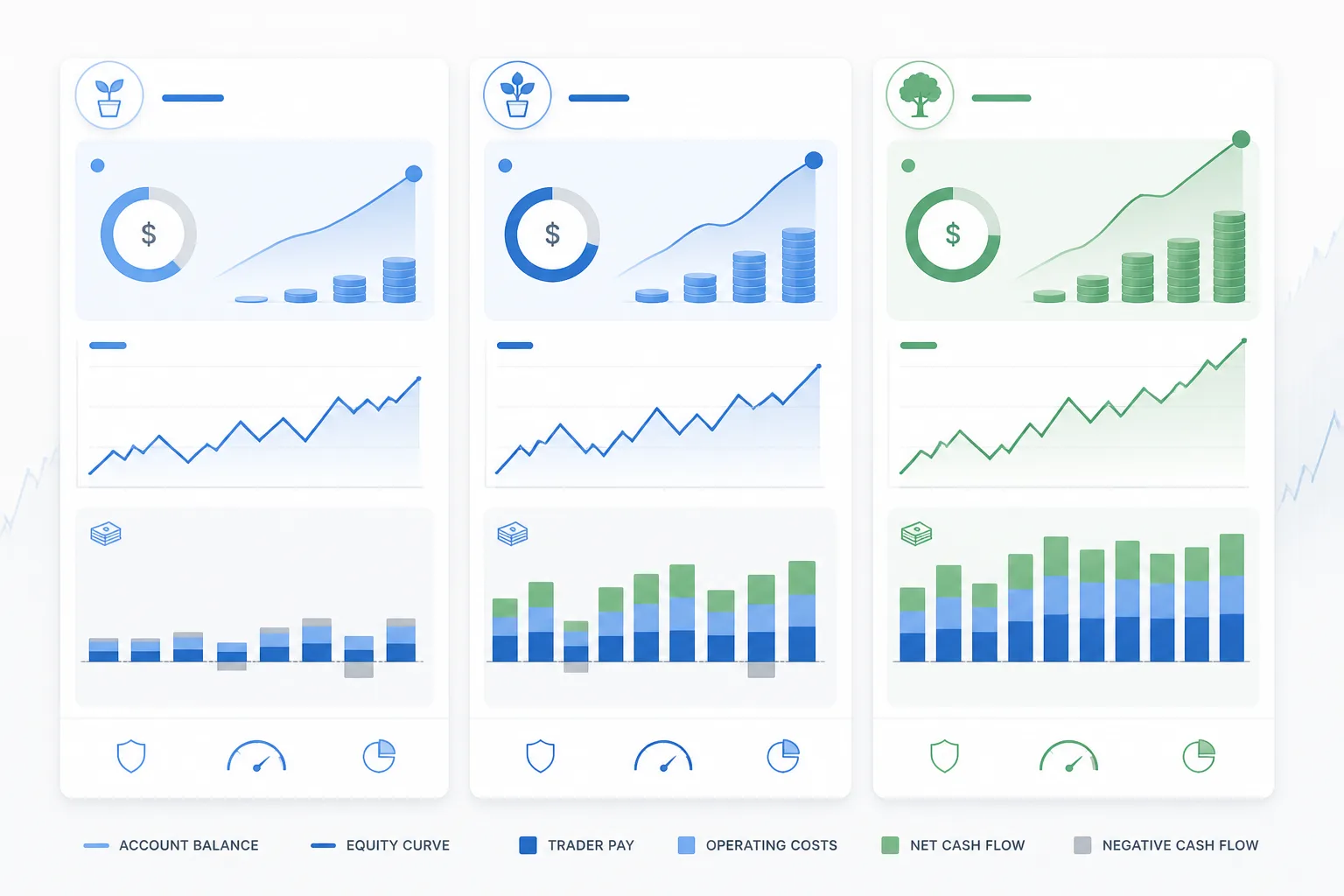
There is no universal safe withdrawal rate for traders because trading returns are less stable than long-term diversified investing. In practice, the lower your withdrawal rate relative to expected return, the more room you have for bad periods. If your planned withdrawals are too close to your expected annual return, the setup is usually fragile.
How much money do you need to trade for a living if you want $3,000 to $5,000 per month?
That depends on whether you are planning with conservative or optimistic assumptions. If you need $36,000 to $60,000 per year, the required capital is often much larger than most traders expect once you account for taxes, drawdowns, and uneven returns.
What is the Trading Income Buffer?
The Trading Income Buffer is a planning model with three layers: your required annual spending, extra capital to absorb drawdowns and underperformance, and a separate cash reserve outside the trading account. It helps turn a theoretical minimum into a more realistic number.
Should trading be treated as side income or primary income?
If your plan only works under optimistic return assumptions, trading should usually be treated as side income. It starts to become a more realistic primary income source only when the account still works under lower returns, deeper drawdowns, and several bad months in a row.
How do you calculate your own minimum viable trading capital?
Start with your annual net spending need. Then gross it up for taxes and trading costs, choose a conservative withdrawal rate, and divide the gross income need by that rate. After that, stress test the result with lower returns and deeper drawdowns, and keep a separate personal cash runway outside the trading account.