Most traders hear “AI” and think prediction: smarter entries, better signals, some machine that can see where price goes next.
For discretionary forex traders, that is usually the wrong place to start. Not because prediction tools are impossible in theory, but because most retail traders lack the data, testing process, and model discipline required to trust them. What they do have is a more immediate problem: process.
If your journal is inconsistent, your rules are loosely enforced, and your reviews depend on memory, AI can help. Not by forecasting EUR/USD, but by making your trading process cleaner, harder to cheat, and easier to learn from.
That is the useful version of AI in discretionary trading: automate recordkeeping, tighten the checklist, and shorten the gap between mistake and correction.
AI Is Useful in Forex Trading—Just Not in the Way Most Traders Hope
The first distinction that matters is simple: AI in trading can mean three different things.
- Prediction and signal generation
- Workflow automation
- AI-assisted review and rule enforcement
This article is about the second and third categories.
Why prediction is the wrong starting point for discretionary traders
Retail traders are often sold the fantasy version of AI: a black box that predicts direction. The problem is not only that many of these tools are exaggerated. Even a legitimate model needs clean data, careful validation, and ongoing monitoring before it deserves trust. Most discretionary traders do not have that infrastructure.
More importantly, another “opinion” about price often adds noise, not clarity. If your process is already loose, AI signals can become one more excuse to override your plan.
Where AI actually helps
AI is far more credible when it acts as:
- a memory system
- a classification layer
- a checklist enforcer
- a pattern spotter
- a review assistant
Many traders do not have an entry problem first. They have a measurement problem. If you cannot reliably see when you followed your rules and when you did not, you cannot tell whether your strategy failed or you did.
The real edge: faster learning cycles
The edge is not that AI makes better market calls.
It is simpler: cleaner data creates better feedback. Better feedback helps you correct mistakes sooner. That shortens the learning cycle and reduces self-sabotage.
What to Automate First in a Discretionary Trading Workflow
Do not start with advanced tooling. Start with the repetitive tasks you do inconsistently.
Trade capture: what to record every time
At minimum, capture:
- instrument
- date and time
- direction
- entry price
- stop-loss
- take-profit
- planned risk
- actual position size
- setup tag
- chart screenshot
- short pre-trade thesis
- short post-trade note
If you use TradingView for charting and MetaTrader 5 for execution, that usually means combining chart screenshots and annotations from TradingView with trade history or exports from MT5.[^1][^2]
Journal fields worth collecting from day one
A solid minimum structure has five buckets:
| Bucket | What to capture |
|---|---|
| Setup | Setup type, timeframe, session, market condition |
| Context | Higher-timeframe bias, nearby news, level or catalyst |
| Execution | Entry, stop, target, size, planned R:R |
| Outcome | Result in pips, result in R, exit reason |
| Behavior | Rule followed, rule broken, emotional note, checklist completed |
That last bucket is the one many traders skip. It is also where a lot of improvement comes from.
Stop doing these calculations manually
You should not recalculate the same formulas by hand every day.
Automate:
- position size
- pip risk
- expected reward-to-risk
- actual R-multiple
- daily total R
- weekly total R
R-multiple matters because it normalizes results. A +1.5R trade and a -1R trade are easier to compare than random dollar amounts, especially if your sizing changes over time.
A spreadsheet in Google Sheets or Excel is enough. You do not need a custom app.
How to Build a Semi-Automated AI Trading Journal
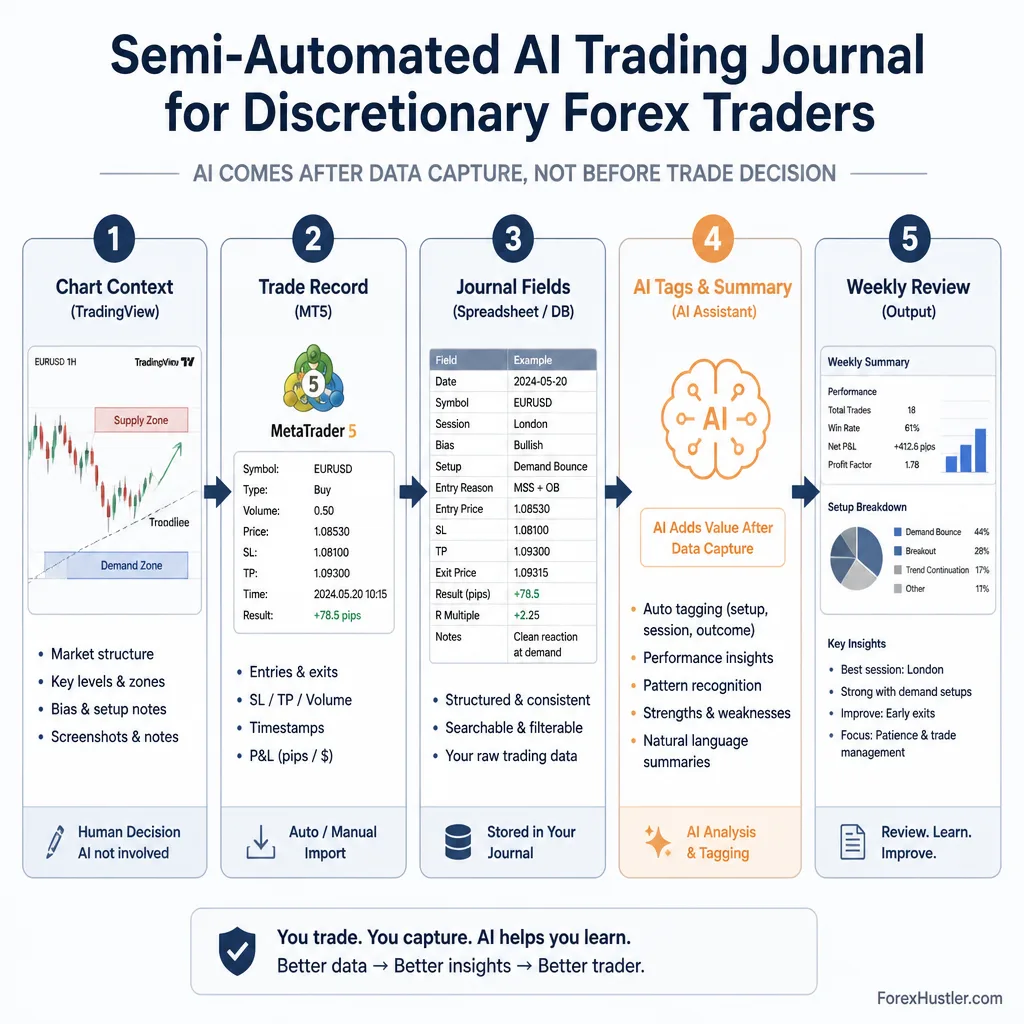
For most traders, the best setup is not fully automated. It is semi-automated and simple enough to survive real life.
A simple workflow that works
A practical stack looks like this:
- TradingView for chart analysis, screenshots, annotations, and alerts.[^1]
- MT5 for execution records, account history, and exportable reports.[^2]
- Google Sheets, Airtable, Notion, or a journal app for structured storage.
- An AI assistant for tagging, summarizing, and reviewing your notes.
That is enough.
You do not need code unless you want deeper MT5 integration through MetaQuotes Python tools, and most traders should not start there.[^3]
How AI can help without pretending to trade for you
This is where AI becomes genuinely useful:
- Turn messy notes into standardized tags
- Summarize long notes into short, searchable entries
- Classify mistakes such as “late entry,” “moved stop,” or “trade outside plan”
- Group trades by setup type, session, or behavior pattern
- Create a weekly summary of repeated strengths and errors
For example, if your raw note says:
“Took breakout after London open, but entered late after candle closed strong. Stop too wide. Felt like I was chasing because I missed first move.”
An AI assistant can turn that into:
- Setup: London breakout
- Mistake type: late entry, chasing
- Rule status: invalid if first trigger already missed
- Behavior tag: FOMO risk
That is not prediction. It is standardization. And standardization is what makes review possible.
Use an AI Copilot as a Pre-Trade Rule Enforcer
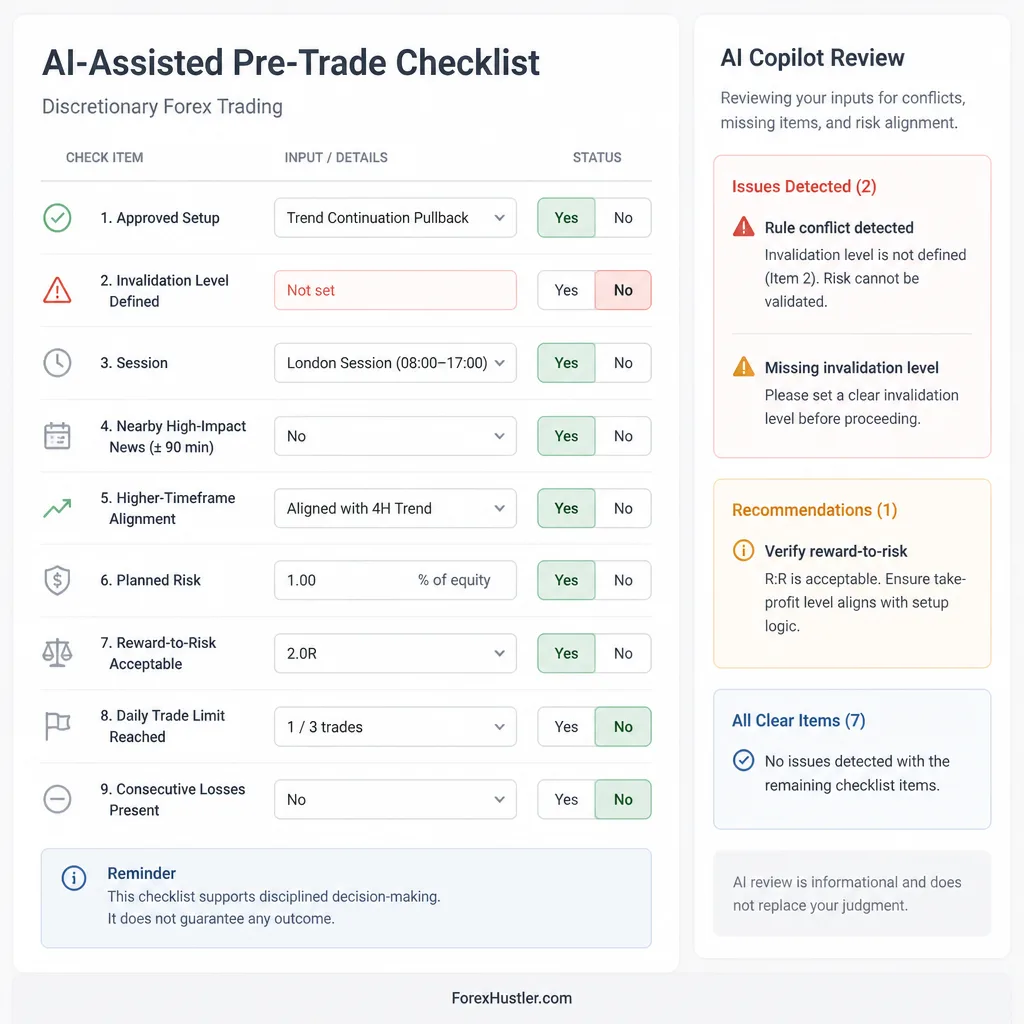
This is probably the highest-value use case.
A discretionary trader still makes the decision. The AI simply forces that decision through a written process first.
Turn your trading plan into a checklist
Your written plan should become a fixed checklist with yes/no or short-answer fields:
- Is this one of my approved setups?
- What is the invalidation level?
- What session is this?
- Is there high-impact news nearby?
- Does higher-timeframe structure support the idea?
- What is the planned risk?
- Is the expected reward worth the trade?
- Have I already hit my daily trade limit?
- Am I entering after consecutive losses?
Then use an AI prompt like this:
Based on this checklist and my trading plan, identify any rule conflicts, missing information, or reasons this trade does not qualify. Do not predict direction.
That last sentence matters.
Questions the copilot should force you to answer
A good pre-trade copilot should make vague thinking uncomfortable. It should ask:
- What exactly makes this setup valid?
- Which written rule allows this trade?
- What would make the trade invalid before entry?
- Is risk size within plan?
- Am I trading because the setup is present, or because I want action?
A trader may think they have a strategy problem when they really have a rule-enforcement problem. Someone complains that “breakout trades stopped working,” but the journal later shows half the losses came from entering after the breakout had already extended beyond the planned trigger zone.
That is not strategy decay. It is slippage in discipline.
Detect Overtrading and Revenge Trading With Simple Metrics
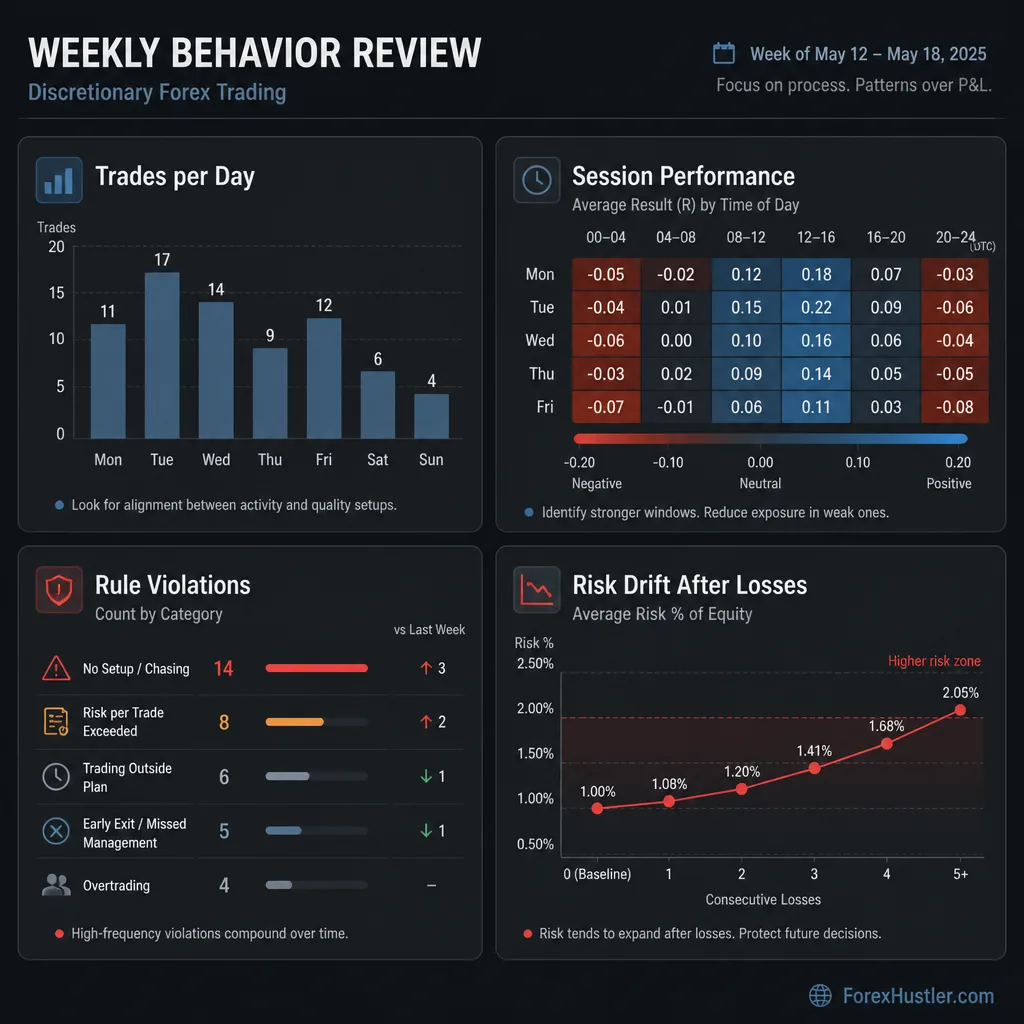
P&L hides a lot.
A green day can still contain bad trading. A red day can still reflect disciplined execution.
Metrics that reveal behavior better than profit
Track these weekly:
- trades per day
- trades per session
- time-of-day performance
- result by setup type
- consecutive losses before the next trade
- rule violations
- checklist completion rate
- deviation from planned risk
- mismatch between planned exit and actual exit
These patterns do not prove emotional state. They highlight behavior worth investigating.
What suspicious patterns look like
Overtrading can be defined operationally, not emotionally:
- more than your max daily trades
- trades outside approved hours
- setups not listed in your plan
- frequency increasing after losses
Revenge trading often shows up indirectly:
- a new trade entered minutes after a stop-out
- larger risk after a loss
- lower checklist compliance after a losing streak
- a sharp increase in low-quality setups late in the day
A useful example: a trader looks flat on the week and assumes the strategy is mediocre. The data says something else. London session trades were fine. Late New York trades gave back the gains. That is not necessarily an edge problem. It may be fatigue, boredom, or forced second-rate setups.
A Practical Weekly Review Process
Your weekly review should not become therapy or a motivational ritual. It should produce one useful correction.
What to review at the end of the week
Look at:
- total trades
- total R
- valid vs invalid trades
- top-performing setup
- weakest setup
- rule violations
- time-of-day breakdown
- trades taken after losses
- notes on exits and stop movement
Then ask the AI assistant:
- Which mistakes repeated most often?
- Which losses were valid and which were avoidable?
- Did any session or time window underperform?
- Did risk drift higher after losses?
- What one rule change would reduce the most damage next week?
Turn recurring mistakes into one rule change
The best weekly output is usually one process change, not five.
Examples:
- No London breakout entries if the initial trigger candle already traveled beyond my maximum entry distance.
- No new trade within 20 minutes of a stop-out.
- No trades after two consecutive losses in the same session.
- No entry without a screenshot and written invalidation level.
That is how review becomes operational.
What TradingView and MT5 Can Actually Help You Automate
This is where many articles overpromise. The platforms are useful, but not magical.
What TradingView can help with
TradingView is useful for:
- chart analysis
- saved layouts
- alerts
- annotations
- screenshots
- custom chart logic through Pine Script[^1]
You can use it to mark setup zones, capture chart context, and create alerts when price enters your area of interest. That reduces missed setups and messy screenshots.
What MT5 can help with
MT5 is stronger on the execution side:
- account history
- trade reports
- exportable records
- scripts and Expert Advisors
- optional Python integration for advanced users[^2][^3]
For most traders, the main value is simple: use MT5 as the record of what was actually executed, then combine that with chart context and behavior notes elsewhere.
What still needs human honesty
No platform can automate:
- whether your setup definition is good
- whether you are forcing trades
- whether your notes are truthful
- whether your rules are specific enough to audit
The hidden cost is not setup. It is maintenance. If the workflow is too complicated, you will stop using it.
The Limits: Garbage In, False Confidence, and Privacy Risk
This matters more than the tooling.
Bad data creates polished nonsense
If your screenshots are missing, your setup names keep changing, or your notes are vague, AI will still produce a neat summary. It just will not be a useful one.
Garbage in, garbage out still applies. AI only makes the garbage sound more convincing.
False confidence is a real risk
Language models are good at sounding certain. They can classify trades inconsistently, invent patterns, or overstate conclusions if your instructions are loose.
Treat AI output as an audit assistant, not a judge.
Privacy matters
If you upload screenshots, broker exports, account identifiers, or personal financial data to third-party AI tools, you create data-retention and confidentiality risk. Review the provider’s privacy terms and avoid sharing anything unnecessary.[^4]
This article is educational and workflow-focused, not financial advice.
Start Small: The Best AI Trading Workflow Is the One You Will Maintain
A beginner-friendly version you can implement this week looks like this:
- Use TradingView for screenshots and chart annotations
- Export or record trade details from MT5
- Store everything in a simple spreadsheet
- Add formulas for pip risk and R-multiples
- Use AI once per day to tag notes
- Use AI once per week to summarize behavior patterns
Do that for a month before adding anything else.
Only after the habit works should you add:
- more detailed tags
- session dashboards
- setup-type filters
- stricter checklist scoring
- optional automations or integrations
Consistency beats sophistication here. A simple journal you actually maintain is more valuable than an impressive system you abandon after ten days.
Conclusion
For discretionary forex traders, AI is most useful when it handles the work humans are bad at doing consistently: capturing data, standardizing notes, enforcing checklists, and surfacing patterns that memory misses.
That is less exciting than “AI predicts price.” It is also more honest.
If you want a practical edge, start by making your process harder to distort. Clean journal data, a pre-trade checklist, and a weekly review loop will not make you omniscient. But they can make you more consistent, more self-aware, and faster to correct expensive behavior.
In trading, that is often where real progress starts.
FAQ
Can AI help discretionary forex traders without generating trade signals?
Yes. Its most credible use is process support: journaling trades, tagging setups, checking rule compliance, summarizing weekly patterns, and highlighting possible behavior problems such as overtrading or risk drift.
What should I automate first in a forex trading workflow?
Start with trade capture and calculations. Record instrument, date and time, direction, entry, stop-loss, take-profit, planned risk, actual size, screenshot, and setup tag. Then automate formulas such as position size, pip risk, and R-multiples.
Can AI enforce my trading rules before I enter a trade?
It can help enforce them, but it should not replace your judgment. A useful setup is a pre-trade checklist where the AI reviews your answers against your written plan and flags rule conflicts, missing information, or disallowed conditions.
What metrics are useful for spotting overtrading or revenge trading?
Look beyond P&L. Useful metrics include trades per day, time-of-day or session performance, consecutive losses before a new entry, rule violations, deviation from planned risk, and whether checklist compliance drops after losses. These patterns suggest problems, but they do not prove emotional state.
What can TradingView and MT5 realistically automate?
TradingView can help with charting, alerts, annotations, screenshots, and custom logic through Pine Script. MT5 can help with execution records, account history, reports, scripts, Expert Advisors, and optional Python integration. Some context and self-assessment still need manual input.
What are the risks of using AI in a trading journal?
The main risks are bad input, false confidence, and privacy exposure. If your notes are vague or your rules are unclear, the output may look polished without adding much value. Uploading screenshots or account data to third-party AI tools also creates confidentiality and data-retention concerns.
Will an AI-assisted journal improve my trading results?
Not automatically. It may improve process visibility, consistency, and the speed of learning from mistakes, but there is no guarantee it will improve profitability. The real benefit is cleaner feedback, not magical forecasting.