Top 5 Day Trading Techniques in 2026: What Works, When, and Why
The real question is not which technique is best, but when it fits
Most struggling day traders are not using terrible setups. They are using decent setups on the wrong kind of day.
That matters even more in 2026. Markets across FX, indices, gold, and crypto can shift quickly between calm balance, clean expansion, and event-driven volatility. A strategy that looks excellent in replay can fail in live trading if the session, volatility regime, or instrument behavior does not support it.
So the useful question is not, “Which strategy works best?” It is, “What kind of day is this, and which technique is built for it?” That distinction separates forcing trades from trading with context.
This article compares five core day trading techniques—scalping, momentum, mean reversion, breakout, and news trading—through one practical lens: what each one is exploiting, when it tends to work, and how it usually fails.
A simple framework for choosing a day trading technique
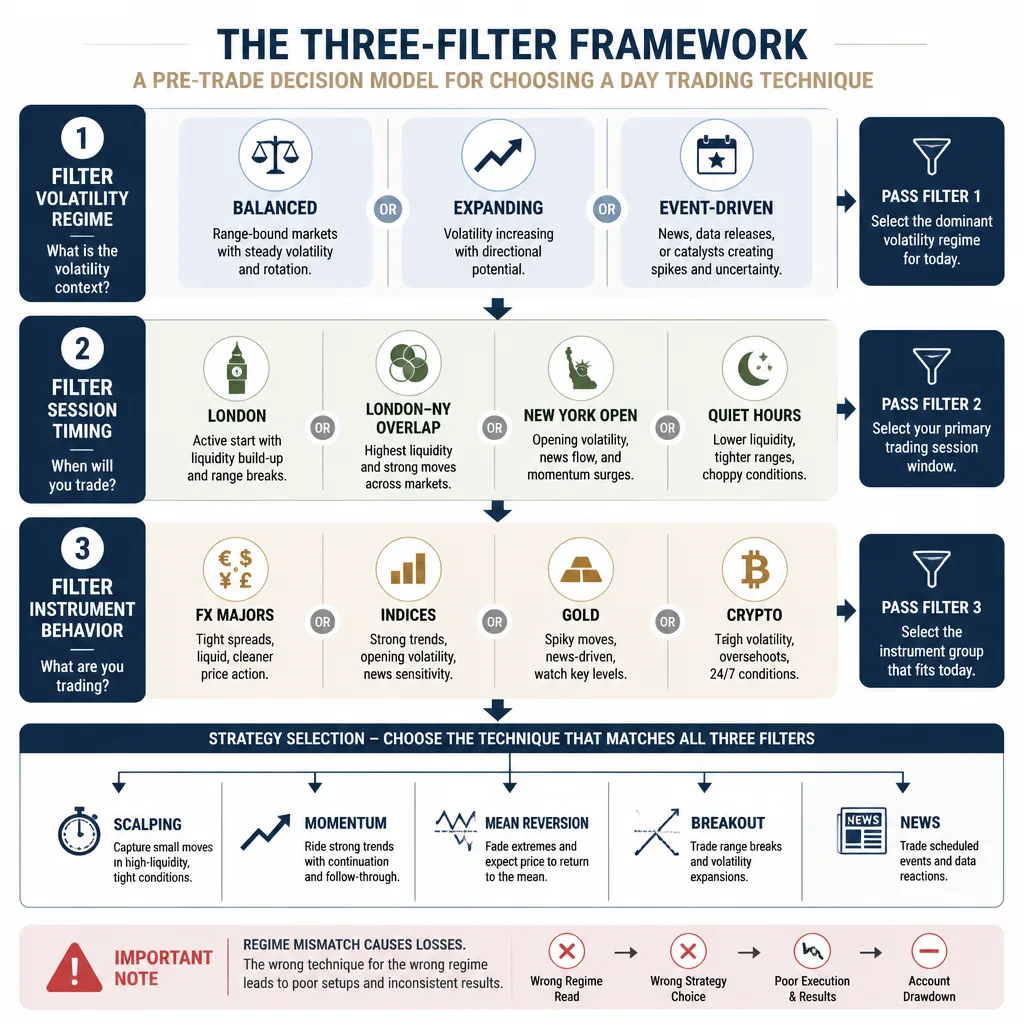
Before comparing strategies, use one simple mental model: match the technique to the regime.
Start with three filters: volatility, session, and instrument behavior
First, classify the volatility. Low-volatility compression is different from healthy directional expansion. Both are different again from unstable, headline-driven movement. Traders often lump them together because all three involve price movement. But not all movement is tradable in the same way.
Second, look at the session. London, the London–New York overlap, the New York open, and quiet off-hours produce very different price behavior. Session timing changes not only how much price moves, but how it moves.
Third, consider the instrument. EUR/USD during London is not the same environment as Nasdaq at the New York open, gold during overlap, or Bitcoin in a thin overnight window. Spread sensitivity, follow-through, and false-break behavior all change.
Why regime mismatch causes more losses than bad entries
A chart pattern can look perfectly valid and still fail because it is being used in the wrong environment.
A trader fading the edge of a mature EUR/USD range may do well for hours—until a real data catalyst hits and the pair starts repricing. The setup did not suddenly become bad. The regime changed.
That is why underperformance often comes from mismatch, not from a lack of chart patterns.
Scalping: best when movement is active but still two-sided
What scalping is really exploiting
Scalping is not just taking small profits. At its best, it exploits short-term order flow, bid-ask rotation, and repeated intraday micro-moves when liquidity is strong and execution costs remain controlled.
It is an execution-heavy style. A scalp that looks profitable on chart replay can become worthless once spread, fees, and slippage are included.
When scalping tends to work
Scalping usually works best when price is active, liquid, and still two-sided rather than chaotic. Think FX majors during London or the London–New York overlap, when spreads are often tighter and price rotates cleanly enough to create repeatable opportunities.
It can also work around the U.S. open in index products, but only if you can handle faster execution and avoid mistaking noise for signal.
Where it struggles and why it fails
Scalping edge disappears quickly when spread and slippage rise. That is the core risk.
It struggles in dead sessions, during unstable news spikes, and in instruments where the spread is too large relative to the target. It also fails when traders overtrade or try to scalp a one-way impulse that is better handled as momentum.
A common mistake in crypto is trying to scalp thin periods because the chart looks active. In reality, the movement is often too erratic, and execution friction eats the edge.
Momentum trading: strongest when participation expands in one direction
What momentum traders are looking for
Momentum is not buying green candles. It is trading expansion plus continuation.
The key idea is that new participants are entering in one direction, and price is not only moving fast but also holding gains and attracting follow-through. Clean pullbacks, strong relative strength or weakness, and acceptance above or below key intraday reference levels often matter more than the initial burst.
Best environments: trend days, directional opens, strong catalysts
Momentum tends to be strongest on trend days, directional opens, and catalyst-driven sessions.
A practical example: a U.S. index opens above a prior range after stronger-than-expected data, breadth expands, and the first pullback holds instead of collapsing. That is a much better momentum environment than a random morning spike with no continuation.
In FX, momentum can also work after a clean session break when a pair escapes overnight balance and holds above the breakout area instead of snapping back immediately.
Failure modes: chasing late, thin follow-through, exhaustion bursts
Momentum traders usually lose by arriving too late.
They chase the third or fourth extension leg, confuse short-covering with real demand, or assume a strong first candle guarantees continuation. Thin lunchtime conditions are especially dangerous because the chart can still look strong while participation has quietly dropped.
Mean reversion: powerful in ranges, dangerous in genuine expansion
Why mean reversion works when markets are balanced
Mean reversion works when the market is balanced and no fresh catalyst is forcing repricing. In those conditions, price often rotates back toward value because extremes keep getting rejected.
This is why mean reversion can feel statistically attractive. You may collect many small wins fading intraday extremes.
Where it tends to work: mature ranges, overextensions without fresh catalysts
It tends to work best in mature ranges and balanced sessions.
A simple example: EUR/USD stays inside the prior session’s value area into early Europe, there is no meaningful data release, and pushes to the edge of the Asian range keep failing. That is a better environment for fading extremes than for chasing breakouts.
Failure modes: fading real breakouts and fighting trend days
This is where traders get hurt. Mean reversion often looks safest right before a regime shift.
You can have six small winning fades, then give back several gains the moment the market stops balancing and starts expanding. The classic mistake is assuming every overbought or oversold move must snap back quickly.
It does not—especially when a true breakout is being accepted.
Breakout trading: best when compression gives way to real participation
What separates a valid breakout from a random poke
A breakout is not just price touching or briefly crossing a level. It is the transition from compression to expansion with evidence of acceptance.
The better clues are often visible before the break: repeated pressure on one boundary, a narrowing range, building tension around a major level, and then the ability to hold beyond that level once it breaks.
That is also the clearest difference between breakout and momentum trading. Breakout trades the transition. Momentum trades the continuation after expansion is already underway.
Where breakouts tend to perform best
Breakouts often perform best near session opens, after clear compression, or when a market has been coiling around an obvious level.
Gold is a good example. If it compresses below an intraday high during overlap and then breaks with sustained acceptance above the level, the better trade is often the hold after the break—not the first tick through resistance.
Failure modes: false breaks, liquidity grabs, and poor timing
False breaks are the obvious danger.
Markets often poke through visible highs and lows, trigger stops, and reverse. Traders also ruin good breakout ideas by entering too early before confirmation or too late after the reward-to-risk is gone.
Thin crypto hours are notorious for this. A level breaks, social chatter picks up, and then the move fades because there was never broad participation behind it.
News trading: potentially high opportunity, but execution risk is the whole game
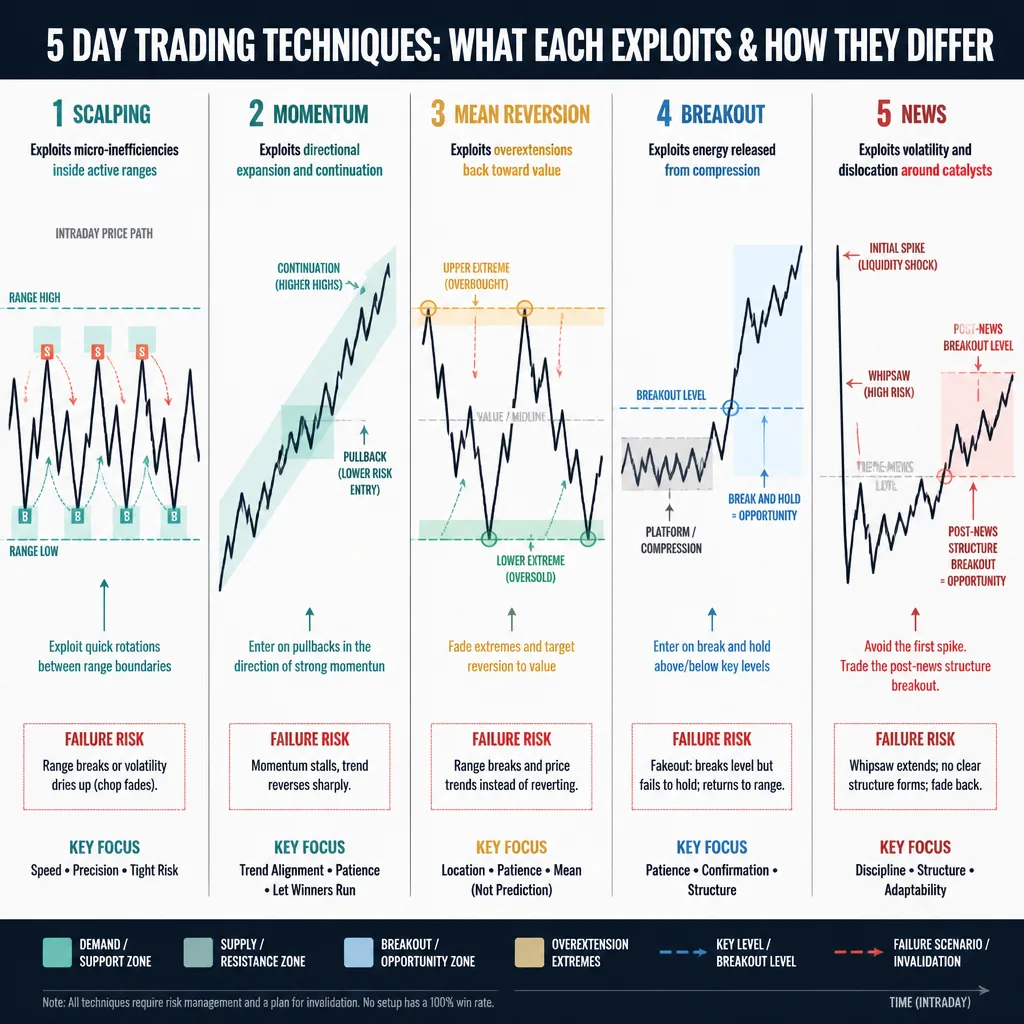
What news trading actually involves
News trading is not just faster breakout trading. It is trading repricing around information shocks.
That means execution risk becomes central. Spreads can widen sharply, fills can deteriorate, and the first move can be more about algorithmic reaction than clear directional opportunity.
When news creates tradable moves versus random noise
News is most tradable when the catalyst is clear, the deviation from expectations is meaningful, and the market shows a consistent interpretation after the first shock.
For many retail traders, the cleaner setup is not the initial spike but the post-news structure. For example, after a major central bank release, GBP/USD might whip both ways first. But once a small range forms after the spike, a break from that structure can be far more tradable than the first candle.
Failure modes: slippage, whipsaw, repricing, and headline misreads
This style fails through slippage, frozen execution, whipsaw, and plain misreading of the release.
That is why many retail traders are better off letting the first reaction pass. If your stop cannot be filled anywhere near where you expect, the setup may be untradeable even if the direction call is right.
Which technique fits which market condition?
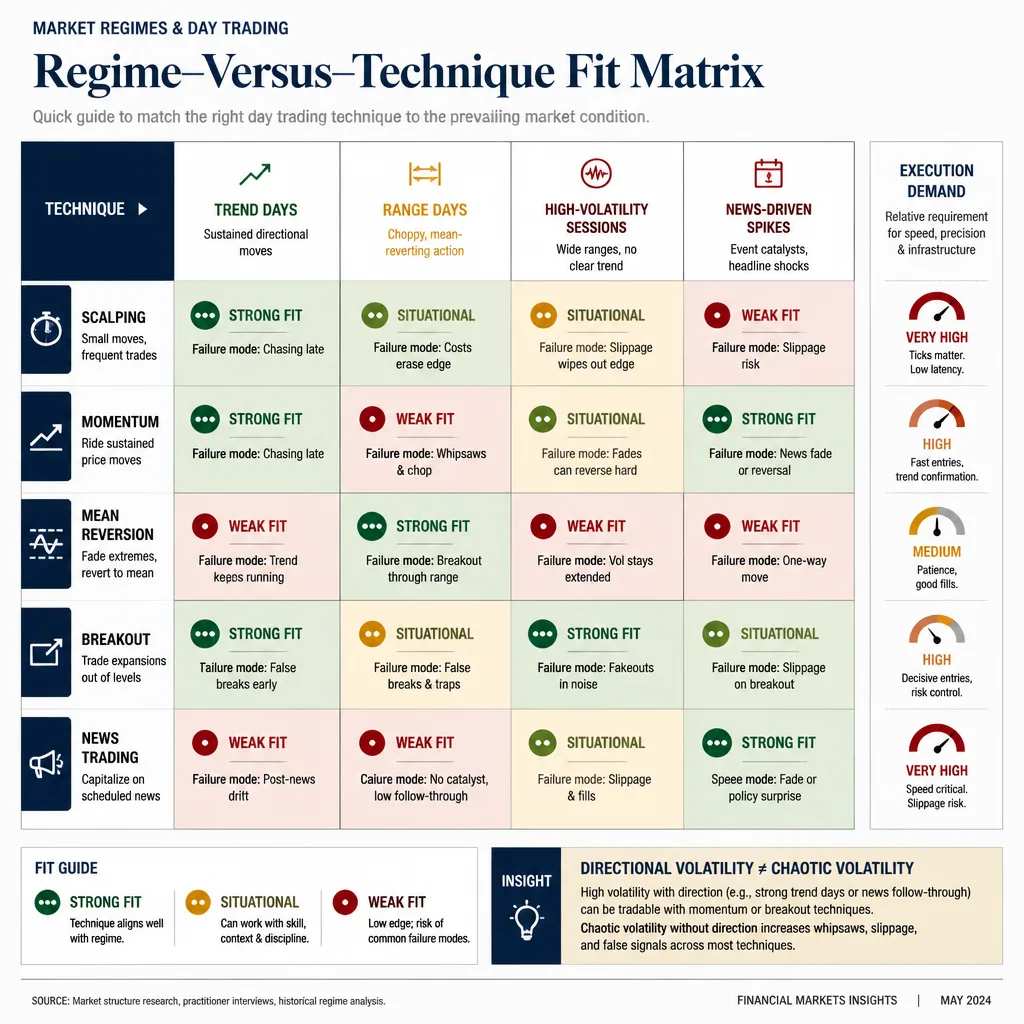
The easiest way to think about these five styles is to ask what problem each one is solving.
| Technique | What it exploits | Best conditions | Weak conditions | Common failure mode | Execution demands |
|---|---|---|---|---|---|
| Scalping | Short intraday rotations and micro-moves | Active, liquid, two-sided sessions | Dead hours, wide spreads, unstable spikes | Costs erase edge | Very high |
| Momentum | Expansion with continuation | Trend days, directional opens, strong catalysts | Choppy ranges, thin follow-through | Chasing late | High |
| Mean reversion | Rotation back toward value | Mature ranges, balanced sessions, no catalyst | Trend days, true repricing | Fading real expansion | Moderate |
| Breakout | Transition from compression to expansion | Session opens, coiled ranges, level pressure | Random range noise, thin markets | False breaks and bad timing | High |
| News trading | Repricing after information shock | Clear catalyst, post-spike structure | Mixed data, chaotic initial reaction | Slippage and whipsaw | Very high |
Trend days
Momentum is usually strongest here. Early breakout trades can also work well if the trend begins with a clean break from compression. Mean reversion is often the worst choice unless the trend clearly exhausts.
Range days
Mean reversion is generally strongest. Selective scalping can also work if the rotations are clean and costs stay low. Breakout trading is usually weakest unless the range starts transitioning into real expansion.
High-volatility sessions
The key question is whether volatility is directional or unstable. If it is directional and liquid, breakout and momentum can be excellent. If it is chaotic, many traders are better off reducing size or standing aside. Mean reversion becomes especially dangerous when volatility reflects genuine repricing.
News-driven spikes
Direct news trading carries the most execution risk. In practice, post-news breakout or momentum setups are often more realistic than trading the first spike. Pure mean reversion is usually the weakest response during the initial reaction.
How session timing changes the edge
London session and London–New York overlap
For FX majors and often gold, this is usually the cleanest window for scalping, breakouts, and structured momentum. Liquidity is broader, spreads are often tighter, and moves are more likely to carry.
A classic example is an Asian range in EUR/USD breaking during early London with real follow-through. That can favor breakout or momentum. If the range keeps rejecting both edges without a catalyst, mean reversion may be the better fit.
New York open and U.S. data releases
Indices often become much more tactical here. Opening drive behavior, fast momentum bursts, failed breakouts, and sharp reversals all become more common.
This is a session where momentum and breakout can work very well—but only if the opening volatility is orderly enough to read. Chaotic open conditions punish late entries quickly.
Quiet hours when the best trade may be no trade
Some of the worst losses come from forcing breakout or momentum setups in lifeless conditions.
If the market is drifting, spreads are less favorable, and participation is thin, “no trade” is not a missed opportunity. It is good strategy selection.
Instrument matters: the same technique behaves differently across markets
FX majors
FX majors often respond well to session-based logic. Breakout and mean reversion can both work, depending on whether the market is balanced or transitioning after a catalyst. Tight spreads during liquid hours also make them friendlier to selective scalping.
Indices
Indices often reward momentum and breakout trading around the U.S. open and after major U.S. data. But they can punish late chasing because reversals can be violent once the opening impulse matures.
Gold
Gold tends to overshoot levels more aggressively than many FX pairs. That makes both breakout continuation and false-break reversals more violent. Tight stops that work in EUR/USD often make less sense here.
Crypto
Crypto offers opportunity around the clock, but that comes with thinner periods and more false breaks outside peak participation. Breakout traders usually need stronger confirmation, and scalpers need to be especially honest about slippage and spread.
A practical pre-session decision process
Step 1: Classify the day before the open
Before the session starts, ask: is this likely to be a balanced, expanding, or event-driven day?
Use the calendar, overnight range behavior, recent volatility, major levels, and whether the instrument has shown directional conviction or repeated balance.
Step 2: Match one primary technique and one backup
Pick one primary technique that fits the expected regime, and one backup if the market shifts.
For example, you might start a quiet FX morning with mean reversion as the primary plan and breakout as the backup only if a data release creates genuine acceptance outside the range. That is very different from randomly switching styles after every loss.
Step 3: Define the condition that invalidates your plan
This is where discipline becomes real.
If you are planning mean reversion, define what tells you the market is no longer balanced. If price breaks from value after a catalyst and holds outside it, stop fading extremes. If you planned momentum and pullbacks are failing instantly, you may not have the continuation you expected.
Predefined invalidation beats emotional adaptation.
The technique is only half the edge
The top five day trading techniques in 2026 are not competing for one crown. Each fits a different environment.
Scalping needs clean execution and active two-sided flow. Momentum needs expansion and follow-through. Mean reversion needs balance. Breakout needs compression turning into acceptance. News trading needs a clear catalyst—and even then, many retail traders are better off trading the structure after the initial shock.
The main takeaway is simple: the edge is not choosing the most exciting strategy; it is choosing the strategy that matches the day. Build a small pre-session decision tree, define what cancels your plan, and get comfortable doing nothing when conditions do not support your method.
FAQ
What are the top 5 day trading techniques in 2026?
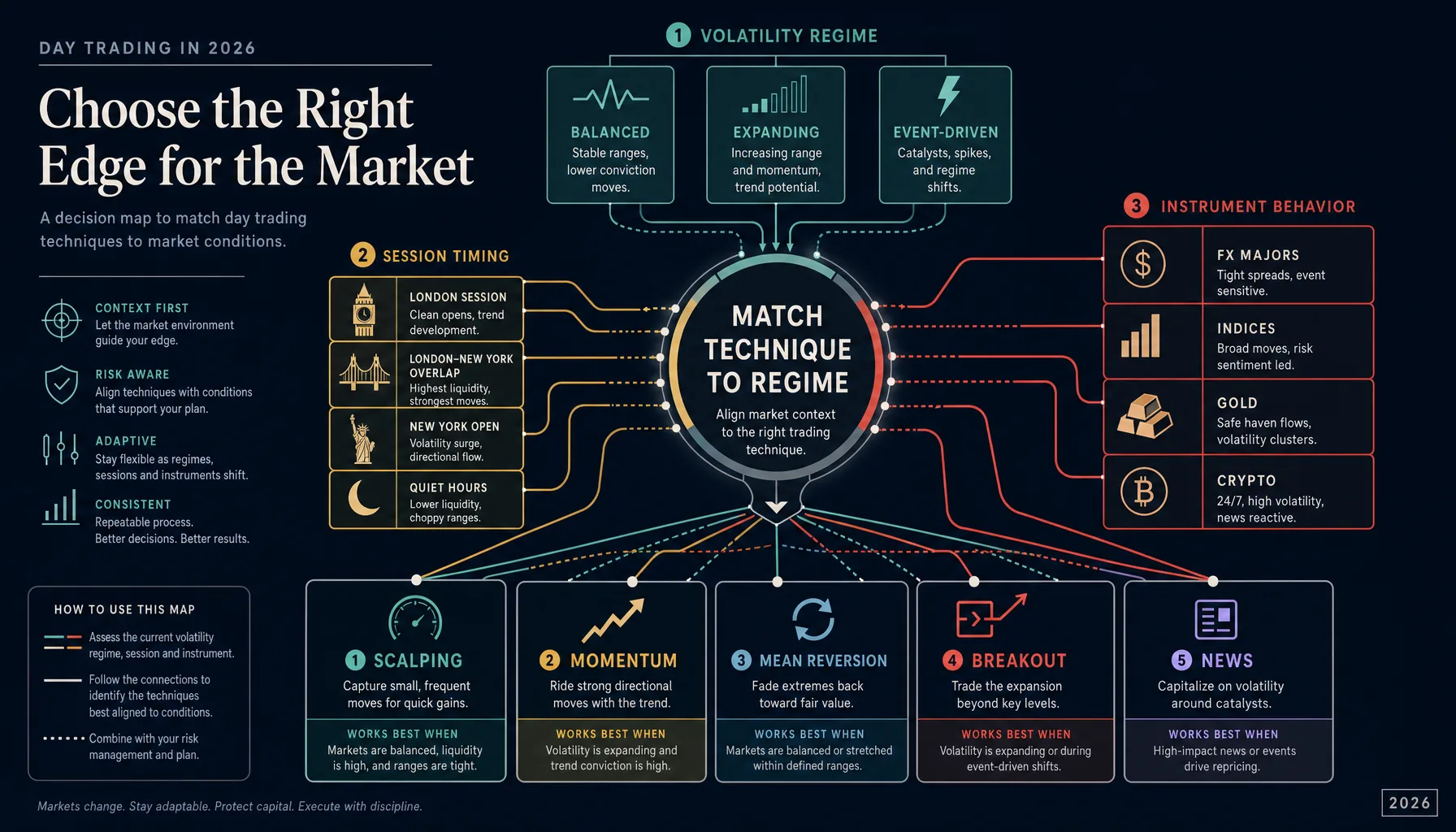
The five techniques compared here are scalping, momentum trading, mean reversion, breakout trading, and news trading. The important point is that each works best in a different market environment rather than across all conditions.
Which day trading technique works best on a trend day?
Momentum trading is usually the best fit on a trend day because it is designed to capture expansion and continuation. Breakout trading can also work well early in the move, while mean reversion is often the weakest choice unless the trend clearly loses participation.
Which day trading technique works best in a range market?
Mean reversion is generally strongest in a balanced range because price tends to rotate back toward value. Selective scalping can also work inside stable intraday rotations, while breakout trades usually struggle unless the range begins transitioning into genuine expansion.
How is scalping different from momentum trading?
Scalping focuses on short-term micro-moves, repeated rotations, and execution efficiency. Momentum trading depends on directional expansion and follow-through, not just quick price movement. Scalping can work in active two-sided markets, while momentum needs sustained participation in one direction.
What is the difference between breakout trading and momentum trading?
Breakout trading is about the transition from compression to expansion, usually around a well-defined level or range. Momentum trading comes after expansion is already underway and focuses on continuation. Traders often confuse the two, but they solve different market problems.
When does mean reversion have an edge?
Mean reversion tends to work best when the market is balanced, no fresh catalyst is forcing repricing, and extremes keep getting rejected. It becomes dangerous when a true breakout or trend day is developing, because several small wins can be erased by one regime shift.
Why do good-looking setups still fail in live trading?
A setup can look valid on the chart but still fail because it is being applied in the wrong regime. Many traders do not lose because the pattern is bad. They lose because they use a range tactic on a trend day, a breakout tactic in dead conditions, or a scalping tactic when spreads and slippage are too high.
How should I choose a day trading technique before the session starts?
Use three filters before the open: volatility, session timing, and instrument behavior. First classify the day as balanced, expanding, or event-driven. Then choose one primary technique and one backup, and define the condition that would invalidate your plan so you do not switch strategies impulsively.
Which day trading techniques tend to work best during the London and New York overlap?
The London–New York overlap often supports scalping, breakout trading, and momentum trading because liquidity is broader and execution is usually cleaner, especially in FX majors and gold. Mean reversion can still work, but only if the market remains balanced rather than shifting into directional expansion.
Is news trading suitable for most retail traders?
Usually not during the initial spike. News trading involves slippage, fast repricing, wider spreads, and headline risk. For many retail traders, the cleaner opportunity comes after the first reaction, when a post-news structure forms and the market shows clearer acceptance or rejection.
How does strategy choice change across FX, indices, gold, and crypto?
FX majors often respond well to session-based breakout or mean reversion setups depending on the catalyst backdrop. Indices often reward momentum and opening-drive trades near the U.S. open. Gold tends to overshoot levels more aggressively, which affects both breakout and reversal setups. Crypto can offer opportunity around the clock, but thin periods often produce false breaks and worse execution.
What is the best day trading strategy for beginners?
There is no universal best strategy for beginners, but simpler approaches with clear context usually help most. Many newer traders do better by learning one or two techniques and matching them to obvious conditions instead of trying to trade all five styles every day.