Choosing What to Trade for a Living: Forex vs Indices vs Crypto
Most traders make this decision backwards. They choose a market because it looks exciting, is popular on social media, or because they saw someone post a huge winning trade. That usually leads to poor fit, not a durable trading business.
If you want to trade for a living, the real question is not which market moves the most. It is which market gives you the most repeatable opportunities during the hours you can actually trade, with costs and volatility you can realistically handle.
This guide compares forex, indices, and crypto through a practical decision framework. You will look at session timing, volatility, spreads and fees, news risk, liquidity, and capital fit. At the end, you will have a simple way to choose one market to focus on.
How to choose what to trade for a living
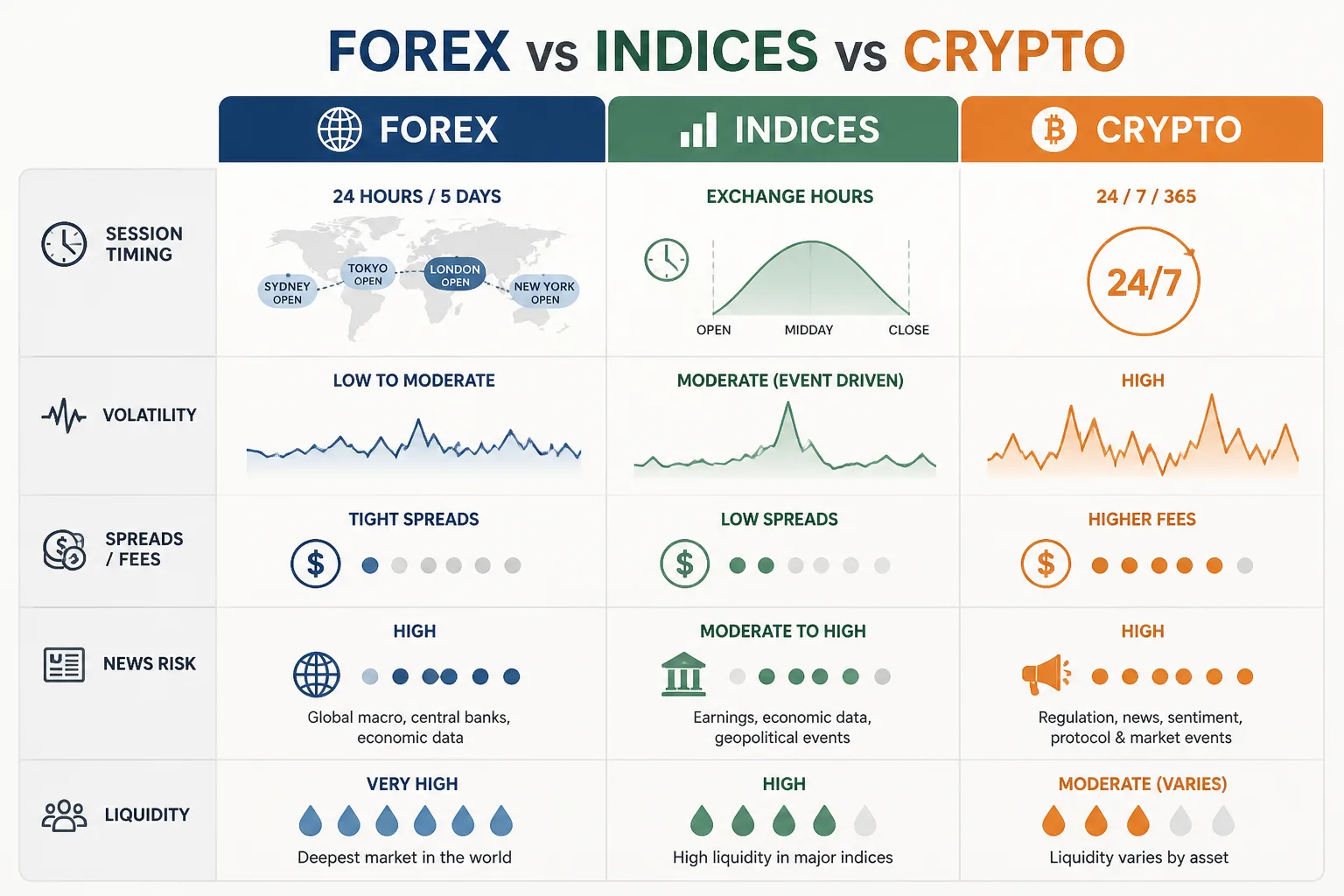
Choosing a market is really choosing a business environment.
Forex, indices, and crypto do not just move differently. They require different trading hours, different emotional control, different tolerance for fast repricing, and different awareness of costs.
A good fit increases the number of setups you can actually observe, execute, and review. A bad fit leads to forced trades, missed entries, poor timing, and inconsistent results.
So instead of asking, “Which market is best?” ask:
Which market fits my schedule, capital, tolerance for volatility, and execution style well enough to trade consistently for months?
That is the question that matters.
Start with the life you are actually able to trade
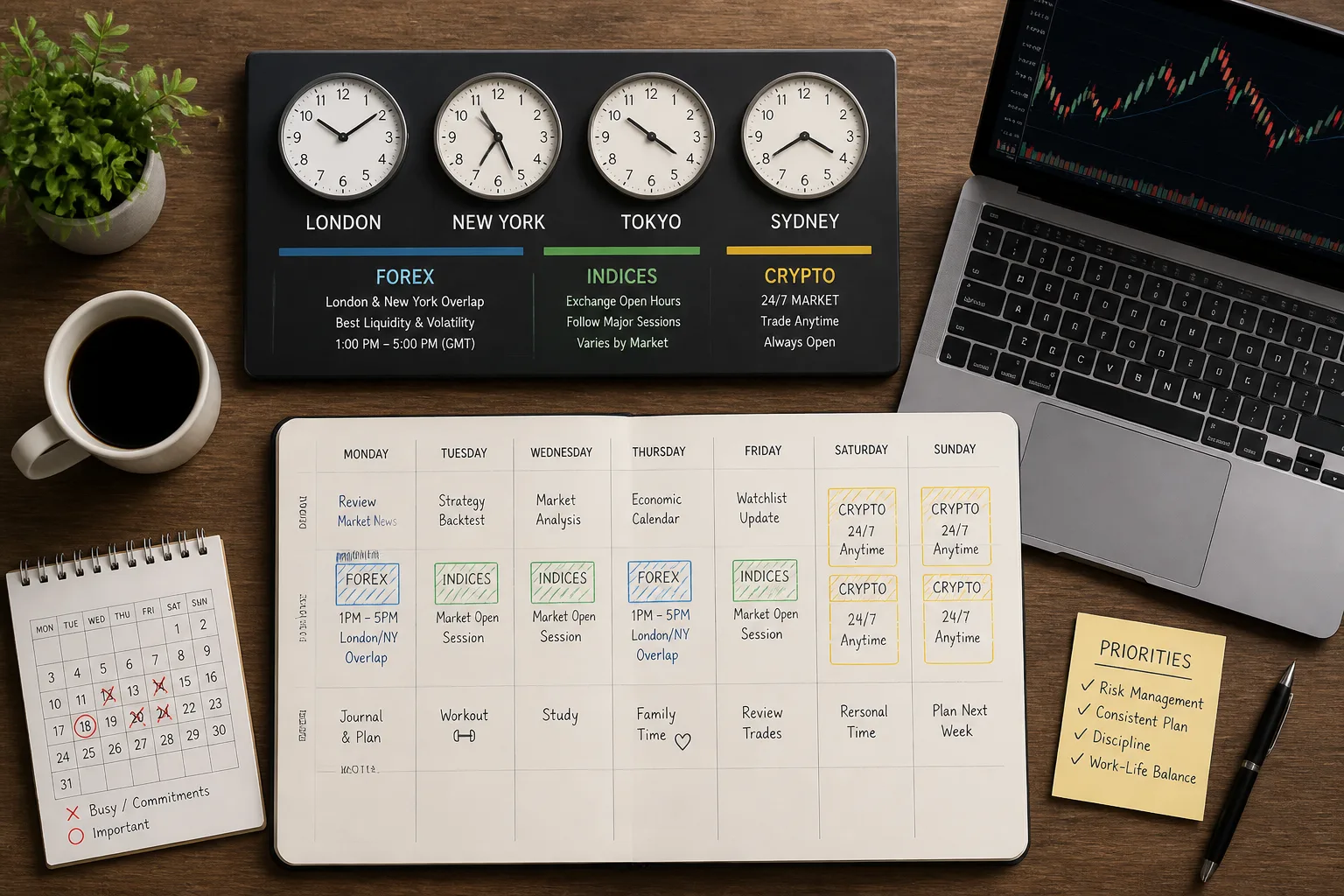
Before you compare charts, compare constraints.
If your schedule is fixed, market hours matter more than strategy
A trader in Europe who can watch the London session and the London/New York overlap has access to some of the best forex conditions of the week. Major pairs like EUR/USD and GBP/USD often show tighter spreads and cleaner movement during those windows.[^1]
A US trader with only 90 minutes around the cash open may find indices more practical. Instruments tied to the S&P 500 or Nasdaq 100 often deliver concentrated movement around the open and major macro events.[^2]
A shift worker with irregular free time may struggle in both environments. For that trader, crypto’s 24/7 access may be more than convenient. It may be the only market they can observe consistently.
If you need income consistency, execution quality matters more than excitement
Fast movement looks attractive until you have to execute inside it.
For someone trading for income, a slightly slower market with deeper liquidity can be better than a highly reactive market that creates constant slippage and emotional mistakes. That is why many traders do better in liquid forex majors or major index products than in thin altcoins or exotic currency pairs.
A clean setup you can execute repeatedly is worth more than dramatic volatility you cannot manage.
If your capital is limited, costs matter immediately
Small accounts feel every friction.
Forex often looks accessible because many brokers offer micro lots, which makes position sizing more flexible. Indices can be traded through smaller products such as micro futures or CFDs, but sizing still needs care because the underlying products can move quickly. Crypto allows fractional sizing, but fee drag, spread, funding rates, and slippage can quietly damage expectancy, especially in perpetual futures.
Limited capital does not just reduce your size. It makes bad market selection more expensive.
The five factors that should decide your market
1. Session timing and when real movement happens
Not every trading hour is equally useful.
In forex, the clearest intraday activity often appears during the London session and the London/New York overlap. Outside those windows, major pairs can become slow and range-bound. That may suit patient traders, but it frustrates traders who need movement quickly.
In indices, meaningful movement often clusters around the cash open, close, and major economic releases. US index futures trade nearly around the clock on weekdays, but overnight activity does not behave like the regular cash session. A trader who confuses “available” with “tradable” usually learns that the hard way.
In crypto, the market is always open, but quality still varies. BTC and ETH may trade well during active regional participation, while weekends or thin overnight periods can behave very differently. Constant access helps only if you can impose structure on it.
Deal-breaker test: If you are rarely available during a market’s best hours, it is probably not your best choice.
2. Volatility and how much movement you can handle
Volatility helps only if you can survive it.
Forex majors often move at a more measured pace than many crypto assets, though major macro events like CPI releases or central-bank decisions can still cause violent repricing. Indices tend to produce concentrated bursts of movement, especially around opens and data releases. Crypto ranges from relatively manageable in BTC and ETH to chaotic in lower-liquidity altcoins.
A practical example: a calm trader who prefers planned entries and measured execution may do well in EUR/USD during active sessions, but struggle with the speed of the Nasdaq open. Another trader with only one hour available and a need for immediate movement may prefer indices.
The right question is not, “Which market moves more?” It is, “Which market moves in a way I can actually trade?”
3. Spreads, fees, and the cost of being wrong
Costs set your breakeven distance.
In forex, major pairs often offer competitive spreads, but the total cost still depends on broker model, commission, and time of day. Trading EUR/USD during active hours is not the same as trading it during quiet rollover conditions.
In indices, costs depend on product choice. Futures can offer transparent pricing and strong liquidity, while CFDs may be easier for smaller traders but can come with wider spreads or overnight financing.
In crypto, traders often underestimate the full cost stack: spread, exchange fee, funding rates in perpetual futures, slippage, and sometimes withdrawal costs. A small-account trader who scalps lower-liquidity altcoins can read direction correctly and still lose because costs consume too much of the move.
In a high-cost environment, even small mistakes get punished harder.
4. News risk and how quickly the market can reprice
Some markets punish being early more than others.
Forex is highly sensitive to central banks, inflation reports, labor data, and geopolitical surprises. A technically clean GBP/USD setup can fail instantly if spreads widen ahead of a Bank of England decision or US CPI release.
Indices also react fast to macro data, Treasury yield shifts, and broader risk sentiment. A strong-looking Nasdaq setup can be invalidated in seconds by a hotter-than-expected inflation print.
Crypto follows a different news pattern. It reacts to regulation headlines, ETF news, exchange events, stablecoin stress, and liquidation cascades. The added complication is timing: some of these moves happen when traditional markets are closed or when depth is thinner.
If your strategy depends on a stable intraday rhythm, news sensitivity matters a lot.
5. Liquidity and how clean your execution is likely to be
Liquidity affects more than fills. It affects whether your whole strategy behaves as expected.
Major forex pairs such as EUR/USD and USD/JPY are among the deepest retail-accessible markets during active sessions.[^1] Major index futures are also highly liquid, especially during US hours.[^2] BTC and ETH can be reasonably liquid on top venues, but that should not be generalized to all of crypto. Conditions in lower-cap coins can be dramatically worse.
A common beginner mistake is saying “I trade crypto” as if BTC and a thin altcoin are the same environment. They are not.
If you need technical levels to hold reasonably well, stops to execute cleanly, and slippage to stay manageable, liquidity should sit near the top of your decision process.
How these markets differ in practice
Forex: best for traders who want structure and deep liquidity
Forex suits traders who value routine. The week has a rhythm, and some sessions matter much more than others. Major pairs often offer cleaner execution during active hours.
This works well for traders who can show up consistently during London or the overlap, and who prefer liquid instruments over dramatic spikes.
The hidden drawback is that forex can become unproductive outside active sessions. Many traders force entries during slow periods simply because they are at the screen.
Indices: best for traders who want concentrated movement
Indices suit traders who prefer shorter windows with clear movement.
If you are available around the US cash open, or you like reacting to major macro catalysts, indices can offer efficient opportunity. You do not need to sit all day waiting for range expansion if your market often moves decisively in the first hour.
The hidden drawback is speed. Liquid does not mean easy. The S&P 500 or Nasdaq can move fast enough around the open to punish hesitation, poor entries, and weak risk control.
Crypto: best for traders who need flexibility
Crypto suits traders who genuinely need access outside standard market hours.
That flexibility is real. If your schedule changes weekly, crypto may be the most practical market to study and trade. BTC and ETH are usually the cleanest place to start.
The hidden drawback is uneven quality. There is no natural close forcing you to stop. Many traders end up over-monitoring and overtrading. Add funding costs and thinner conditions in weaker pairs, and flexibility can quickly turn into noise.
A simple decision matrix
Use this as a fit score, not an absolute ranking.
| Trader factor | Forex | Indices | Crypto |
|---|---|---|---|
| Available during London or London/NY overlap | 5 | 3 | 3 |
| Available mainly around US cash open | 3 | 5 | 3 |
| Irregular schedule / nonstandard hours | 2 | 2 | 5 |
| Prefers structured weekday routine | 5 | 4 | 2 |
| Tolerates fast, concentrated volatility | 3 | 5 | 4 |
| Needs deep liquidity and cleaner execution | 5 | 4 | 3 |
| Small account needing flexible sizing | 4 | 3 | 4 |
| Sensitive to fees and execution friction | 4 | 3 | 2 |
| Comfortable with weekend / overnight exposure | 2 | 3 | 5 |
How to use it
- Score each row based on how important it is to you.
- Add the totals.
- Review your two lowest sub-scores.
- If one low score is a true deal-breaker, choose the runner-up market instead.
A market can win on total points and still be wrong for your life.
Three example profiles
1. Europe-based trader with access to London and the overlap
Best fit: Forex
Runner-up: Indices
Why: The schedule aligns with the strongest FX windows. Execution quality is often solid in major pairs, and the trader can build routine around repeating session behavior.
2. US trader with only 2 hours around the open
Best fit: Indices
Runner-up: Forex
Why: This trader benefits from concentrated movement. Forcing a forex style that depends on different session timing may reduce opportunity.
3. Trader with an irregular schedule and higher uncertainty tolerance
Best fit: Crypto
Runner-up: Forex
Why: Access matters most here. But the trader should start with BTC and ETH, avoid thin altcoins, and create fixed personal trading windows to prevent overtrading.
What the wrong market choice looks like
Trading a market that does not match your hours
A trader with a morning job tries to trade the US index open from a phone between meetings. The issue is not talent. It is environmental mismatch. They miss the clean opening move, chase late, and spend the rest of the day managing poor entries.
A better fit might be forex during an earlier session, or no intraday trading at all until the schedule changes.
Choosing volatility you cannot execute through
A trader moves from EUR/USD to the Nasdaq because the index “moves more.” But every normal pullback feels dangerous, so they cut trades too early and hesitate on re-entry.
The problem is not that indices are bad. The problem is that the trader chose a pace they cannot handle consistently.
Ignoring cost structure until expectancy breaks down
A small-account trader starts scalping altcoins because the charts look explosive. After fees, spread, and slippage, the account slowly bleeds even when direction is often read correctly.
In that case, the answer may not be quitting crypto entirely. It may be narrowing the universe to BTC or ETH, trading less often, or moving to a lower-friction market.
A practical rule for making the final choice
Pick the market that gives you the most repeatable good conditions
The best market is not the one with the most movement on paper.
It is the one that regularly gives you usable setups during the hours you are available, with execution quality and costs that do not destroy your edge.
If two markets look equally attractive, choose the one with lower execution friction and clearer session structure first. Early on, consistency usually beats optionality.
Test one market deeply before adding another
A simple workflow works better than endless comparison:
- Choose one candidate market.
- Observe or simulate 20 to 30 sessions.
- Log when the best movement happens.
- Note spreads, fees, slippage, and news behavior.
- Record your own focus and execution quality.
- Review whether the market fits your real life.
Ask yourself:
- Did I see tradable movement when I was available?
- Were costs manageable for my strategy?
- Did news behavior help or hurt my edge?
- Was execution stable enough to trust the results?
That is how to choose a market based on evidence, not online opinion.
Conclusion
The choice between forex, indices, and crypto is not about finding the most exciting chart. It is about finding a market environment you can work with consistently.
Forex often fits traders who want structured sessions and deep liquidity. Indices often fit traders who want concentrated movement around opens and macro events. Crypto often fits traders who need 24/7 access and can impose their own structure.
Use the matrix. Choose one market. Test it under your real schedule, not your ideal schedule.
That is what gives you a real chance of building something repeatable.
FAQ
What is the best market to trade for a living: forex, indices, or crypto?
There is no single best market in the abstract. The best choice is the one that matches your trading hours, tolerance for volatility, capital, and ability to execute consistently. Forex often suits traders who can access structured weekday sessions, indices fit traders who prefer concentrated movement around opens, and crypto fits traders who need 24/7 access and can handle less even conditions.
How do I choose between forex, indices, and crypto?
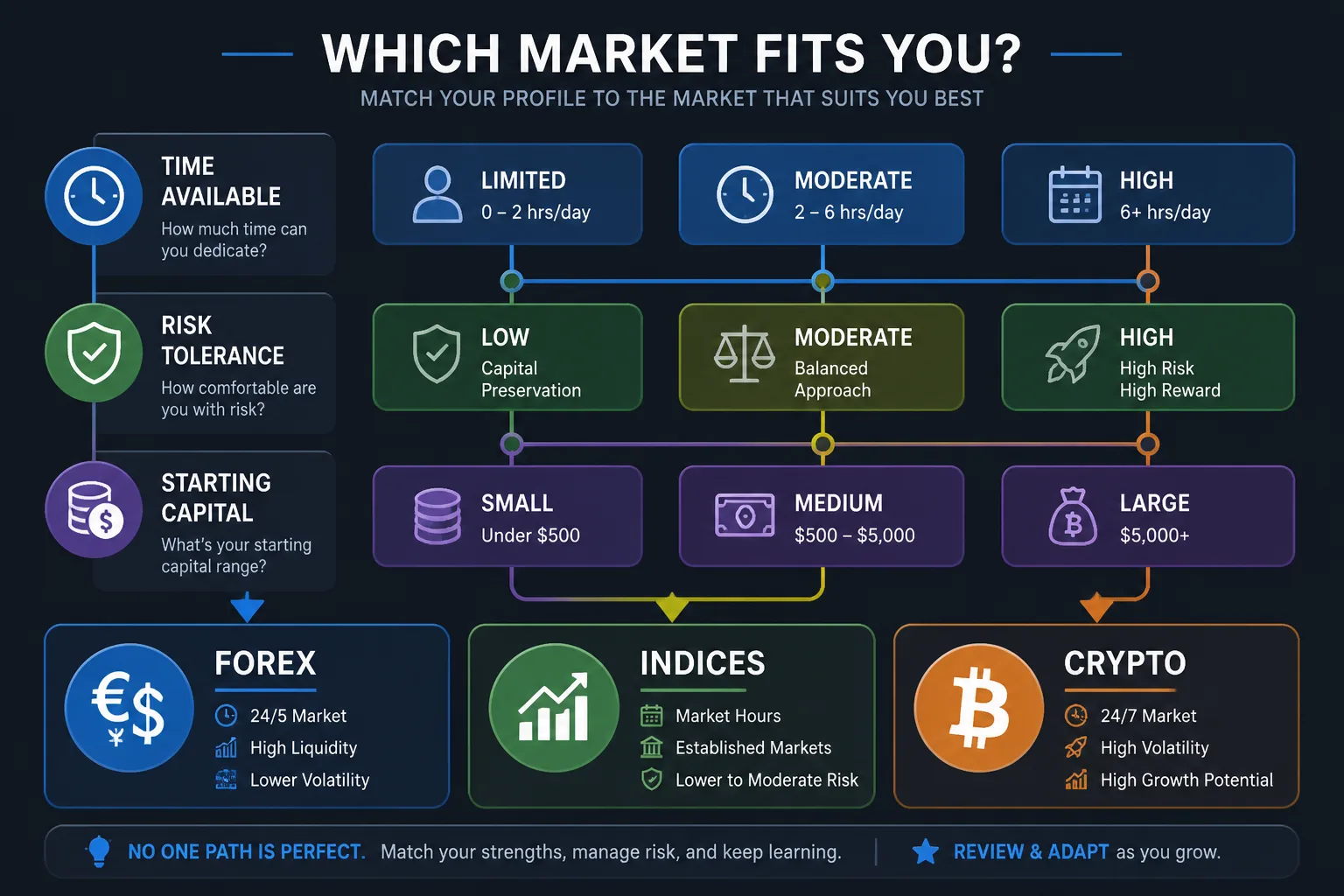
Start with fit, not excitement. Compare each market across session timing, volatility, spreads and fees, news risk, liquidity, and capital requirements. Then score each one based on your real schedule and trading style. If one factor is a deal-breaker, such as being unavailable during active hours, eliminate that market even if it looks attractive overall.
Is forex better than crypto for beginners?
Not always, but forex is often easier to structure around because major pairs usually have deep liquidity and clearer active sessions during the business week. Crypto offers more flexibility, but 24/7 access, uneven liquidity across coins, and fee drag can make it harder for beginners to stay selective and disciplined.
Are indices better for day trading than forex?
They can be, especially if you only have a short trading window around the cash open or major macro releases. Indices often deliver concentrated movement in a narrow time block. Forex may be a better fit if you want deep liquidity and more session-based structure, especially during London or the London/New York overlap.
What matters more when choosing a market to trade: volatility or liquidity?
For most traders trying to build consistency, liquidity matters first because it affects fills, slippage, and whether setups behave cleanly enough to repeat. Volatility creates opportunity, but only if you can size positions correctly and execute through normal price swings without panicking.
How much starting capital do I need for forex, indices, or crypto?
It depends more on the product and strategy than on the market name alone. Forex can be accessed with micro lots, indices may require more care because contract values can be larger unless you use smaller products, and crypto allows fractional sizing but can become expensive if volatility and fees are high. A small account can participate in any of the three, but limited capital increases the pressure to overleverage, which makes market choice more important, not less.
Why do many traders choose the wrong market?
A common mistake is choosing a market because it looks exciting on social media or because someone else trades it successfully. That ignores session fit, execution quality, and cost structure. A market can move a lot and still be a poor fit if you are never available during its best hours or if its normal volatility is too large for your account and psychology.
What is a practical way to test market fit before committing?
Pick one market and track 20 to 30 sessions. Log when the best movement happens, how spreads or fees behave, how often news disrupts your setups, and whether you can stay focused during the key windows. If the market consistently gives you good conditions when you are actually available, it is a stronger candidate for specialization.