Forex Correlations in Practice: How to Use DXY, US10Y, Gold, and Oil Without Overcomplicating Trades
Many traders know correlations matter, but in practice they fall into one of two traps. They either ignore them and trade only the chart, or they open a stack of macro tabs and end up with more noise than clarity.
The goal is much simpler. You do not need to become a macro analyst. You just need a fast way to judge whether the broader market is supporting your trade, pushing against it, or not relevant at all.
That is where a small set of proxies helps. If you understand what DXY, US10Y, gold, and oil usually signal, you can filter weaker setups and choose cleaner pair expressions without turning every trade into an intermarket research project.
In this article, you’ll get a simple framework you can use in about two minutes before entry: the 4-Proxy Pre-Trade Check.
Why Traders Need a Simpler Correlation Framework
The real issue: too much information, not enough usable context

Most traders do not have an information problem. They have a decision problem.
They can see DXY moving, yields ticking, gold reacting, and oil selling off. They can also read endless commentary explaining each move in real time. But none of that helps if they still cannot answer one basic question:
Does this market context support the trade I’m about to take?
That is the practical use of correlations. Not prediction. Not certainty. Better filtering.
Key Insight: Correlations are most useful when they keep you out of low-quality trades, not when they give you a reason to force one.
What this article will help you do
By the end, you should be able to:
- understand what each proxy tends to signal
- identify which proxy matters most for a setup
- separate confirmation, contradiction, and noise
- use a simple pre-trade process before entering USD-related trades
- choose the cleaner pair to express a view
Bottom Line: The point of correlation work is not to add complexity. It is to improve trade selection.
What DXY, US10Y, Gold, and Oil Usually Represent
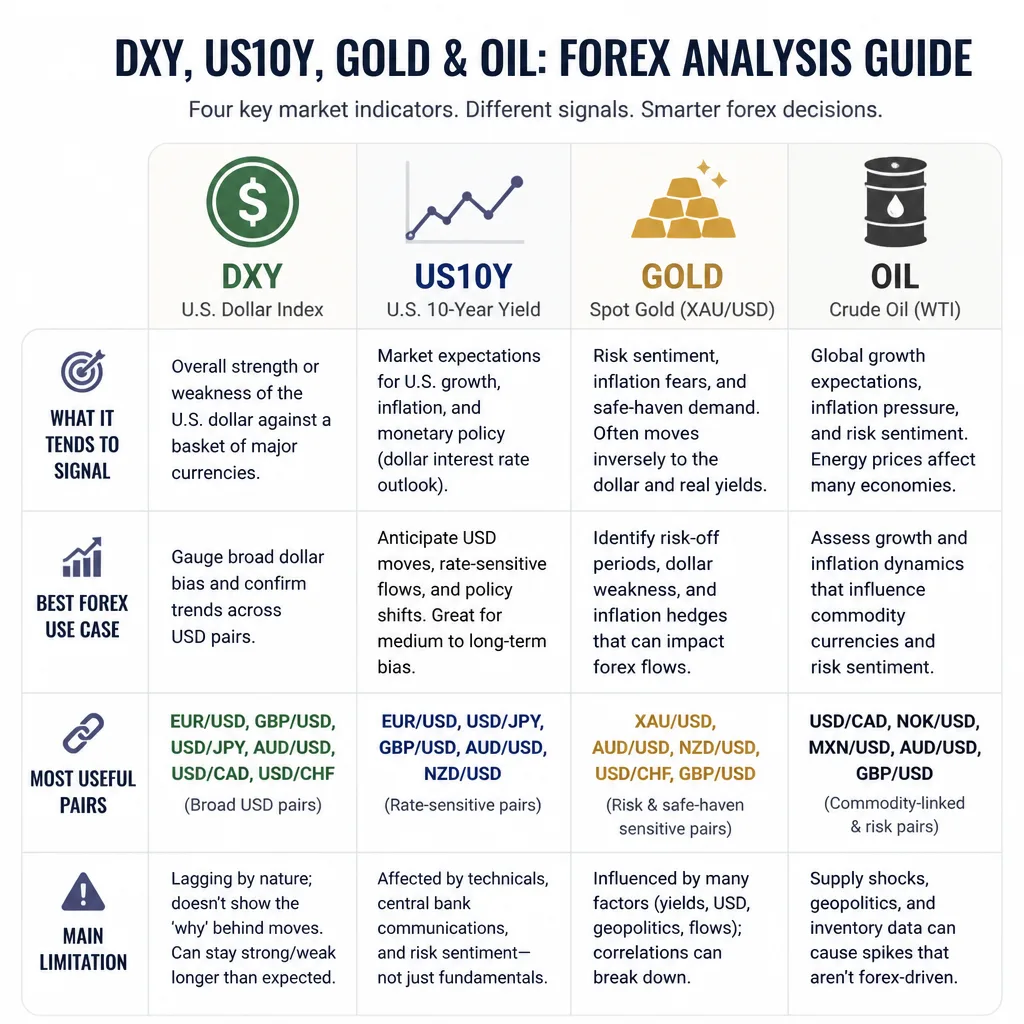
Each proxy plays a different role. Traders often miss that and treat them as interchangeable.
| Proxy | What it tends to signal | Best forex use case | Most useful for | Main limitation |
|---|---|---|---|---|
| DXY | Broad USD strength or weakness | Checking general dollar tone | EUR/USD, broad USD view | Euro-heavy construction can distort non-EUR reads |
| US10Y | Rates expectations and macro repricing | Judging whether yield moves support USD | USD pairs during Fed repricing | Higher yields do not always mean a stronger USD |
| Gold | Defensive demand, real-yield sensitivity, sometimes anti-dollar behavior | Checking whether market tone supports or fights a USD move | XAU/USD, AUD/USD, broader risk context | Gold and USD can rise together in stress |
| Oil | Inflation and growth expectations, energy-linked currency context | Trading CAD or NOK-related themes | USD/CAD, NOK pairs | Commodity sensitivity is not constant |
DXY: a broad USD read, not a universal signal
The U.S. Dollar Index (DXY) measures USD performance against a basket of major currencies, with the euro carrying the largest weight under the standard ICE methodology[^1]. That makes DXY useful, but not universal.
If you are trading EUR/USD, DXY often provides strong context because the relationship is structurally close. If DXY is breaking higher while EUR/USD sits on support, that matters.
But if you are trading GBP/USD during a Bank of England repricing or USD/CAD during a major oil move, DXY is less direct.
For example, if DXY is rising mainly because the euro is weak, that does not automatically mean GBP or AUD will weaken by the same amount.
Decision Rule: Use DXY as a broad USD filter, not as a one-size-fits-all signal.
US10Y: rates expectations in market form
The 10-year U.S. Treasury yield is one of the clearest gauges of rate and macro repricing[^2]. In forex, that matters because USD often responds to changing expectations around Fed policy, growth, and inflation.
A simple way to frame it:
- Rising yields can support USD when markets are pricing tighter policy or stronger U.S. data
- Falling yields can weaken USD when markets are pricing easing or softer growth
But the relationship is not automatic. If yields rise because inflation fears are hurting growth expectations, FX may not respond cleanly.
For most traders, the practical takeaway is straightforward: when a USD move is clearly about rates repricing, US10Y often tells you more than headlines do.
Gold: risk, real yields, and sometimes the dollar
Gold is not just a “risk-off” asset. It often reflects real-yield expectations, defensive flows, and at times a weaker-dollar theme.
That is why gold can be useful, but messy. Often:
- gold up and USD down fits a softer-yield, softer-dollar environment
- gold down and USD up fits a firmer-yield, firmer-dollar environment
But in stress regimes, both gold and USD can rally together. That is not a contradiction. It usually means safety demand is dominating.
For example, in a volatile macro session with weak equities, firm gold, and a stronger USD, gold is telling you more about caution than about a clean anti-dollar move.
Oil: most useful when energy is actually driving FX
Oil matters because it affects:
- inflation expectations
- global growth sentiment
- commodity-linked currencies such as CAD and NOK
If crude is making a meaningful move because of supply shocks, demand repricing, or broader growth fears, that can spill into FX.
But traders often overstate its importance. CAD does not move one-for-one with oil. Bank of Canada expectations, U.S.-Canada yield spreads, and broad USD strength can matter more.
For example, a bearish oil move may support USD/CAD if CAD is trading like an energy currency that day. But if the main driver is a Bank of Canada surprise, oil may be secondary.
Bottom Line: DXY, US10Y, gold, and oil are not giving you the same information. Each answers a different market question.
The Core Principle: Use Proxies as Context, Not Triggers
Correlation is conditional, not permanent
Correlations in forex are regime-dependent, timeframe-dependent, and pair-dependent.
That means the same proxy can be highly useful one week and nearly irrelevant the next. Traders get into trouble when they treat tendencies like fixed rules.
Instead of asking, “What does gold always mean for USD?” ask:
- What is driving my trade idea?
- Which proxy should matter most here?
- Is that proxy helping or fighting the trade?
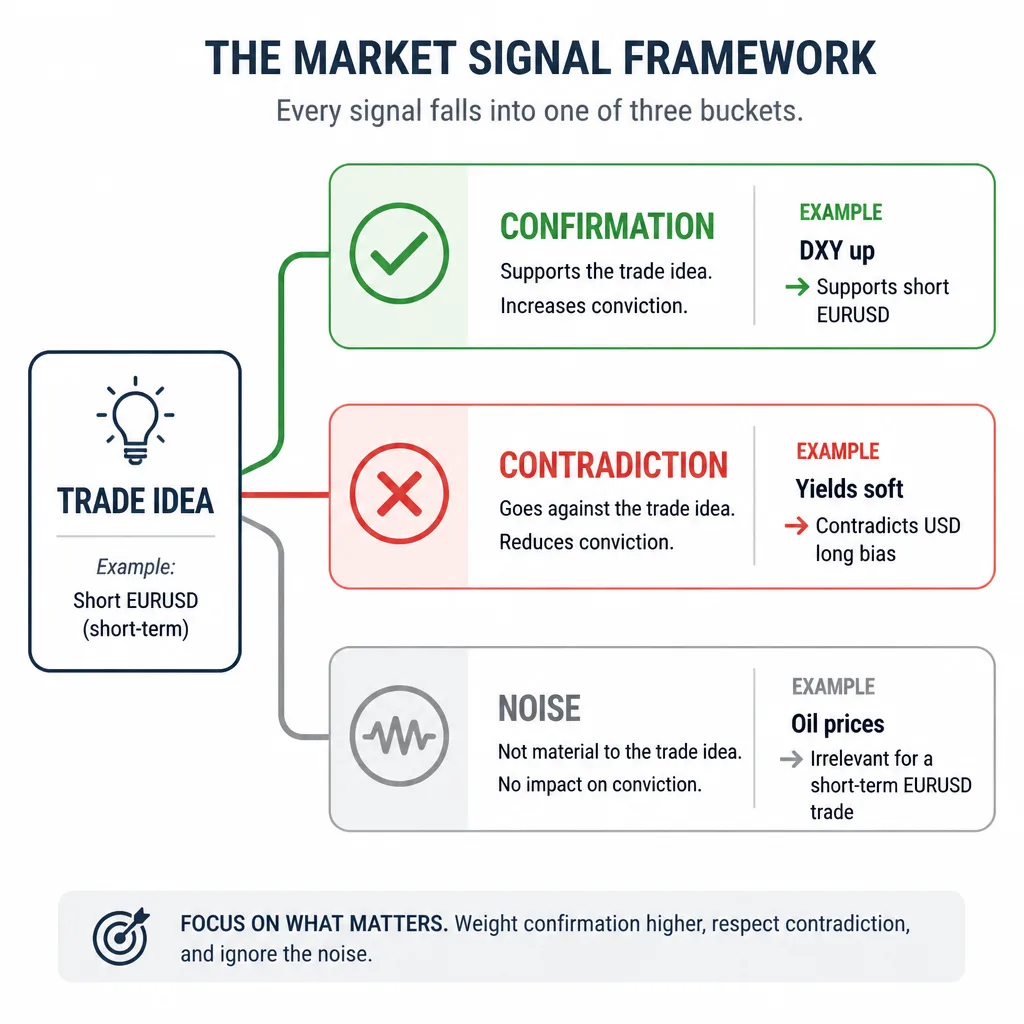
Confirmation, contradiction, and noise
This is the simplest model to use:
Confirmation
The proxy behavior supports the trade thesis.
Example: you want to short EUR/USD, and DXY is pushing higher while US10Y is firming. That adds context behind the setup.
Contradiction
The most relevant proxy is moving against the thesis.
Example: you want to short EUR/USD, but DXY is flat to lower and yields are soft. The chart may still break, but the macro support is weak.
Noise
The proxy is not important enough for this pair, theme, or timeframe to matter.
Example: oil is usually noise for a short-term EUR/USD trade unless energy pricing is clearly driving inflation expectations that day.
Key Insight: Do not force every proxy to matter. The skill is knowing which one matters most.
When Correlations Help—and When They Don’t
Clear risk-on or risk-off phases
Correlations tend to work better when the market is in a clean regime.
In broad risk-off phases, you often see:
- USD stronger
- growth-sensitive currencies like AUD and NZD weaker
- yields lower
- gold firmer
But even here, the mix can vary. Sometimes both gold and USD rally because safety demand dominates.
Central bank repricing
When the market is repricing the Fed, US10Y often becomes especially useful.
If U.S. data surprises to the upside and yields rise as traders price a more hawkish Fed path, USD pairs often respond more cleanly. In those periods, yields can matter more than general commentary.
Commodity-led moves
Oil becomes more useful when the market is clearly repricing energy.
That can happen during:
- supply disruptions
- large crude inventory surprises
- demand shock narratives
- inflation repricing tied to energy costs
In those environments, USD/CAD or NOK pairs may offer cleaner expressions than a generic USD pair.
Breakdown scenarios
This is where discipline matters most.
Correlations weaken when:
- a local central bank surprise overrides broad USD tone
- a currency has its own domestic story
- crowded positioning triggers a squeeze
- month-end or flow-driven price action distorts the session
- proxies send mixed macro signals
- your proxy timeframe does not match your trade timeframe
For example, DXY may be strong while GBP/USD holds up because the Bank of England is being repriced more hawkishly than expected.
Common Mistake: Using a daily proxy move to justify a 5-minute trade around a local technical setup.
Bottom Line: Correlations work best when one macro regime is clearly in control. They weaken when too many drivers compete.
A Practical Pre-Trade Correlation Check
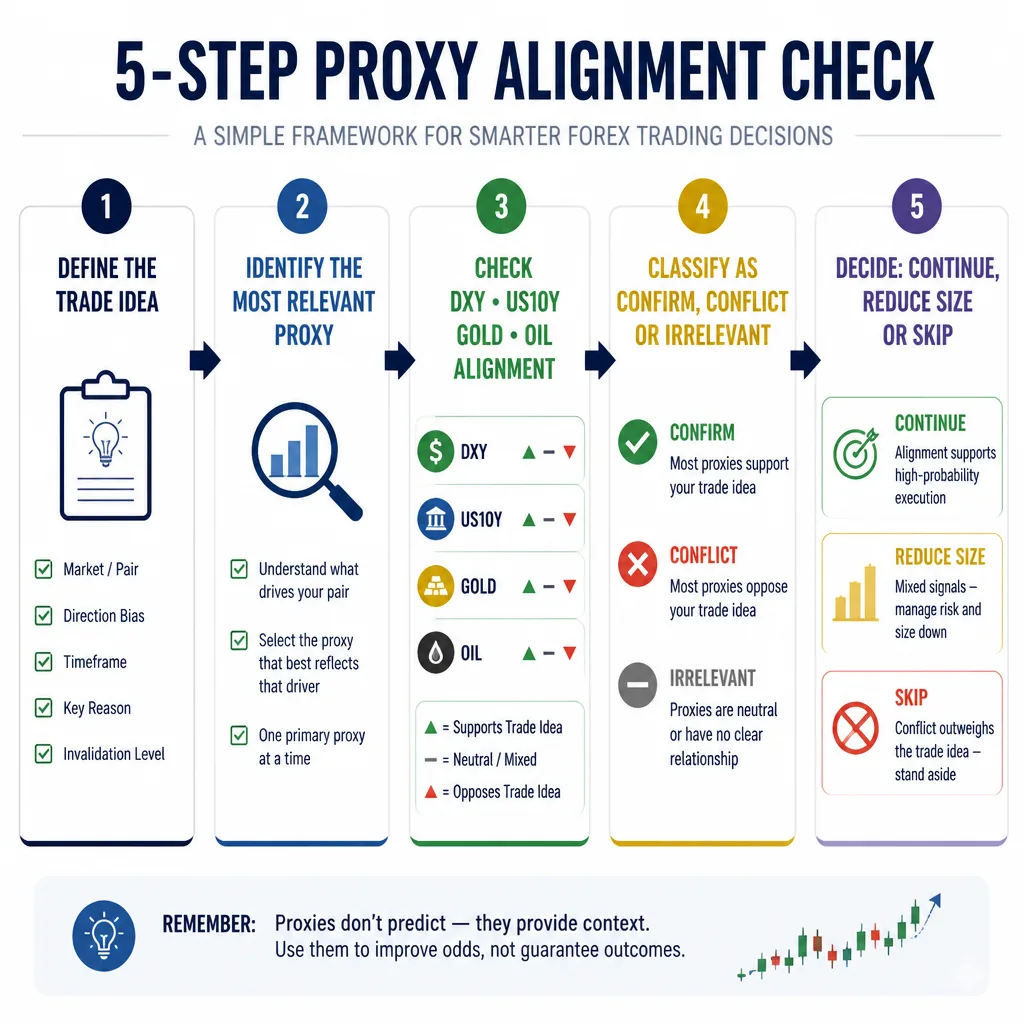
This is the process to use before entry.
Step 1: Define the trade idea in one sentence
If you cannot explain the trade simply, you cannot check the right context.
Example:
“I want to short EUR/USD because support is breaking and I think today’s move is driven by USD strength.”
Step 2: Identify which proxy should matter most
Not every trade should weight the same proxy the same way.
- Broad USD trade: DXY and US10Y matter most
- Yield repricing trade: US10Y matters most
- Risk-sensitive AUD/USD trade: gold and general risk tone may help
- USD/CAD trade tied to crude: oil becomes more relevant
Step 3: Check alignment across the four proxies
You are not looking for perfect agreement. You are checking whether the important proxies support the idea.
Step 4: Label each one
Use simple labels:
- Confirm
- Conflict
- Ignore
Step 5: Decide what to do
If the lead proxy confirms and no major signal strongly conflicts, continue.
If the lead proxy conflicts, lower conviction. That may mean reducing size, waiting, or skipping.
If the read is mixed, demand a better chart or choose a cleaner pair.
Decision Rule: If your lead proxy conflicts with your thesis, treat the trade as lower quality until proven otherwise.
The 4-Proxy Decision Framework
A simple table for reading each proxy
| Proxy | What you expected to see | What it is actually doing | Status | Impact |
|---|---|---|---|---|
| DXY | Rising for bullish USD / falling for bearish USD | Confirm / Conflict / Ignore | Broad USD context | |
| US10Y | Firm for hawkish USD / soft for dovish USD | Confirm / Conflict / Ignore | Rates support or resistance | |
| Gold | Often soft on firm USD / firm on soft USD, but stress can distort | Confirm / Conflict / Ignore | Tone check | |
| Oil | Supporting or hurting energy-linked FX if relevant | Confirm / Conflict / Ignore | Commodity context |
How to score alignment without overfitting
Keep it simple:
- +1 = confirms
- 0 = irrelevant
- -1 = conflicts
Give the lead proxy extra weight in your judgment. You do not need a complex formula. The point is structure, not fake precision.
Decision rules
| Read | Meaning | Practical action |
|---|---|---|
| Lead proxy confirms, no major conflict | Good alignment | Take the trade if the chart is valid |
| Lead proxy neutral, mixed read elsewhere | Weak conviction | Reduce size or wait for cleaner structure |
| Lead proxy conflicts | Thesis is under pressure | Skip or find a better pair |
| Proxies mostly irrelevant | Trade is local or technical | Rely more on pair-specific factors |
Bottom Line: The framework should simplify judgment, not replace it.
Workflow Example 1: Filtering a Bad Trade
Setup: a technical breakout looks clean
Suppose EUR/USD breaks below support during the London session. The chart looks clean, and your first instinct is to short the breakdown.
What the proxies are saying
Now you run the 4-Proxy Pre-Trade Check:
- DXY: flat, not breaking higher
- US10Y: drifting lower
- Gold: stable to slightly bid
- Oil: irrelevant for this setup
Why the trade is weaker than it looks
Your idea is a USD-strength short in EUR/USD, so DXY and US10Y are the lead context tools.
But neither is helping:
- DXY is not showing broad dollar pressure
- yields are soft, which weakens the USD side
- gold being firm is not a strong pro-USD signal
Could EUR/USD still fall? Yes. But the setup is now technically valid and contextually weak.
That is exactly the kind of trade correlations can help you avoid.
Key Insight: A good chart pattern is not always a good trade if the underlying driver is missing.
Workflow Example 2: Choosing the Cleaner Pair
Setup: bullish USD after strong U.S. data
Now assume you have a broad bullish USD view after strong U.S. data.
You are comparing:
- EUR/USD
- GBP/USD
- AUD/USD
Proxy read
- DXY: higher
- US10Y: higher
- Gold: softer
- Risk tone: fragile, which often hurts AUD
- Oil: not a major factor here
Pair comparison
| Pair | What helps the trade | What complicates it | Cleanliness |
|---|---|---|---|
| EUR/USD | DXY directly relevant, USD supported by yields | If EUR has local support, downside may be slower | Good |
| GBP/USD | USD side supported | GBP may resist if BOE pricing is supportive | Medium |
| AUD/USD | USD supported, softer risk tone hurts AUD too | Can be noisy if China-related headlines hit | Very good |
Why correlations improve pair selection
In this case, AUD/USD may be the cleaner expression because both sides of the pair align:
- stronger USD supports the short
- weaker risk tone can also pressure AUD
By contrast, GBP/USD may be a weaker expression if sterling has local support from Bank of England repricing.
This is one of the best uses of correlations: not just deciding whether to trade, but deciding which pair expresses the view most cleanly.
The same logic applies to oil. If your real view is bearish oil, then USD/CAD may be a better vehicle than EUR/USD—but only if CAD is actually trading with crude and local Canadian factors are not dominating.
Common Mistakes With Correlations
Treating relationships as fixed rules
Gold down does not always mean USD up. Oil down does not always mean CAD down. These are tendencies, not laws.
Watching too many markets
Four proxies are enough for most discretionary traders. More screens often create more noise, not more edge.
Ignoring timeframe mismatch
A daily DXY trend may matter for a swing trade, but it may be nearly useless for a five-minute scalp.
Using DXY blindly on non-EUR setups
Because DXY is euro-heavy[^1], it can create false confidence on pairs where the non-USD side has its own dominant story.
Forcing trades when proxies are mixed
Mixed signals often mean the market is not offering a clean expression.
Common Mistake: Treating a proxy as a trigger instead of asking whether it is relevant to the pair and timeframe.
How to Build This Into a Trading Routine
A 2-minute checklist before entry
- Write the trade thesis in one sentence
- Decide whether the idea is mainly driven by USD, rates, risk, or commodities
- Identify the lead proxy
- Check DXY
- Check US10Y
- Check gold
- Check oil if relevant
- Label each one: confirm, conflict, or ignore
- Decide: continue, reduce size, or skip
What to journal after the trade
After the trade, note:
- which proxy mattered most
- whether the pair was the cleanest expression
- whether a conflict warned you early
- whether the proxy timeframe matched the trade horizon
- whether the trade worked because of clean alignment or despite poor alignment
How to learn which proxies matter most for your pairs
The best learning comes from repetition.
Track 20 to 30 trades and look for patterns:
- Does US10Y consistently matter for your EUR/USD swings?
- Does gold help on AUD/USD days more than on GBP/USD?
- Does oil improve your USD/CAD decisions, or are rate spreads doing more of the work?
That is how intermarket analysis becomes practical instead of theoretical.
Bottom Line: You do not need to master every macro relationship. You need to know which few matter for your setups.
Conclusion
Correlations are most useful when they stay simple.
DXY, US10Y, gold, and oil can give you better context before a trade, but only if you use each for the right job. DXY helps with broad dollar tone. US10Y helps with rates-driven USD moves. Gold helps you read defensive tone and real-yield pressure. Oil helps when energy and commodity sensitivity are actually in play.
The key shift is this: stop treating proxies as entry signals. Use them as a pre-trade quality check.
If the lead proxy confirms your idea, conviction improves. If it conflicts, caution rises. If it is irrelevant, move on and focus on what actually matters.
That is the real value here: better filtering, cleaner pair selection, and fewer trades taken for the wrong reasons.
FAQ
What are forex correlations in practical trading terms?
They are recurring relationships between currency pairs and other markets such as DXY, Treasury yields, gold, or oil. In practice, traders use them as context tools to judge whether a setup is supported, contradicted, or mostly unaffected by broader market moves.
How does DXY help forex traders?
DXY gives a broad read on USD strength or weakness. It is especially useful for EUR/USD and general dollar tone, but it is not a perfect signal for every USD pair because the index is heavily weighted toward the euro.
Why does US10Y matter in forex?
The 10-year U.S. Treasury yield often reflects rates expectations and broader macro repricing. When FX moves are being driven by Fed expectations, growth, or inflation, US10Y can offer clearer context than headlines.
What does gold correlation mean in forex?
Gold often acts as a proxy for real yields, defensive demand, and sometimes anti-dollar behavior. Traders watch it to see whether market tone supports or fights a USD move, but the relationship is conditional rather than fixed.
How does oil affect forex pairs?
Oil can influence forex through inflation expectations, growth sentiment, and commodity-linked currencies such as CAD and NOK. It is most useful when energy pricing is a clear driver, not as an automatic signal for USD/CAD.
When do correlations break down?
They often weaken during local currency-specific news, central bank surprises, positioning squeezes, month-end flows, or mixed macro regimes. Timeframe mismatch is another common issue.
Should all four proxies align before taking a trade?
No. The goal is not perfect alignment. The better approach is to identify which proxy matters most for the trade idea, then judge whether that lead proxy confirms or conflicts with the setup.
What is a simple pre-trade correlation strategy?
Use a 4-Proxy Pre-Trade Check: define the trade idea in one sentence, identify the lead driver, check DXY, US10Y, gold, and oil, label each as confirm, conflict, or ignore, then decide whether to continue, reduce size, or skip.
Can correlations help with pair selection?
Yes. One of their best uses is choosing the cleanest pair to express a market view. If your idea is bullish USD and risk sentiment is weak, one USD pair may offer much cleaner alignment than another driven by local news.
What is the biggest mistake traders make with correlations?
Treating them as fixed rules or direct trade triggers. They work best as filters that improve trade quality, not as standalone reasons to enter.
[^1]: ICE U.S. Dollar Index methodology / composition.
[^2]: U.S. Treasury market and benchmark yield conventions.