Prop Firm Due Diligence Framework (2026): Counterparty Risk, Rule Ambiguity Scoring, and Payout Verification
Most traders approach a prop challenge as a skills test. Can I hit the target? Can I manage drawdown? Can I turn this into a larger payout stream?
That is only half the equation.
The other half is the firm. In 2026, a prop challenge is not just a trading exercise. It is a contract with a counterparty that sets the rules, controls the infrastructure, reviews your behavior, and decides how payouts are handled.[^1][^2] If that sounds more like operational risk than trading opportunity, that is exactly the point.
The practical question is not just whether you can pass. It is whether the firm deserves your fee, your time, your data, and your payout expectations. The strongest traders increasingly treat firm selection like vendor due diligence: verify the terms, score the ambiguity, test the environment, and only then decide whether the expected value makes sense.
Introduction: The real question is not whether you can pass
The prop industry still sells upside first: funded accounts, profit splits, scaling plans, fast payouts. That framing pulls traders toward the exciting part of the offer and away from the fragile part.
But a prop relationship only works if two things are true at the same time: your strategy works, and the firm’s rules, infrastructure, and payout process work predictably. U.S. regulators have long warned retail traders to be cautious with offers built around trading someone else’s capital for shared profits, which is a reminder that the risk is not only market risk.[^1]
So the right starting point is a mindset shift. Do not evaluate a prop firm like an opportunity. Evaluate it like a counterparty.
Why due diligence starts with counterparty risk
A prop challenge is a contract, not just a trading test
This sounds obvious, but traders often treat a challenge like a neutral proving ground. It is not. Official terms from firms such as FXIFY make clear that the relationship starts when you pay the challenge fee, and that the firm’s terms govern demo trading behavior, reviews, and termination rights.[^2]
That matters because many traders price only the fee. They do not price the contract risk attached to it.
The three risks traders underestimate
Payout risk is the easiest to understand and one of the easiest to underestimate. A firm may show payout screenshots, but the real question is whether the process is documented, repeatable, and recently consistent. Official help-center documentation from firms like The5ers is more useful than social proof because it spells out timing, thresholds, and processing windows.[^3]
Rule interpretation risk is where many disputes begin. Hard rules such as max daily loss are usually not the issue. The problem is language like “sole discretion,” “abnormal market conditions,” “harmful trading,” or undefined consistency requirements. FXIFY’s published terms show why this matters: some clauses leave meaningful room for interpretation after the fact.[^2]
Dependency risk is less visible but increasingly important. Platform access can depend on upstream vendors, bridges, brokers, and payout rails. MetaQuotes’ 2025 support change for older MT4/MT5 versions was a reminder that traders can be affected by infrastructure decisions made well above the individual firm.[^4]
Why a cheap evaluation can be expensive
A low challenge fee can be misleading. If the rules are vague, support is inconsistent, and the payout process is unclear, a “cheap” challenge can become expensive in time, opportunity cost, and emotional drag.
That is not a certainty for every firm. It is an expected-value argument. If a firm adds enough uncertainty at the contract and enforcement layer, your edge has to overcome more than market variance.
The 2026 due diligence framework: five pillars
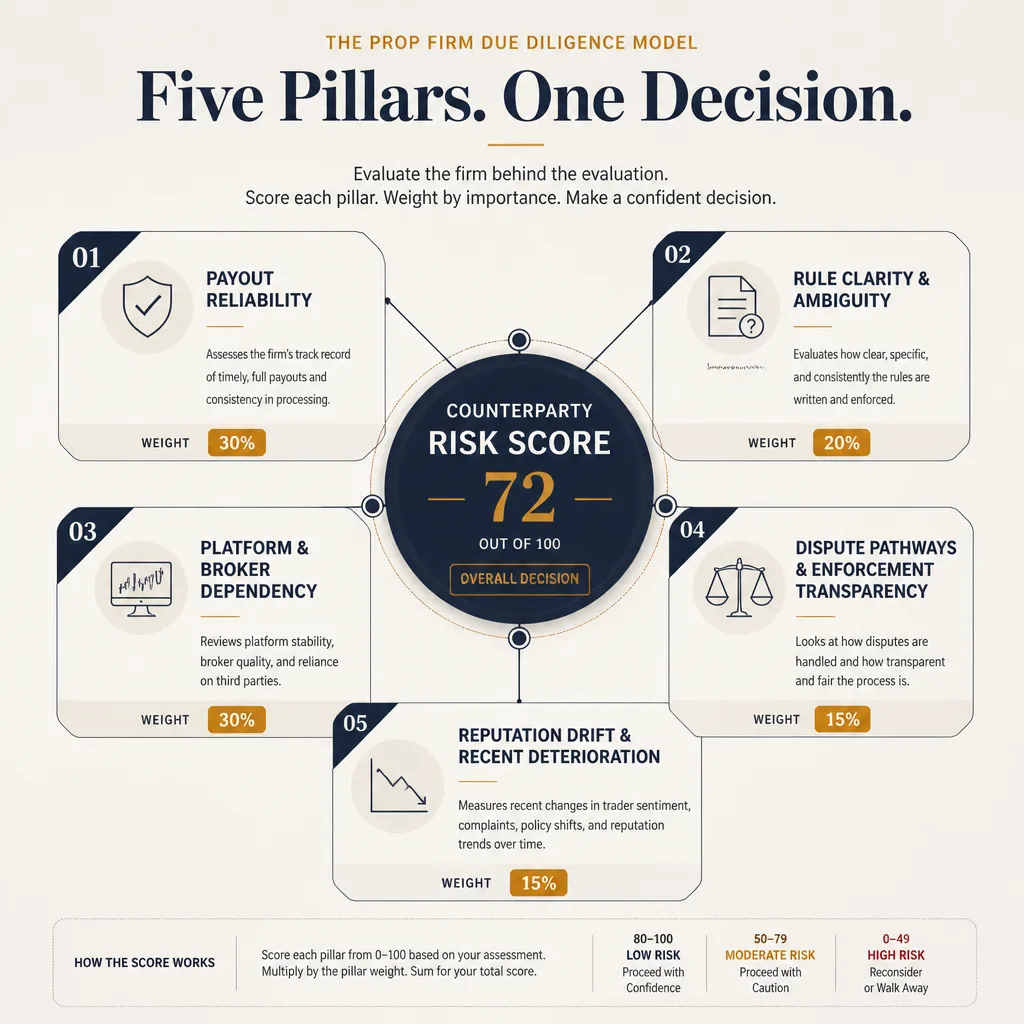
This framework is built around five questions. Not “Can I pass?” but “What can break before or after I pass?”
Pillar 1: Payout reliability
Start with official documentation. Look for:
- first withdrawal eligibility
- payout frequency
- minimum thresholds
- payment methods
- processing windows
- review triggers
The5ers, for example, publicly states funded withdrawal timing, thresholds, and a typical 5–8 business day processing window for approved requests.[^3] FundedNext uses “Performance Reward” terminology in some materials, which matters because traders searching only for “payout” may miss relevant conditions.[^5]
Strong evidence: official payout policy plus repeated recent user reports that match it.
Weak evidence: a handful of screenshots, influencer testimonials, or “I got paid” posts with no timing or dispute context.
Failure pattern: vague payout terms, inconsistent terminology across the site, and no clarity on when compliance review starts or what can delay a withdrawal.
Pillar 2: Rule clarity and ambiguity scoring
A restrictive rule is not automatically a bad rule. A vague rule is.
The5ers’ consistency examples are useful because they are measurable. On one futures evaluation example, no single trade may account for more than 40% of total profits, and the page explains how a soft breach can become compliant as total profits increase.[^6] FundedNext’s micro-scalping rule is also restrictive, but at least testable: profitable trades closed within 10 seconds count toward a threshold, and a 40% share of cycle profit can trigger a violation.[^7]
Contrast that with broad “sole discretion” language. That is where ambiguity risk rises sharply.[^2]
Strong evidence: measurable thresholds, examples, product-specific explanations, and advance disclosure.
Weak evidence: catch-all clauses, undefined terms, and rules that can be amended with little notice.
Pillar 3: Platform, broker, and infrastructure dependency
Many firms do not control their full stack. They rely on external platforms, liquidity relationships, bridge technology, and payout vendors.[^4][^8]
That does not automatically make a firm unsafe. It does mean you should ask different questions:
- Which platform does the account use?
- Is the setup stable across products?
- Are there known version or access dependencies?
- Which payout rails are used?
- Does the firm disclose enough about the execution environment and infrastructure partners?
Failure pattern: traders assume platform access equals operational stability, then discover that a vendor change or outage changes conditions overnight.
Pillar 4: Dispute pathways and enforcement transparency
Read the terms as an enforcement map.
Look for refund policy, account termination rights, review procedures, support channels, and any meaningful explanation of how disputes are handled. FXIFY’s published materials explicitly describe compliance review of the full trading history when a withdrawal is requested, not just a balance check.[^9] That matters because many payout problems surface at review time, not during the challenge.
Strong evidence: defined review steps, written explanations, and support responses that clarify rules in plain language.
Weak evidence: generic “compliance issue” explanations, no visible escalation path, or broad contractual rights with no operational guidance.
Pillar 5: Reputation drift and recent signal deterioration
This is the most dynamic pillar in 2026.
The useful question is not “Does the firm have complaints?” Every firm does. The better question is whether the direction of change is improving or deteriorating. Frequent rule-page edits, new anti-abuse pages, changing payout language, or new conduct programs may simply reflect maturation. They may also signal rising enforcement intensity or business-model stress. That is an inference, not proof.[^10][^11]
Recent updates matter. Old reviews often describe firms that no longer exist in the same form. FTMO’s March 2, 2026 announcement that OANDA Prop Trader would conclude on March 31, 2026 is a reminder that ownership and program structure can change faster than surrounding content does.[^12]
Build the scorecard: a practical rubric
Suggested scoring model: 0 to 5 per category
Use a simple 0–5 score for each pillar:
| Category | Weight | What a 5 looks like | What a 0 looks like |
|---|---|---|---|
| Payout reliability | 30% | Clear official process, repeatable recent reports, defined timing | Vague process, conflicting terms, weak evidence |
| Rule clarity | 25% | Specific, measurable, disclosed rules | Broad discretion, undefined terms, changeable lists |
| Infrastructure dependency | 20% | Stable platform setup, disclosed dependencies, few surprises | Opaque stack, unstable access, unclear execution context |
| Dispute pathway | 15% | Clear review logic, responsive support, written clarifications | Generic denials, no escalation, boilerplate answers |
| Reputation drift | 10% | Stable recent signals, thoughtful updates | Sudden rule churn, complaint clustering, mixed messaging |
A practical threshold:
- 4.0+ weighted score: worth deeper consideration
- 3.0–3.9: test small and expect extra friction
- Below 3.0: probably not worth the fee unless you have a very specific reason
Weighting by trader profile
A swing trader may care most about payout mechanics and rule clarity.
A scalper should put more weight on ambiguity and infrastructure because fast exits, spread behavior, and short-duration trade rules matter more.
A news trader should heavily overweight event restrictions. A firm with acceptable general terms may still be unusable if it bans trades around high-impact releases or reduces profits earned within a news window, as some firms do.[^11][^13]
What a passing score should look like before you buy
Do not look for perfection. Public information is too incomplete for that.
Look for enough clarity that you can predict the operational experience with reasonable confidence. If the firm only makes sense when affiliates explain it, that is already a bad sign.
How to score rule ambiguity without fooling yourself
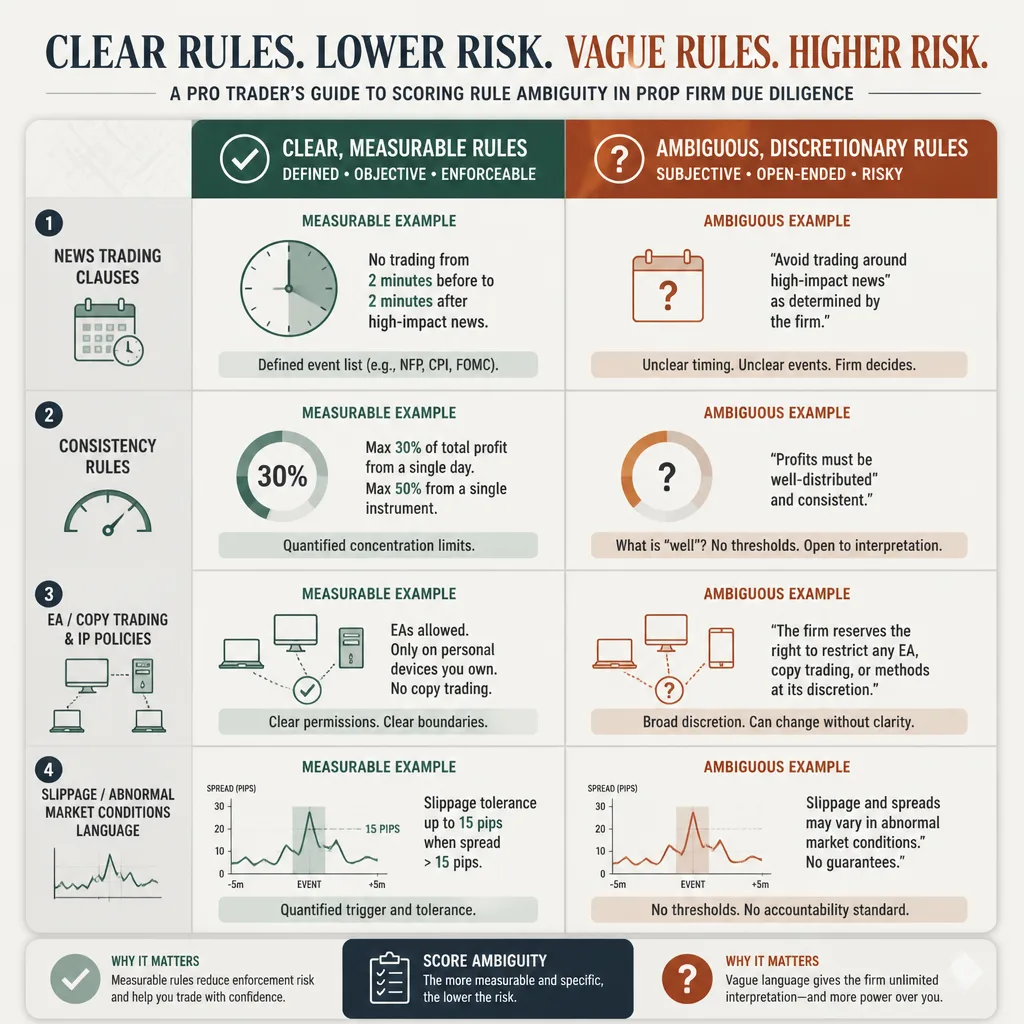
News trading clauses: clear prohibition or discretionary trap?
A clear prohibition is inconvenient, but manageable. For example, one The5ers page states that executing orders from two minutes before until two minutes after high-impact news is not allowed.[^13]
A more complex rule may sound flexible but create more payout uncertainty. FundedNext’s 2026 help content shows a model where news trading may be allowed on some products, but profits from trades inside a defined event window can receive a reduced split.[^11]
The better rule is not always the looser-sounding one. It is the one you can model in advance.
Consistency rules: risk control or retroactive disqualification lever?
Consistency rules can be legitimate risk controls. They become dangerous when they are vague.
A rule like “no single trade above 40% of total profits” is restrictive but measurable.[^6] A rule like “must demonstrate consistency” with no numerical guidance is not really a rule. It is a future argument.
Copy trading, group trading, EA use, and IP/device policies
These areas deserve extra attention because firms often review them late, especially at payout time. Official materials from FXIFY note concerns around account sharing, identity verification, coordinated behavior, and related patterns during review.[^9]
That means strategy legality is not enough. Operational footprint matters too. If you use multiple devices, travel often, share networks, or run automation, get clarification in writing before assuming it is fine.
Slippage, spread widening, and “abnormal market conditions”
This is where legal language meets real execution. Some discretion here is unavoidable. Firms do need protection against latency abuse, toxic flow, or simulated-environment exploitation.[^14]
But “abnormal market conditions” should still have boundaries. If the clause is broad and unsupported by examples, score it down. The rule does not need to be permissive. It needs to be predictable.
Scenario testing before purchase
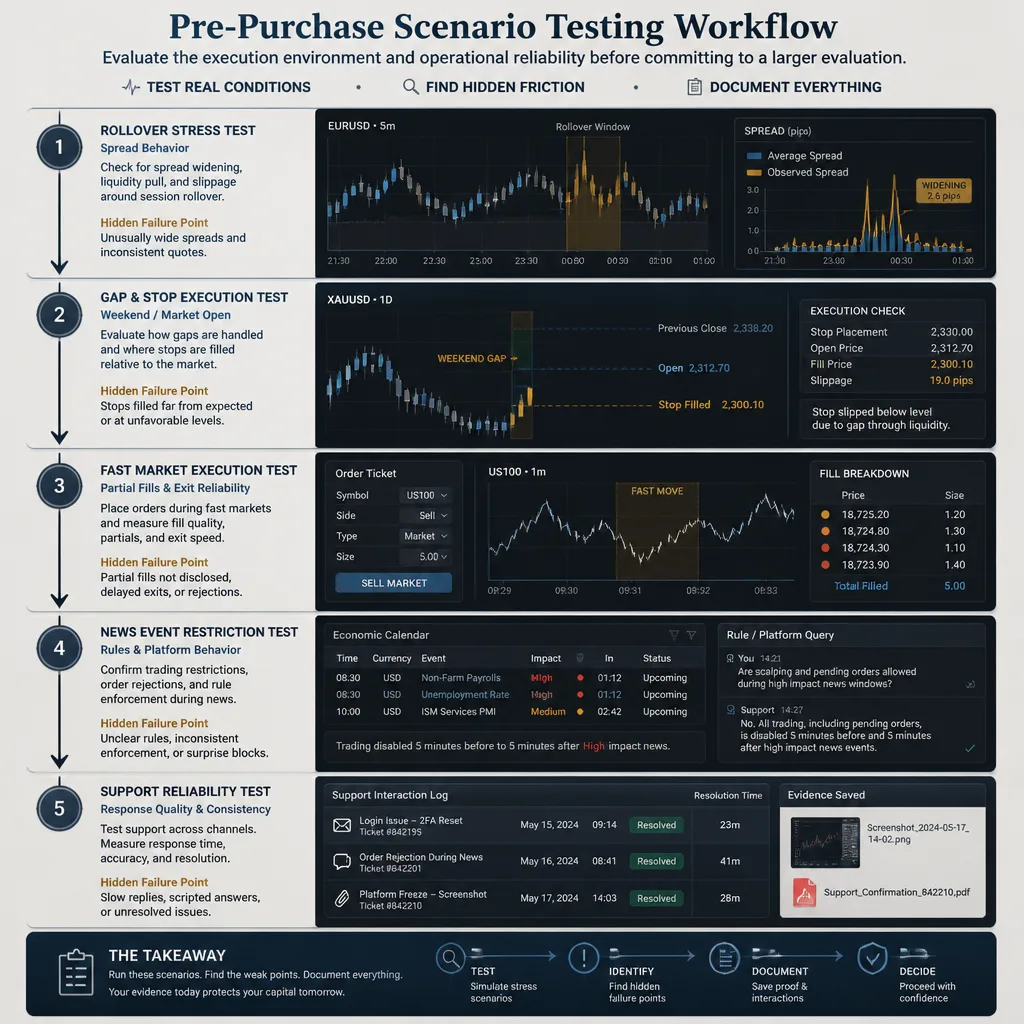
This is the part most traders skip.
The goal is not to perfectly simulate funded conditions. It is to see how the environment behaves when conditions get worse.
Spread spike test during rollover or volatile sessions
Open the platform around rollover and record spreads on your main instruments across several sessions. If you trade indices or gold, check your real trading windows, not generic off-hours.
A scalper who needs tight exits may discover that an otherwise acceptable firm is structurally unsuitable.
Gap and stop execution test
Watch how stops behave through session transitions or after weekend reopening on the instruments you actually trade. You are not trying to prove malpractice. You are checking whether your strategy has enough tolerance for the environment.
Partial fill and fast-market exit test
If the platform and product support it, test rapid entries and exits in small size. Watch for lag, slippage, or strange platform behavior when closing quickly.
News-event restriction test
Send support a specific question before purchase: “If I open before the event and close during the restricted window, how is that handled?” If the answer is vague, that tells you something. Get the answer in writing.
Support-response test and documentation trail
Ask one rule question and one payout question before paying. Judge not just speed, but precision.
Good due diligence produces a paper trail. Save screenshots, terms pages, support replies, and date stamps.
Payout verification: what counts as evidence
Weak evidence: isolated screenshots and affiliate testimonials
A screenshot proves only that one account appears to have been paid once. It does not tell you about denial rates, delays, review friction, or whether the account was later restricted.
Affiliate content is even weaker because incentives are often misaligned.
Stronger evidence: repeated recent payout records and time-to-payment patterns
The strongest public evidence is boring: official process documentation that matches repeated, recent, non-isolated user experience.[^3][^5]
Look for pattern consistency:
- same timing range mentioned repeatedly
- similar document requests
- similar approval workflow
- no obvious mismatch between official terms and user reports
What to verify before your first withdrawal request
Before you trade toward a first payout, verify:
- eligibility timing
- minimum amount
- payout method
- KYC or identity review triggers
- whether full account history is reviewed
- whether prior rule issues can be raised later at withdrawal time
That last point matters. Some firms explicitly state they review the full funded history when a withdrawal is requested.[^9]
How to document your own account in case of review or denial
Keep:
- trade logs
- account statements
- platform exports
- screenshots of live rule pages
- payout-policy pages
- support ticket IDs
- KYC confirmations
- login/device records if your setup is mobile or distributed
Documentation does not remove risk. It improves your position if the relationship turns adversarial.
When the framework says “walk away”
Immediate red flags
Walk away if you see a cluster of these:
- broad sole-discretion enforcement language
- prohibited-strategy lists that can change quickly
- weak or inconsistent payout documentation
- unclear review triggers
- support that cannot answer simple rule questions clearly
- a marketing-heavy front end with thin contractual detail[^2]
Gray-zone warnings that call for a smaller test
Some firms are not obvious avoids, but still deserve caution. If the payout process is documented and the rules are mostly measurable, but recent updates show tightening conduct controls or strategy-specific restrictions, the right move may be the smallest possible test rather than a full commitment.[^10][^11]
Cases where a good trader is still a bad fit
This is common.
A swing trader may do fine at a firm that is hostile to micro-scalping. A news trader may be a terrible fit at a firm with tight event windows. An EA user may run into operational issues even at a firm that pays many discretionary traders.
A firm can be legitimate enough to pay and still be wrong for your style.
Conclusion
The central mistake in prop trading is assuming your edge lives only in entries, exits, and risk management. In reality, it also depends on counterparty selection.
A good strategy inside a weak firm can still produce poor expected value. A less exciting offer from a clearer, more stable counterparty can be the better decision. That is why this framework matters in 2026: it forces you to evaluate payout reliability, rule ambiguity, infrastructure dependency, dispute friction, and reputation drift before the fee is gone and the real review begins.
If a firm cannot survive structured due diligence, it has not earned the right to test your trading. That is the filter.
FAQ
What is a prop firm due diligence framework?
It is a repeatable way to evaluate a proprietary trading firm before buying a challenge. Instead of focusing only on whether you can pass, it helps you assess the firm as a counterparty by checking payout reliability, rule clarity, platform and broker dependencies, dispute processes, and recent signs of deterioration.
Why should traders treat prop firms as counterparties instead of opportunities?
Because your expected value depends on more than strategy. A trader can pass an evaluation and still face delayed withdrawals, discretionary rule enforcement, infrastructure issues, or payout denial. Treating the firm as a counterparty shifts attention to contractual and operational risk, which is often more important than the advertised account size.
How do I verify whether a prop firm actually pays traders?
Start with official payout documentation, not social media screenshots. Check withdrawal eligibility rules, minimum payout thresholds, processing windows, payment rails, identity-review requirements, and whether payout terms are consistent across the site, help center, and terms. Then compare that with repeated recent community reports to see whether timing and outcomes match the official process.
Are payout screenshots reliable proof that a prop firm is safe?
Not by themselves. Screenshots can show that some traders were paid, but they do not reveal denial rates, delays, account reviews, follow-up restrictions, or whether the trader had affiliate incentives. Stronger evidence comes from official payout policies plus repeated recent reports showing consistent payment behavior and manageable dispute friction.
What is rule ambiguity in prop firm terms?
Rule ambiguity is the gap between what a firm says is prohibited and what a trader can actually predict in practice. It usually appears in phrases like sole discretion, abnormal market conditions, consistency expectations, harmful behavior, one-sided trading, or prohibited strategies that are not clearly defined. The more a rule depends on interpretation instead of measurable thresholds, the higher the ambiguity risk.
Which rules deserve the most scrutiny?
News trading rules, consistency rules, copy trading restrictions, EA and automation policies, IP or device rules, slippage and spread clauses, and any catch-all language about abnormal conditions or harmful trading deserve the closest review. These are the areas where many disputes happen because enforcement often depends on interpretation rather than a simple hard breach.
How should I score rule ambiguity?
A practical approach is to score each rule area from 0 to 5. A 5 means the rule is specific, measurable, disclosed in advance, and strategy-compatible. A 0 means the rule is broad, discretionary, changeable, or unclear enough that you cannot confidently know what behavior could trigger enforcement. The score should reflect predictability, not whether you personally like the rule.
What is counterparty risk in prop trading?
Counterparty risk is the risk that the firm on the other side of the relationship cannot or will not honor the expected process. In prop trading, that can mean payout delays, rule reinterpretation, platform interruptions, support failures, changing terms, or weak dispute pathways. It is different from market risk because the problem is not your trade idea but the firm relationship itself.
Why do platform and broker dependencies matter?
Many prop firms rely on outside platforms, brokers, bridge providers, payout vendors, and backend technology partners. If any part of that stack changes, fails, or becomes restricted, your trading conditions or access can change quickly. A firm may look stable on the front end while still being operationally fragile behind the scenes.
What scenario tests should I run before buying a larger challenge?
Useful tests include checking spreads around rollover, testing stop execution during faster conditions, observing behavior around gaps or high-impact news windows, watching how partial fills or quick exits behave, and sending support questions that force the firm to clarify a rule in writing. The goal is not perfect simulation but stress testing where hidden failure points appear.
What counts as a strong dispute pathway?
A strong dispute pathway usually includes clear written rules, a visible review process, defined support channels, consistent explanations, and documentation showing how payout reviews or rule investigations are handled. Weak pathways rely on vague terms, delayed replies, generic denials, or broad discretionary language with no meaningful escalation route.
When should I walk away immediately?
Walk away if you see several of these together: vague sole-discretion clauses, weak official payout documentation, frequent recent rule changes, unclear ownership or platform dependencies, inconsistent support answers, or heavy marketing with little usable contract detail. One issue may be manageable. A cluster usually is not.
Can a prop firm be legitimate but still be a bad fit for my strategy?
Yes. A firm can pay traders reliably and still be hostile to your style. News traders, scalpers, copy traders, EA users, and high-frequency intraday traders often face much higher rule risk than swing traders. Due diligence should measure both firm quality and strategy fit.
What documents should I keep in case of a payout dispute?
Keep trade logs, account statements, platform exports, screenshots of rule pages, payout terms, support replies, ticket IDs, KYC confirmations, device and login records, and copies of any policy pages that were live when you traded. Good records will not remove counterparty risk, but they improve your position if a review or denial happens later.