MT5 Python API vs MQL5 EA: Reliability, Latency, Deployment, and Debugging Tradeoffs
Most traders start this comparison in the wrong place.
They ask whether Python is better than MQL5, which one is faster, or which feels more modern. Those questions matter during development. They matter much less at 3:12 a.m. when your VPS reboots, your broker session drops, and your strategy has to figure out whether it already sent an order.
That is the real decision: not syntax, but operational shape.
If your system will run live on MetaTrader 5, the safer choice is often the one with fewer failure points. Python is flexible and excellent for research, analytics, machine learning, and external APIs. MQL5 is native to the terminal and usually easier to keep running. The practical question is whether Python’s extra capability is valuable enough to justify the added operational burden.[^1][^2]
The real decision is operational
Why language preference is the wrong starting point
In research, Python often wins easily. You get pandas, external data pipelines, custom analytics, and a much larger tooling ecosystem.
Live trading is different. It is a long-running production process, and the biggest risks are usually mundane: disconnects, hung processes, restart behavior, stale state, and weak logs.
That is why “I prefer Python” is not an architectural argument. Neither is “MQL5 is native, so it must be safer.” Both can fail. The better question is simpler: which setup gives me the smallest failure surface without weakening the strategy’s edge?
Core thesis: fewer moving parts usually means safer live execution
That will not be true in every case. A disciplined team can build a safer Python stack than a poorly written EA.
Still, as a rule, simpler systems fail in fewer ways. For most retail and semi-professional MT5 traders, that matters more than elegance.
How the two setups actually run
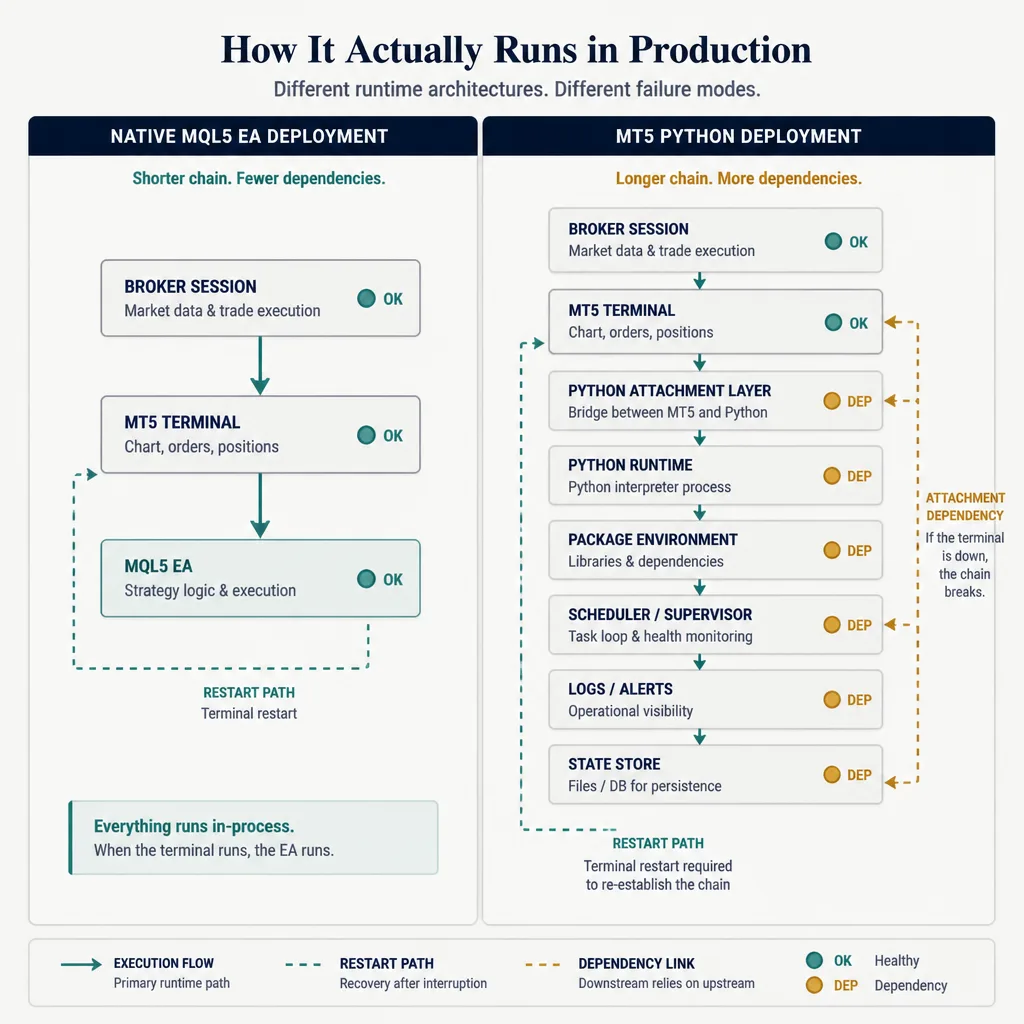
MQL5 EA: logic runs inside the MetaTrader terminal
A native MQL5 Expert Advisor runs inside MetaTrader and uses the platform’s event-driven model. Your execution layer lives where the trading session already lives.
Operationally, that matters because the deployment surface is small:
- MT5 terminal
- EA
- broker session
That does not make it foolproof. It does make it easier to reason about.
Python with MT5: Python talks to the terminal
The official MetaTrader5 Python package is not a standalone broker connection. MetaQuotes documents that initialize() connects to the MetaTrader 5 terminal and can even launch it if needed.[^1] The Python integration reference also describes the package as obtaining data from the terminal and sending trade requests through terminal-mediated functions such as order_send().[^2][^3]
That changes the architecture. A Python setup is not just strategy code in another language. It usually includes:
- MT5 terminal
- Python interpreter
- package environment
- terminal attachment layer
- process launch or scheduling
- logging and restart controls
Why architecture matters more than features
This is where many traders underestimate risk.
Python may be more expressive than MQL5, but each added runtime layer creates another way to fail: broken attachment, hung interpreter, dependency drift, orphaned process, or a restart that leaves the system unsure about account state.
That is why this comparison should focus on architecture, not feature count.
Reliability tradeoffs: where systems fail
MQL5 strengths: fewer dependencies, cleaner restart path
MQL5’s biggest advantage is containment. The strategy runs inside the same environment as the terminal. There is no external interpreter to supervise, no Python environment to maintain, and no separate bridge process to reconnect.[^1][^2]
That often makes restart behavior cleaner. If the terminal restarts, the EA restarts with it. You still need proper state handling, but the recovery path is more direct.
MQL5 weaknesses: quiet bugs and limited observability
The danger with MQL5 is assuming native means safe.
It does not.
A badly instrumented EA can fail quietly. If your logs only say “buy opened” or “error occurred,” post-trade analysis turns into guesswork. Native execution reduces layers, but it does not remove logic bugs, broker rejects, partial fills, session rollovers, or reconnect edge cases.
A common mistake is failing to log state transitions. You want to know not just that an order was sent, but why, from which signal, with what position snapshot, and what the server returned.
Python strengths: observability and external integrations
Python’s strongest reliability advantage is observability.
It is easier to build structured logs, persist state to files or databases, inspect objects, alert on heartbeat failures, and integrate outside services. If your strategy depends on economic calendar feeds, model inference, cross-broker analytics, or custom risk engines, Python may be the practical choice.
In other words, Python can be the safer option when the real complexity already lives outside MT5. Forcing that complexity into MQL5 can create a different kind of fragility.
Python weaknesses: more failure modes
The list is longer, though.
Python-controlled MT5 systems commonly run into four problems:
- Terminal attachment risk. The Python process may still be running while its connection to the terminal is effectively dead.[^1][^2]
- Process health ambiguity. A script can be alive but blocked on I/O, stuck in a retry loop, or silently failing downstream.
- Environment drift. Package changes, path issues, and Windows task behavior can break a deployment that worked a week ago.
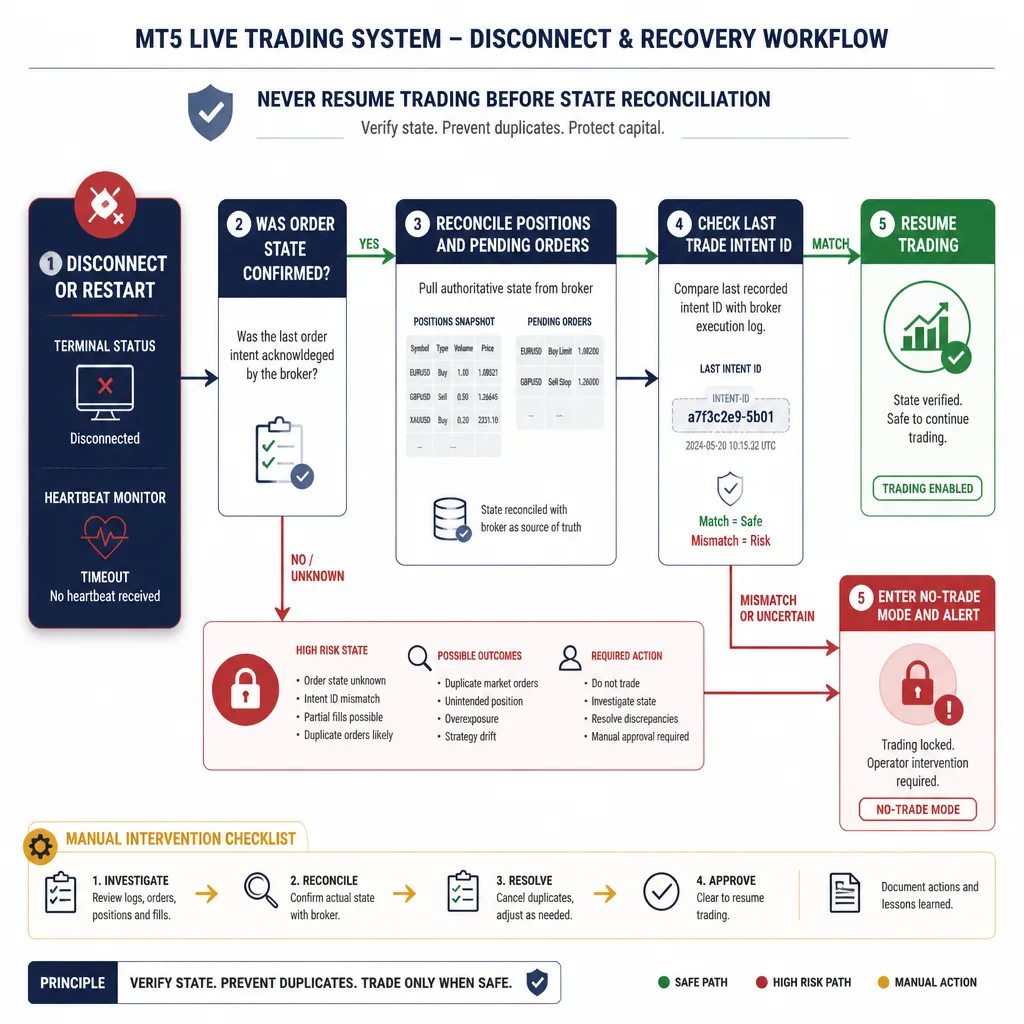
- Duplicate-order risk after restart. After a disconnect, the system may not know whether the last instruction was never sent, rejected, or accepted by the trade server.
That last issue is the most dangerous. Every trade intent should have a unique identifier, and every restart should reconcile account state before new orders are allowed.
Latency: important, but often misunderstood
Why MQL5 is usually cleaner for time-sensitive execution
If you care about tight execution timing, MQL5 usually has the cleaner path because the logic runs inside the terminal rather than through an external Python control layer.[^1][^3]
That is not the same as claiming a universal benchmark advantage. It is an architectural judgment: fewer handoffs usually mean fewer opportunities for delay.
Why many systems will not be limited by Python overhead
For a swing strategy trading a few times a day, or an intraday system acting on bar close, raw Python overhead is often not the bottleneck.
Network conditions, broker execution, spread, slippage, and the strategy’s own rules usually matter more. In those cases, choosing Python for model quality or data workflows can be completely reasonable.
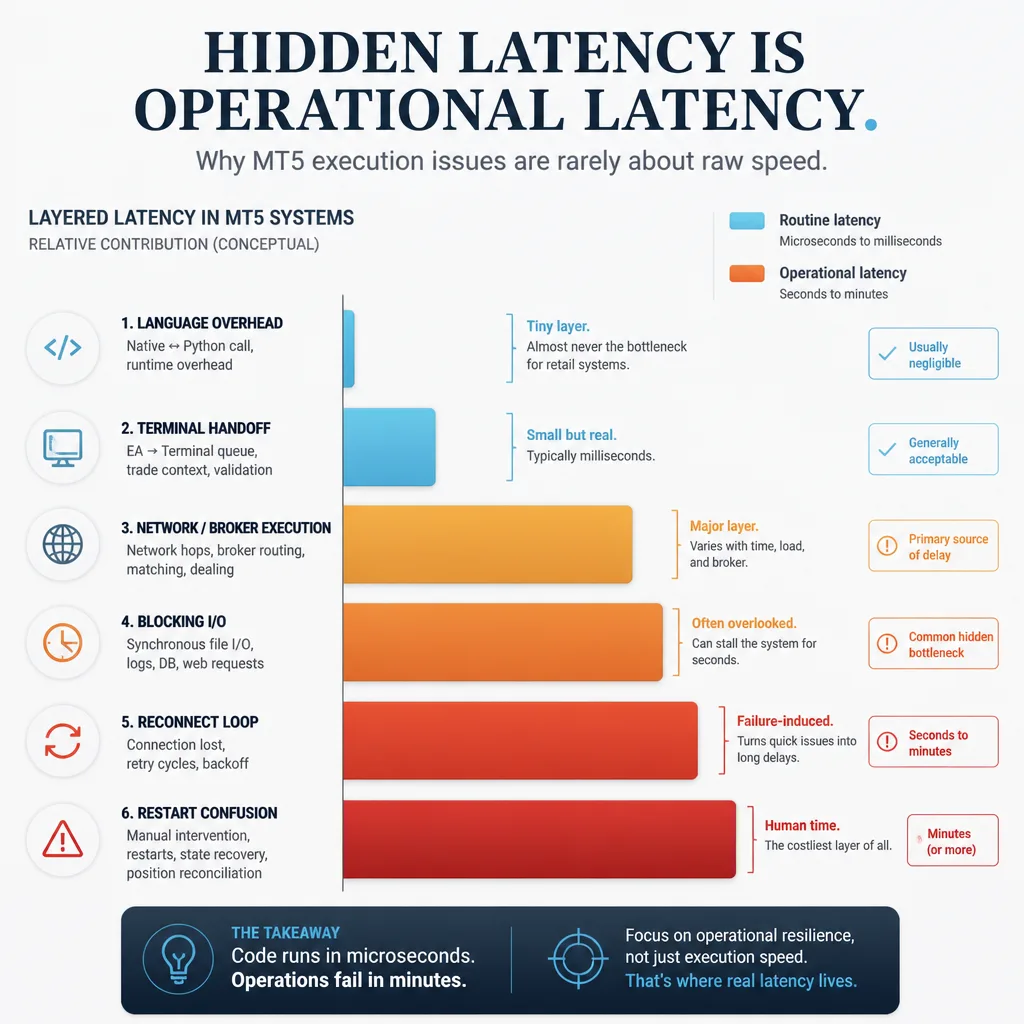
The hidden latency problem
Most traders focus on the wrong kind of latency.
The bigger risk is operational latency: seconds or minutes lost because a process blocked, a reconnect loop stalled, or a restart happened at the wrong time.
For most retail MT5 systems, that matters more than language-level overhead.
Deployment complexity: where Python gets expensive
MQL5 deployment model
The native EA model is simpler to ship. You compile, attach, configure, test restart behavior, and monitor logs.
That simplicity is one reason MQL5 often wins as the safer live-execution choice.
Python deployment model
Python adds operational cost quickly.
A serious deployment usually needs:
- a pinned Python environment
- explicit startup behavior
- a supervisor or watchdog
- heartbeat monitoring
- structured logs
- restart-safe state persistence
- reconciliation logic on boot
That does not mean Python is the wrong choice. It means it should earn its place in the execution path.
Operational cost is part of the design
A system that is slightly nicer to code but much harder to operate is often the worse trading system.
You usually learn that only after a few real failures.
Debugging and observability: Python is easier to inspect, MQL5 is easier to contain
Debugging in MetaEditor and terminal logs
MQL5 has a tighter native tooling loop. MetaEditor supports debugging and profiling, including work on real-time and historical data within the integrated environment.[^4][^5]
That is useful for execution-layer development because everything stays inside the MetaTrader ecosystem.
Debugging in Python
Python usually wins on inspection. You can log JSON events, persist snapshots, send alerts, and use mature tooling around exceptions, metrics, and health checks.
For example, if a signal is generated at 09:29:58, a Python log can capture the feature vector, model version, decision score, terminal status, order payload, broker response, and retry count in a single traceable record.
That level of observability is harder to build cleanly in many EAs.
The practical tradeoff
Python is easier to inspect.
MQL5 is easier to contain.
That is the tradeoff in one line.
A practical decision framework
Choose MQL5 when execution reliability and low operational complexity matter most
MQL5 is usually the better choice when:
- your edge does not depend on Python-specific libraries
- your strategy must run unattended for long periods
- clean restart behavior matters more than flexibility
- you want the leanest execution stack possible
A simple trend-following EA or session breakout system often fits this profile.
Choose Python when the strategy depends on external tooling
Python makes sense when the strategy actually needs it, not just when you prefer it.
Examples include:
- model inference using external ML workflows
- heavy
pandaspreprocessing - nontrivial API integrations
- cross-platform data aggregation
- custom risk orchestration outside MT5
If Python is the source of edge, the added burden may be justified.
Choose a hybrid model when research and execution need different environments
This is often the best compromise.
Let Python do what it is best at: research, scoring, external data, signal generation. Let MQL5 handle terminal-local execution, sanity checks, duplicate protection, and broker-facing order flow.
But hybrid is not free. You now need message handoff rules, stale-signal protection, and recovery logic for cases where one side is alive and the other is not.
VPS ops checklist for live MT5 automation
Base server setup
Use a stable Windows VPS with predictable update behavior. Avoid surprise reboots during market hours. Keep one terminal per strategy cluster where possible, and do not overload one instance with unrelated experiments.
If you use MetaQuotes virtual hosting, remember that synchronization is explicit, not automatic. Local changes do not appear in the hosted environment until you re-sync.[^6] MetaQuotes also documents that scripts are not migrated during synchronization.[^6]
Process control
At minimum, define:
- what starts on boot
- what restarts the terminal
- what restarts Python
- how many retries are allowed
- when the system enters no-trade mode instead of looping forever
For Python, a watchdog is not optional if the system is running serious money.
Logging
Your logs should capture:
- timestamp in UTC
- symbol
- strategy ID or magic number
- signal ID or trade intent ID
- current position snapshot
- order payload
- broker or server response code
- retry count
- terminal connection status
- last heartbeat time
If you cannot reconstruct a bad trade from logs alone, the logging is not good enough.
Time discipline
Time drift causes subtle bugs. Sync the VPS clock with NTP, normalize logs to UTC, and do not rely on vague local timestamps during diagnosis.
Broker disconnect handling
Define what counts as disconnected, how often to retry, and when to stop retrying. After reconnect, reconcile open positions and pending orders before allowing new trade decisions.
Failover rules
A good fail-safe rule is simple: after N missed heartbeats or any uncertain order state, stop trading automatically and require reconciliation.
That is better than guessing.
Validation before go-live
Before risking capital, run four tests:
- Restart test: reboot the VPS and confirm clean recovery.
- Disconnect test: simulate lost terminal or network connectivity.
- Order replay test: verify duplicate-order prevention after restart.
- Log review test: confirm every decision and response is visible.
The bottom line
The best architecture for live MT5 trading is usually the least complex one that still preserves your edge.
If Python is not essential, keep it out of the execution path. A native MQL5 EA is often easier to deploy, restart, and supervise over long unattended runs. If Python is essential, treat it like a production system rather than a convenient script. Add supervision, structured logging, reconciliation, and explicit no-trade fail-safes.
That is the real dividing line in this debate.
Not which language feels better.
Which one still behaves correctly after the first ugly failure.
FAQ
Is the MT5 Python API directly connected to my broker?
Not by itself. The official MetaTrader5 Python package connects to the MetaTrader 5 terminal, and trade requests are then sent from the terminal to the broker’s trade server.[^1][^3] That means your Python setup inherits terminal state, attachment, and restart risks.
Is MQL5 always more reliable than Python for live trading?
Not always, but it is usually simpler operationally. A native MQL5 EA runs inside MetaTrader, so there are fewer moving parts to supervise. Python can still be production-safe if you add strong process control, structured logging, reconnect logic, and duplicate-order prevention.
Does Python add meaningful latency in MT5 trading?
For many retail and low-frequency systems, raw language overhead is not the main issue. The larger risk is operational latency from blocking code, reconnects, retries, frozen processes, or restart confusion. For time-sensitive execution, MQL5 usually offers the cleaner path.
When should I choose MQL5 over Python for MT5 automation?
Choose MQL5 when your edge does not depend on Python-specific tooling and your main priority is execution reliability with lower operational complexity. It is usually the safer option for strategies that need to stay lean, restart cleanly, and run unattended on a VPS.
When is Python the better choice for MT5 automation?
Python makes more sense when your strategy depends on pandas workflows, machine learning inference, custom analytics, or external APIs that would be awkward to rebuild in MQL5.[^2] In that case, the extra flexibility can justify the added operational burden.
Is a hybrid Python plus MQL5 architecture a good compromise?
Often, yes. A hybrid model lets Python handle research, signal generation, or external integrations while MQL5 handles execution and guardrails inside the terminal. The tradeoff is extra coordination complexity, so it only makes sense when Python is genuinely essential.
What should a live MT5 VPS checklist include?
At minimum: stable Windows settings, controlled updates, terminal auto-start behavior, a watchdog or supervisor, structured trade logs, heartbeat monitoring, NTP time sync, reconnect rules, stale-session detection, idempotent order handling, and restart tests before go-live.
What is the biggest operational mistake in Python-controlled MT5 trading?
A common failure is not making order handling restart-safe. After a crash or disconnect, the system may not know whether the last order was sent, accepted, or partially processed. Without idempotency rules and reconciliation checks, duplicate trades become a real risk.
How does debugging differ between MQL5 and Python?
MQL5 benefits from native MetaEditor tooling, including debugging and profiling within the MetaTrader ecosystem.[^4][^5] Python usually gives you richer structured logs and easier external inspection, but it also creates more components where failures can hide.
Does MetaTrader virtual hosting automatically sync local changes?
No. Official MQL5 virtual hosting guidance says synchronization happens only when the user requests it, and scripts are not migrated.[^6] That means local changes do not appear in the hosted environment unless you explicitly re-sync.