XAUUSD for Forex Traders: Session Behavior, Spread Traps, and Position Sizing That Won’t Break Your Risk Model
XAUUSD is easy to access on most retail FX platforms. That convenience is exactly why it catches so many traders off guard.
The issue is not only that gold moves more. It is that many traders bring EURUSD habits into a market that punishes them: stops that are too tight, sizing based on vague pip logic, and execution decisions that ignore how quickly spread and liquidity can change.
Gold can be traded systematically. But it needs a different mental model. If you treat it like just another forex pair, your risk model may look disciplined on paper while being wrong in live conditions.
Why XAUUSD punishes copy-paste forex thinking
Gold sits on an FX platform, but it does not behave like a major pair
On most retail platforms, XAUUSD is offered as spot gold or a gold CFD. It looks familiar in MT4 or MT5, but it is not a major currency pair. Contract size, tick value, minimum lot, margin rules, swaps, and pricing conventions can vary by broker.[^1]
That matters more than many traders realize. If your broker defines 1.00 lot as 100 troy ounces, then a $1.00 move in gold is roughly $100 per lot. A $10 move is roughly $1,000 per lot.[^1] That is not a technical footnote. It is the difference between a controlled trade and accidental overexposure.
Gold also tends to show larger visible intraday movement than major FX pairs. A chart can look manageable while carrying far more account volatility than a typical EURUSD setup. That is where platform familiarity creates false confidence.
Think in dollars per $1 move, not forex-style pip intuition
The cleanest way to think about XAUUSD is not pips first. It is dollars first.
Ask:
- How much am I willing to lose on this trade?
- How far is my stop in gold-dollar terms?
- What does a $1 move mean per lot on my broker’s contract specification?
That shift fixes a surprising number of sizing mistakes.
If your broker uses the common 100-ounce convention, then:
- 1.00 lot ≈ $100 per $1 move
- 0.10 lot ≈ $10 per $1 move
- 0.01 lot ≈ $1 per $1 move
Verify that on your platform before trading. Do not assume every broker defines XAUUSD the same way.[^1]
How XAUUSD changes across Asia, London, and New York
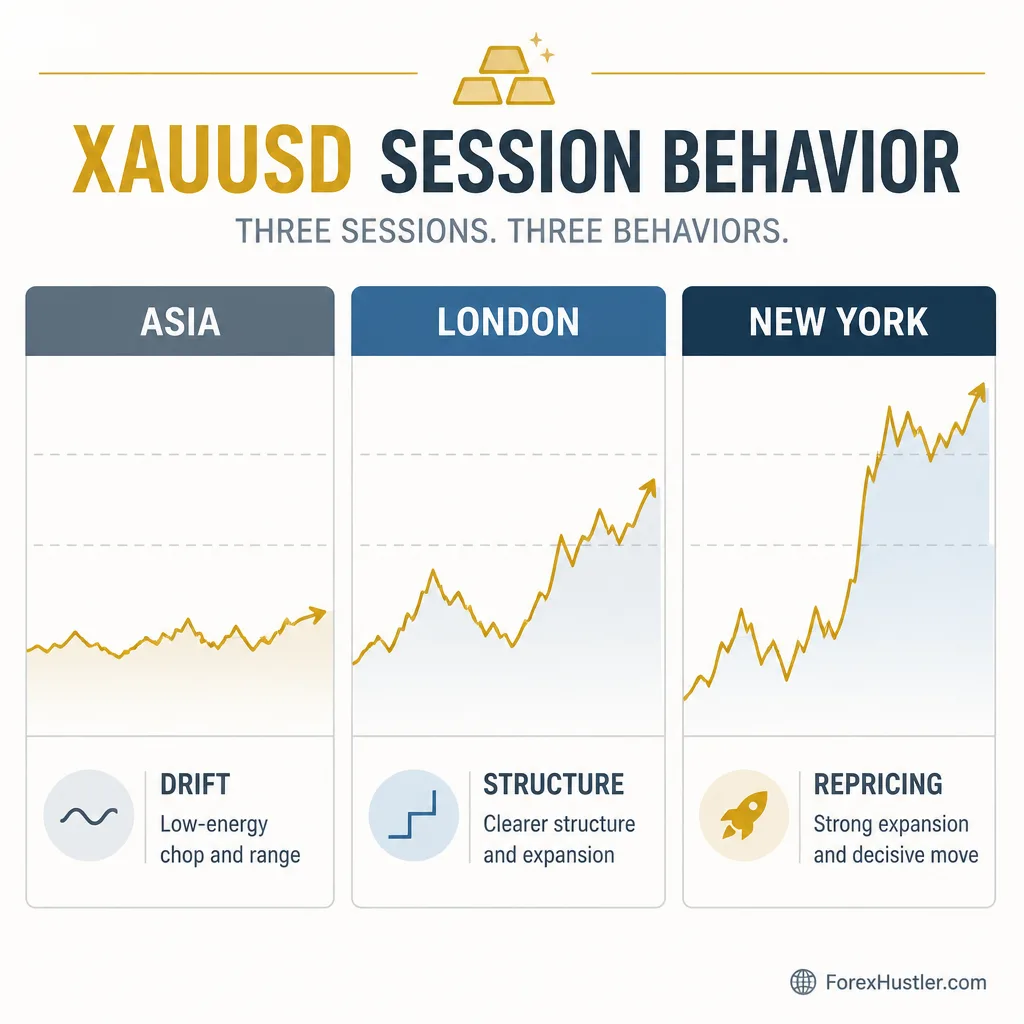
Session behavior in gold is not perfectly predictable. But it is not random either. Liquidity, catalyst risk, and execution quality change through the day, and XAUUSD often reflects that more clearly than many traders expect.
Asia: thinner flow, more drift, easier to get chopped
Asia often brings lighter participation in gold than London or New York. That can mean slower rotations, weaker conviction, and plenty of movement that looks active but goes nowhere.
This is where many retail traders overtrade. Gold prints candles, price twitches enough to feel alive, and traders start forcing intraday setups in conditions that offer little follow-through.
That does not mean Asia is useless. Some Asia sessions trend, especially after a strong U.S. move or a geopolitical headline. But as a baseline, it is usually a poor place to assume breakout conditions.
London: better participation, but not automatic trend
London often improves structure. Volume and participation are usually better than late Asia, and the market may begin to show clearer directional intent.
Still, this is where traders make another common mistake: assuming that more movement automatically means trend day. It does not. Gold may trade actively in London and still wait for U.S. data, Treasury yield moves, or broader dollar repricing before committing to a decisive move.
A London breakout can work well. It can also become the high or low of the day once New York opens. Context matters.
New York: the session that often rewrites the day
If one session most often changes the character of the day in gold, it is New York.
That is not mysterious. Gold is highly sensitive to U.S. macro releases, dollar movement, Treasury yields, and broader risk sentiment.[^2][^3] CPI, PPI, Non-Farm Payrolls, ISM, retail sales, and especially Federal Reserve-related events can all reshape intraday price action.[^4][^5]
In practical terms, New York often does one of three things:
- validates the London move
- reverses the London move
- ignores the earlier structure and creates a new intraday auction
The London-New York overlap is often one of the most active windows. That can create the best opportunities of the day, but it is also the most dangerous environment for traders using mechanical entries with no regard for event timing.
What session behavior means for stop placement
A stop that survives Asia chop may be too tight for New York volatility. A target that makes sense in a slow session may become unrealistic once spread and slippage show up around data.
That is the real takeaway: stop placement should reflect market conditions, not habit.
In quiet hours, expect drift, false starts, and lower-quality breakouts. In active U.S. windows, expect wider candles, faster repricing, and more friction around entries and exits.
Treating all hours as equal is one of the fastest ways to turn a decent strategy into a bad one.
The retail failure modes that show up again and again
Using EURUSD-style stops on a market that needs more room
A tight stop can feel disciplined. On gold, it is often just misplaced.
A realistic example: a trader sees a clean intraday long and places a stop $3 or $4 away because it feels responsible. In a quieter pair, that might be enough. In gold, especially during London or New York, that stop may sit inside ordinary noise.
Then the trade does what gold often does: dips, clips the stop, and later moves in the original direction.
The problem was not poor discipline. It was poor calibration.
Ignoring spread expansion around rollover, news, and thin conditions
Gold spreads are not static. They often widen around rollover, major economic releases, and thin liquidity windows.[^1]
That matters because spread does not only affect entry cost. It changes your effective stop distance and your real reward-to-risk. In poor conditions, a trade can fail not because the underlying idea was wrong, but because spread expanded into your stop zone.
Backtests and demos often hide this. Live trading does not.
If you hold positions into rollover or trade close to high-impact U.S. data, planned risk is an estimate, not a guarantee.
Overtrading chop because gold looks active
Gold can look busy all day. That is not the same as being tradable all day.
There is a difference between visual movement and directional quality. A market that keeps printing candles but rotates both ways, with unstable spreads and weak follow-through, is often worse than a quieter pair with cleaner structure.
Many traders confuse stimulation with opportunity. Gold is particularly good at encouraging that mistake.
Oversizing because the contract spec was never checked
This is the most avoidable error in the instrument.
A trader decides to risk 1%, estimates the stop, clicks a position size that looks small, and only later realizes the broker’s lot convention made the trade much larger than intended.
The fix is dull but necessary: check the contract spec every time you trade a new broker or symbol. Contract size, tick value, margin requirement, minimum lot, and lot step are part of risk management, not admin work.[^1]
Position sizing for XAUUSD without fooling yourself
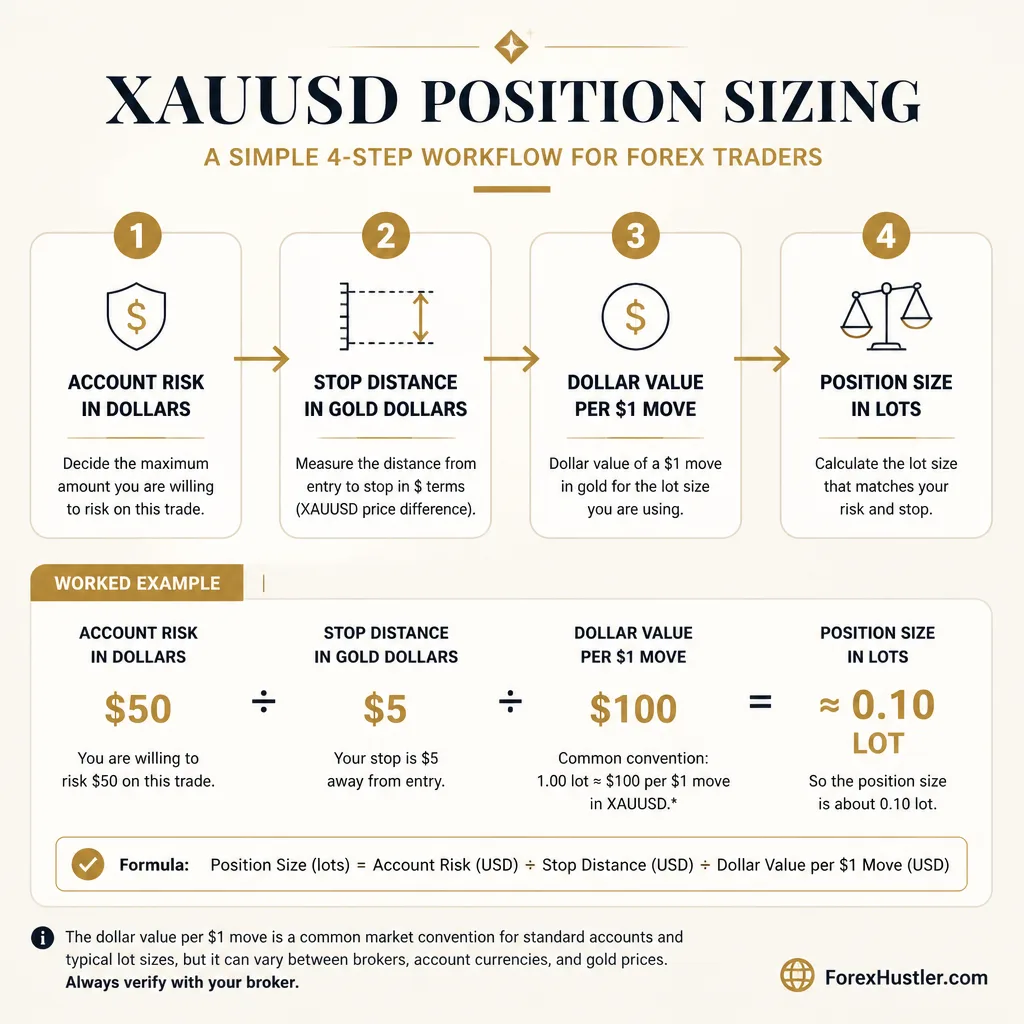
This is where most of the damage gets prevented.
Start with account risk, then convert the setup into dollars
The sequence matters:
- Define account risk in dollars.
- Define stop distance in gold-dollar terms.
- Calculate risk per lot.
- Derive position size.
Do not start with the lot size you want and reverse-engineer the stop. That is how traders accidentally oversize.
A simple formula under the common 100-ounce convention is:
Position size in lots = Account risk in dollars / (Stop distance in gold dollars × $100 per lot)
That $100 figure must be verified with your broker. It is common, not universal.[^1]
Example: fixed fractional sizing on gold
Say you have:
- Account balance: $5,000
- Risk per trade: 1%
- Dollar risk: $50
- Stop distance: $5.00
- Broker convention: 1.00 lot = 100 ounces
If gold moves $1.00, 1.00 lot gains or loses about $100.
So with a $5.00 stop:
- Risk on 1.00 lot = $500
- Risk on 0.10 lot = $50
That means 0.10 lot is your rough position size before spread and slippage.
This is exactly why gold hurts traders who eyeball size. A move that looks small on the chart can already consume the full intended risk.
Example: ATR-based sizing when volatility expands
ATR can help when gold’s normal range changes. Its value is simple: it adapts stop distance to current conditions instead of forcing the same stop into every environment.
Suppose your rule is:
- Stop distance = 0.8 × ATR
- Account risk = $50
- Broker convention: 1.00 lot = 100 ounces
If ATR is $6.00:
- Stop = 0.8 × 6 = $4.80
- Risk per 1.00 lot = $480
- Position size ≈ $50 / $480 = 0.104 lot
If ATR expands to $12.00:
- Stop = 0.8 × 12 = $9.60
- Risk per 1.00 lot = $960
- Position size ≈ $50 / $960 = 0.052 lot
Same account. Same 1% risk. But size is roughly cut in half because volatility doubled.
That is the point.
| Approach | Best when | Main advantage | Main weakness |
|---|---|---|---|
| Fixed stop sizing | Your setup has stable structure and similar conditions across trades | Simple and repeatable | Can become unrealistic when volatility expands |
| ATR-based sizing | Volatility shifts meaningfully by session or regime | Adapts stop distance to current movement | Does not fix poor entries or bad trade location |
Why the same risk percentage can still feel different on gold
A mathematically correct 1% risk on gold can feel much harder to hold than 1% on EURUSD.
The math is the same. The path is not.
Gold often moves with wider candles, faster unrealized swings, and more visible P/L fluctuation. Spread drag also tends to matter more for small retail accounts, especially when targets are modest.
So yes, two trades can both risk 1%. One can still feel calm while the other feels violent.
That psychological difference matters. If you keep cutting winners or moving stops because the path volatility feels uncomfortable, your sizing may be technically correct but behaviorally too large.
Execution on gold: when limit orders help and when they become a trap
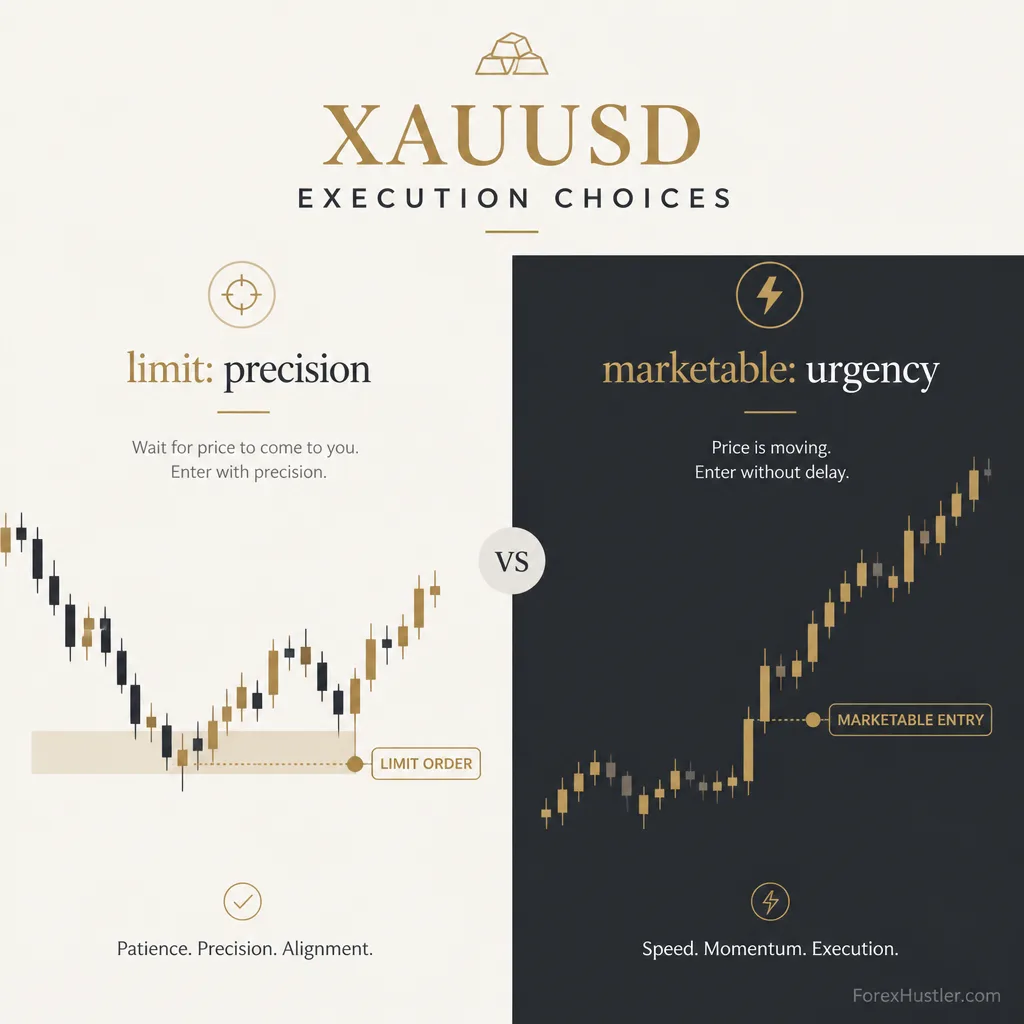
There is no universal best order type for XAUUSD. The better question is what the market is asking from you: patience or urgency?
When limit orders make sense
Limit orders work best when the trade depends on price location.
Typical examples:
- pullback entries into a clear level
- mean-reversion setups
- fading overextension into known resistance or support
- situations where spread cost matters relative to target size
If your edge comes from getting paid for patience, a limit order can improve execution and preserve reward-to-risk.
When limit orders create missed fills or false precision
Now imagine a New York session after a strong CPI surprise. Gold reacts fast, the dollar reprices, and the market starts moving before your ideal pullback appears.
You place a limit order just below market because you want a perfect entry. Price misses you by a few ticks and runs.
At that point, traders often make the worst second decision: chasing late, from a worse location, in a faster market.
The issue is not that limit orders are wrong. It is that the setup required participation, not perfection.
The real question is not market vs. limit. It is liquidity vs. urgency
That is the better lens.
Choose a limit order if:
- your edge depends on price precision
- the market is rotating rather than repricing
- missing the trade is acceptable
- spread cost is a meaningful part of trade economics
Choose a marketable entry if:
- the move is catalyst-driven
- the market is repricing quickly
- immediate participation matters more than perfect entry
- waiting for a pullback may mean missing the trade entirely
Gold punishes rigid execution rules almost as much as bad sizing.
A gold readiness checklist for forex traders
Before trading XAUUSD seriously, you want a checklist that catches structural mistakes early.
Broker and contract checks
Confirm all of this on your platform:
- contract size for 1.00 lot
- minimum lot and lot step
- tick size and tick value
- margin requirement and leverage rules
- trading hours and daily reset window
- whether your broker widens requirements during volatile periods
If you do not know what a $1 move means for 0.01, 0.10, and 1.00 lot on your broker, you are not ready to size the trade.
Spread and cost checks
You should know:
- typical spread during Asia, London, and New York
- what happens to spread around rollover
- whether commission is included in spread or charged separately
- overnight swap or financing cost if you hold positions
- whether there is a triple-swap day
For day traders, this is execution friction. For swing traders, it becomes part of the strategy.
Strategy-fit checks
Ask yourself:
- Was this strategy actually tested on gold, or just copied from EURUSD?
- Does the stop reflect gold’s range, not my habit?
- Am I trading a session that fits the setup?
- Am I accounting for spread and slippage, especially near data?
- If volatility doubles, does my size shrink automatically?
- Can my account tolerate wider stops without forcing bad decisions?
And one more question traders often avoid:
- Do I even need to trade gold?
Some traders do very well with it. Others are simply mismatched to the instrument. If your account is small, your edge relies on very tight stops, or your temperament hates path volatility, major FX pairs may be the more rational choice.
Conclusion
Gold is not untradeable. It is just unforgiving when approached with the wrong assumptions.
The biggest shift is simple: stop thinking like an FX trader who found a more exciting chart, and start thinking like a risk manager trading a different instrument. That means sizing in dollars per $1 move, respecting session behavior, planning for spread expansion, and choosing execution that fits actual liquidity conditions.
The traders who do well on XAUUSD are not the ones who treat it like EURUSD with bigger candles. They are the ones who rebuild their model around what gold actually is.
FAQ
Why is XAUUSD harder to trade than major forex pairs like EURUSD?
XAUUSD often has larger intraday swings, less forgiving spread behavior, and more variation in broker contract specs than major FX pairs. The main problem is not just volatility. It is that many traders apply EURUSD habits to a market that needs different stop placement, sizing logic, and execution expectations.
How should forex traders think about position sizing on gold?
Start with account risk in dollars, then calculate how much your stop distance in gold-dollar terms would lose per lot. A common convention is that 1.00 lot equals 100 ounces, so a $1 move in gold is about $100 per lot, but that must be verified with your broker. The key shift is to think in dollars per $1 move, not generic pip intuition.
What is a simple XAUUSD position sizing example?
On a $5,000 account risking 1%, your maximum planned loss is $50. If your stop is $5 away and your broker uses the common 100-ounce contract size, 1.00 lot would risk about $500. That means 0.10 lot risks about $50 before spread and slippage.
Why do tight stops fail so often on gold?
Many tight stops fail because they come from FX habit rather than gold’s normal price behavior. Gold often needs more breathing room than major currency pairs. A stop can look disciplined on paper while still sitting inside ordinary noise, especially during London and New York.
How does XAUUSD behave across Asia, London, and New York sessions?
Asia often brings thinner participation and more drift or chop. London usually improves activity and structure, but not every move turns into a trend. New York is often the decisive session because U.S. data, Treasury yields, dollar flows, and broader risk sentiment can validate, reverse, or completely rewrite the earlier move.
When do gold spreads usually widen the most?
XAUUSD spreads often widen around rollover, during major economic releases, and in thin liquidity conditions. This matters because spread expansion can distort entries, reduce effective reward-to-risk, and sometimes trigger stops even when the underlying move is not especially large.
Should I use ATR to size XAUUSD trades?
ATR can be useful because it adapts stop distance to current volatility. If volatility expands, ATR-based stops get wider and your position size should shrink if your account risk stays fixed. ATR helps calibrate risk, but it does not fix poor trade location or protect you from slippage during fast conditions.
Are limit orders better than market orders on gold?
Not always. Limit orders help when the setup depends on price location, such as pullbacks or mean-reversion entries. Marketable entries make more sense when urgency matters, such as fast New York repricing after major U.S. data. The better question is not limit versus market. It is whether the trade needs precision or immediate participation.
What broker details should I verify before trading XAUUSD?
Check contract size, minimum lot, lot step, tick size, tick value, margin requirement, leverage rules, trading hours, typical spread by session, rollover behavior, commission model if any, and overnight swap charges. These details vary by broker and directly affect risk.
Is XAUUSD suitable for every forex trader?
No. Gold can be systematic and tradable, but it is not a mandatory instrument. If your account is small, your strategy depends on very tight stops, or you cannot tolerate larger swings and higher friction, sticking with major FX pairs may be the more rational choice.