How to Choose a Trading Platform: 12 Criteria That Matter More Than “Features” (With a Scoring Template)
Most traders choose a platform the wrong way. They compare screenshots, count indicators, and pick whatever looks most “professional,” then run into the real issues later: awkward order entry, limited broker support, poor exports, expensive data, or a painful switch when their needs change.
A better method is to judge platforms by how well they fit your trading process. That matters far more than raw feature count. A platform can look powerful and still be the wrong choice if it slows execution, locks you into one broker ecosystem, or makes review and automation harder than they need to be.
This guide gives you a practical 12-factor framework for comparing platforms such as MetaTrader 5, TradingView, cTrader, NinjaTrader, and thinkorswim without relying on marketing pages or popularity alone.[^1][^2][^3][^4][^5]
The goal is not to name one universal winner. It is to help you rank platforms by execution, data, automation, portability, and total cost so you can choose with fewer regrets.
How to Choose a Trading Platform: The Quick Answer
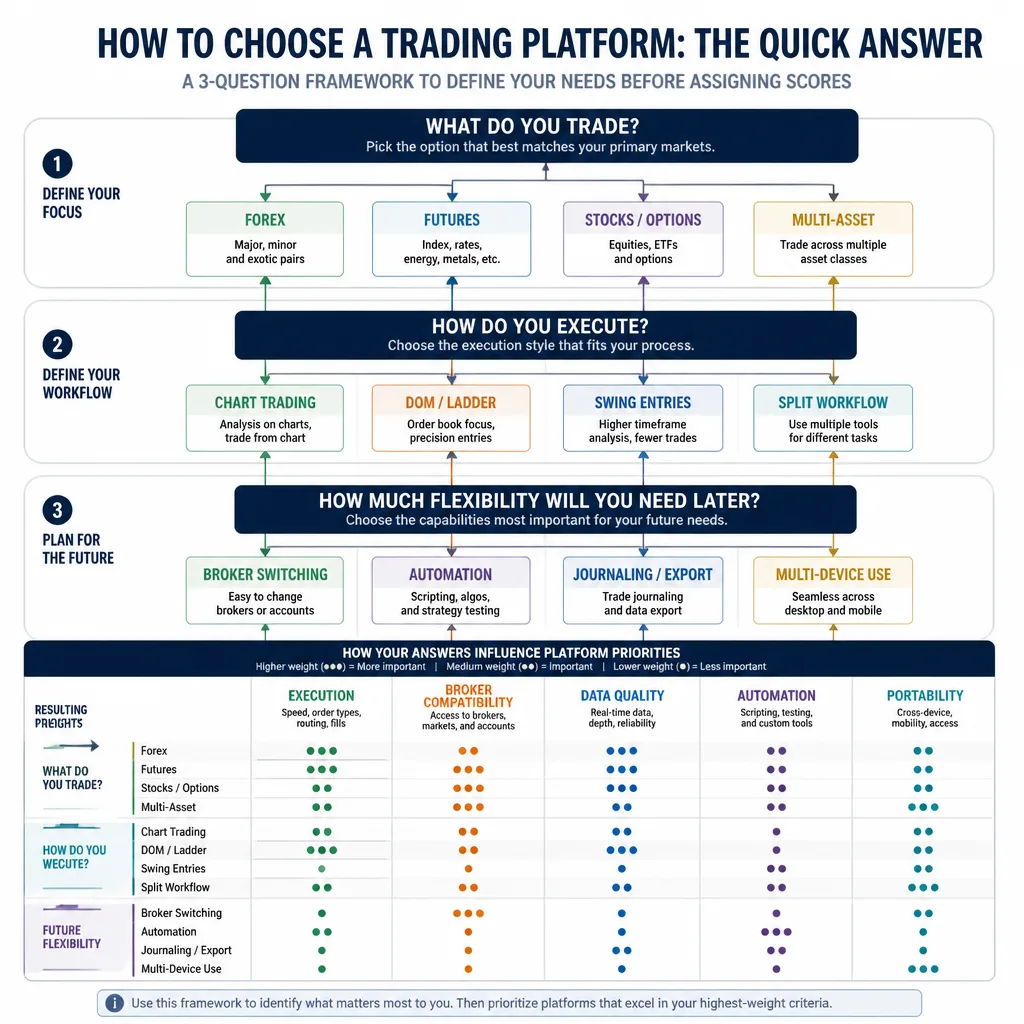
Short answer: choose the platform that fits your workflow best, not the one with the longest feature list.
Why “more features” is usually the wrong way to compare platforms
Feature lists hide the tradeoffs that matter in real use. They rarely tell you:
- how many clicks it takes to place and adjust a bracket order
- whether your preferred broker supports the workflow you need
- how clean your trade-history exports are
- whether backtesting is realistic or just available
- how difficult it will be to switch later
In practice, workflow fit beats abstract capability. A simpler platform that matches your process can be better than a more advanced one that adds friction.
The 3 questions to answer before scoring any platform
Before you score anything, answer these:
What do you trade?
Forex, futures, stocks, options, CFDs, or a mix.How do you execute?
Slow swing entries, active intraday trading, DOM or ladder-based execution, chart trading, or a split charting and execution workflow.How much flexibility will you need later?
Broker switching, automation, API access, journaling, and multi-device use all affect long-term fit.
The Platforms Most Traders Compare
MetaTrader 5 (MT5)
MT5 is widely used in retail forex and CFD trading and can support multiple asset classes depending on the broker setup.[^1] The biggest variable is the broker itself. Market access, data, and execution quality can differ significantly from one broker to another.
TradingView
TradingView is a charting-first platform popular with discretionary traders who value browser-based access, watchlists, and visual analysis.[^2] Whether it works as a complete execution platform depends heavily on broker integration and your order-entry needs.
cTrader
cTrader is often compared with MT5 in forex and CFD markets, especially by traders who care about interface design and execution workflow.[^3] As with MT5, the broker-platform combination matters more than the platform alone.
NinjaTrader
NinjaTrader is a common choice for active futures traders and for users who care about execution tools, charting, and strategy development.[^4] The experience still depends on your brokerage and data setup.
thinkorswim
thinkorswim is closely tied to the Charles Schwab ecosystem and is known for broad retail trading tools and research workflows.[^5] Its fit depends on product eligibility, account type, and jurisdiction.
How This Scoring Framework Works
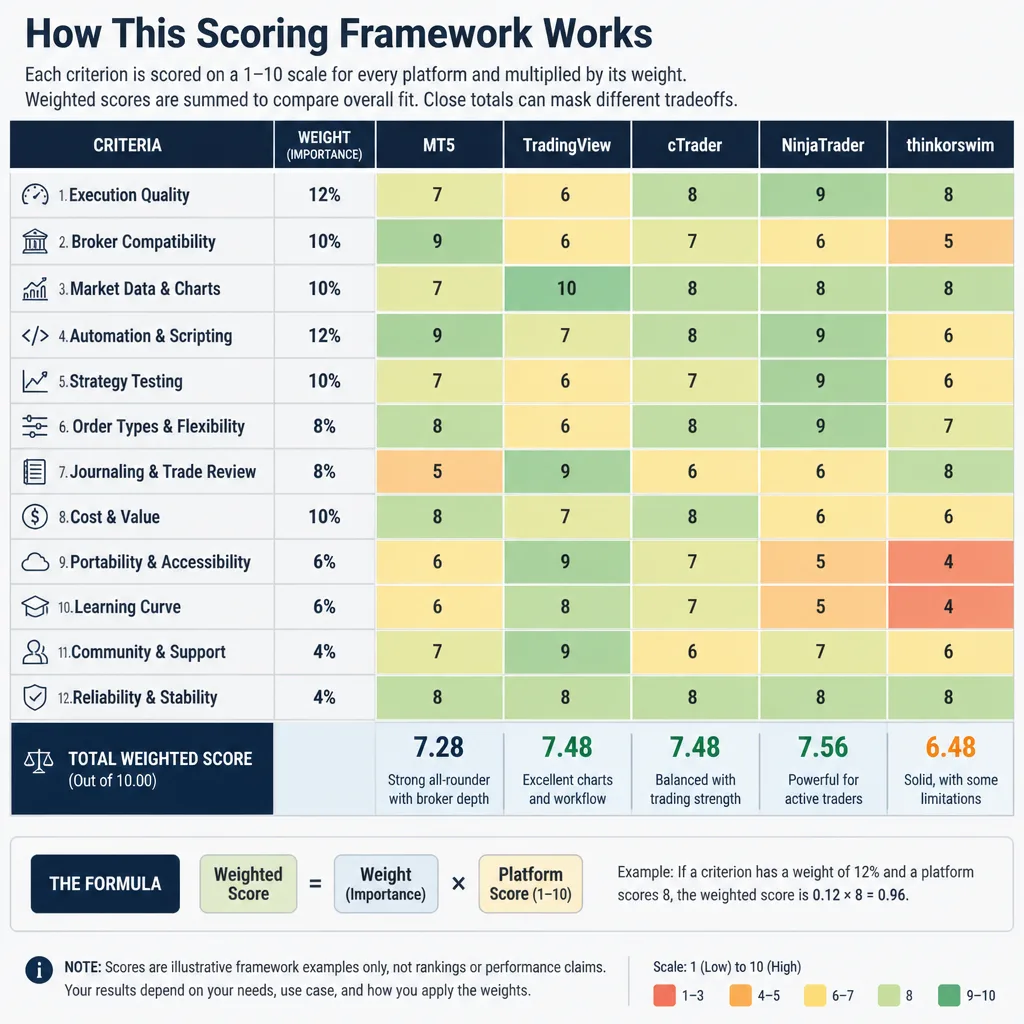
Featured summary: Use a weighted scorecard instead of a flat checklist. Give each criterion a weight based on your trading style, score each platform on the same scale, and compare totals. If scores are close, workflow tradeoffs matter more than the final number.
The 12 criteria and why they matter
These 12 factors usually have more impact on trading results and operational risk than a generic feature list:
- Execution workflow
- Broker compatibility
- Asset support
- Data quality
- Automation constraints
- Backtesting realism
- Journaling and export
- Total cost
- Learning curve
- Stability and cross-device consistency
- Integrations and APIs
- Portability
How to assign weights based on your trading style
A day trader should place more weight on execution, data, and stability. A swing trader may care more about chart reliability, journaling, and ease of use. An automation-focused trader should place much more emphasis on scripting, testing, integrations, and portability.
Simple scoring method: 1 to 5 or 1 to 10
Use either scale, but keep it simple.
Weighted Score = Criterion Weight × Platform Score
If your weights add up to 100, the final comparison becomes easy to manage in a spreadsheet. Avoid false precision. A platform scoring 82 instead of 79 is not automatically better if the lower score wins on your top priorities.
The 12 Criteria That Matter More Than Features
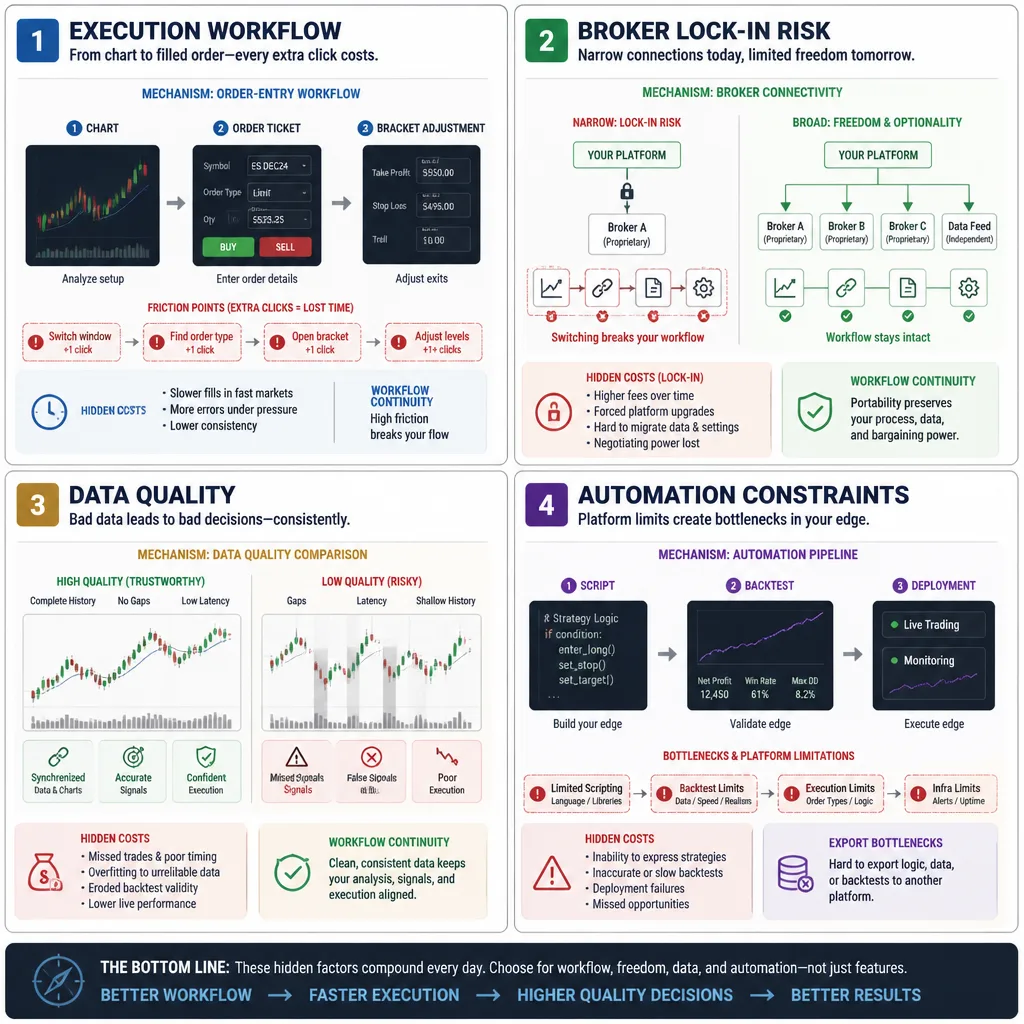
1. Execution workflow and order-entry speed
This measures how efficiently you can place, adjust, and exit trades. Think hotkeys, one-click trading, bracket orders, chart trading, and DOM or ladder workflow where relevant.
Why it matters: for day traders, extra clicks are not cosmetic. They create friction. Swing traders can usually tolerate more of it.
2. Broker compatibility and lock-in risk
This is separate from platform quality. A strong platform can still be the wrong fit if broker support is limited or restrictive.
Why it matters: if switching brokers later means rebuilding your workflow, your hidden switching cost is high.
3. Market and asset-class support
Score the platform based on what you can actually trade through your intended setup, not on headline claims.
Why it matters: traders often compare forex, futures, stocks, options, and CFDs as if access is the same everywhere. It is not. Broker and region both matter.
4. Data quality, latency, and chart reliability
Check whether real-time data, historical depth, intraday granularity, and chart consistency meet your needs.[^2][^4]
Why it matters: weak or costly data often becomes obvious only after you move past demo use.
5. Automation and scripting constraints
Does the platform support scripting well? Is automation built in? How difficult is deployment? Is functionality broker-dependent?
Why it matters: a platform can be excellent for manual charting and still weak for serious automation.
6. Backtesting quality and realism
Backtesting should be judged by realism, not by whether it exists. Can you model commissions, slippage, and realistic fills? Is the historical data good enough?
Why it matters: a poor tester can create false confidence faster than no tester at all.
7. Journaling, export, and trade review
Can you export clean trade history? Add notes? Capture screenshots? Review fills? Integrate with a journal or spreadsheet?
Why it matters: improvement depends on review. Many traders ignore this until months of records become difficult to analyze.
8. Total cost of ownership
This includes more than the platform price. Add broker commissions or spreads, data fees, exchange fees, premium plans, VPS needs, connectors, and switching costs.[^2][^4][^5]
Why it matters: a setup that looks cheap at first can become expensive once you need better data or more advanced tools.
9. Learning curve and interface friction
How long does it take to become competent? Are common tasks intuitive? Is the documentation usable?
Why it matters: time spent fighting the platform is a real cost, especially for beginners and part-time traders.
10. Stability, uptime, and desktop/mobile consistency
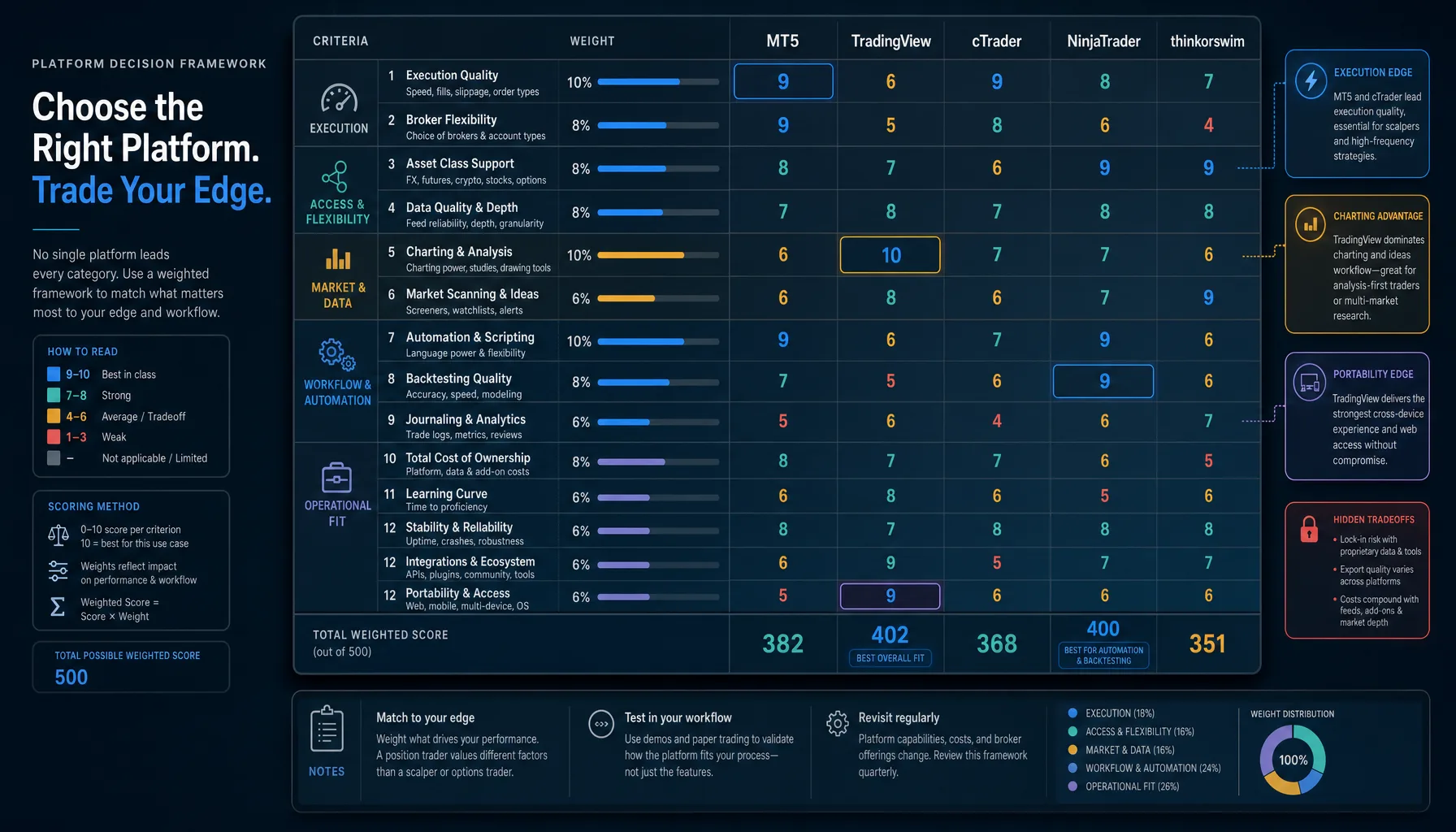
Do not rely on marketing claims here. Test reconnect behavior, workspace recovery, cross-device sync, and whether mobile is truly useful or just a backup.
Why it matters: platforms tend to fail under stress, not in screenshots.
11. Integrations, APIs, and ecosystem depth
Look at official APIs, third-party tools, scripts, marketplaces, and extension options where available.[^2][^4]
Why it matters: even if you do not need integrations today, future journaling, automation, and customization often depend on them.
12. Long-term portability and switching costs
Can you move layouts, scripts, records, and habits elsewhere without starting from zero?
Why it matters: portability is strategic. Many traders only notice it when they need to leave a broker or change markets.
A Copy-and-Paste Trading Platform Scoring Template
Sample weighted scoring table
Copy this into a spreadsheet:
| Criterion | Weight % | Platform | Score (1-5) | Weighted Score | Notes |
|---|---|---|---|---|---|
| Execution workflow | 15 | Bracket orders, hotkeys, DOM, chart trading | |||
| Broker compatibility | 10 | How many viable brokers? Region limits? | |||
| Asset support | 8 | Forex, futures, stocks, options, CFDs | |||
| Data quality | 12 | Real-time, historical depth, chart stability | |||
| Automation/scripting | 10 | Native scripting, deployment friction | |||
| Backtesting realism | 8 | Slippage, commissions, fill assumptions | |||
| Journaling/export | 8 | Clean exports, notes, screenshots | |||
| Total cost | 10 | Platform, data, broker, add-ons | |||
| Learning curve | 6 | Setup time, documentation, usability | |||
| Stability/consistency | 6 | Reconnects, workspace recovery, mobile sync | |||
| Integrations/APIs | 4 | Ecosystem depth | |||
| Portability | 3 | Switching friction later | |||
| Total | 100 |
Suggested default weights for discretionary traders
A practical default:
- Execution workflow: 15%
- Data quality: 12%
- Broker compatibility: 10%
- Total cost: 10%
- Automation: 10% if relevant, otherwise lower
- Journaling/export: 8%
- Backtesting realism: 8%
- Asset support: 8%
- Learning curve: 6%
- Stability: 6%
- Integrations: 4%
- Portability: 3%
Suggested default weights for algo traders
Algo-focused traders usually shift more weight toward:
- automation and scripting
- backtesting realism
- stability
- integrations and APIs
- portability
Execution still matters, but manual chart elegance matters less.
How to interpret final scores
Treat scores as decision support, not as absolute truth. If two platforms are close, test the tasks that carry the most weight in demo or trial conditions:
- place a bracket order
- modify stops quickly
- export trade history
- load watchlists and layouts
- test one alert or automation workflow
Example: How Different Trader Types Should Score Platforms Differently
Day trader focused on execution
Weight execution, data quality, and stability heavily. A platform with attractive charting but clumsy order handling should score poorly here.
Swing trader focused on charting and journaling
Weight chart reliability, layout comfort, trade review, and clean exports more heavily. Execution still matters, but speed is less important than review quality and decision clarity.
Automation-focused trader
Weight the scripting environment, testing realism, integrations, and long-term maintainability. A platform that feels great for manual trading may still be a poor fit here.
Multi-asset trader who wants portability
Weight asset support, broker flexibility, portability, and total cost. This type of trader should be cautious about tightly closed ecosystems.
Common Mistakes Traders Make When Choosing a Platform
Confusing the broker with the platform
A good platform does not fix poor market access, weak pricing, or regional restrictions. Always evaluate the platform and broker separately.
Ignoring export and journaling until it is too late
This is one of the most expensive “small” mistakes. If your records are fragmented, your review process weakens just when you need it most.
Choosing charting first and execution second
This is especially risky for active traders. Good-looking charts do not make up for slow or awkward order management.
Underestimating future switching costs
Scripts, templates, layouts, and habits all create lock-in. What feels convenient now may become expensive later.
Decision Framework: Which Platform Traits Matter Most for You?
Choose charting-first platforms if...
- visual analysis is central to your edge
- you trade slower timeframes
- you can tolerate some execution tradeoffs
- you may use a split workflow
Choose broker-native execution platforms if...
- speed and order management matter most
- you trade intraday or in fast markets
- you want fewer moving parts between chart and execution
Choose automation-friendly platforms if...
- strategy development is part of your plan
- you need robust scripting and testing
- you care about deployment and maintainability
Choose portability-first setups if...
- you expect to change brokers later
- you trade multiple asset classes
- you want cleaner exports, broader flexibility, and lower lock-in risk
Frequently Asked Questions
How do you choose a trading platform without getting distracted by feature lists?
Start with your trading workflow, not the marketing page. Define what you trade, how often you trade, how you place orders, and whether you may need automation or a broker switch later. Then score each platform on execution speed, broker compatibility, data quality, journaling, and total cost. A platform with fewer visible features can still be the better choice if it fits your process with less friction.
What criteria matter most when comparing trading platforms?
The highest-impact criteria are usually execution workflow, broker compatibility, market support, data quality, automation constraints, backtesting realism, journaling and export, total cost, learning curve, stability, integrations, and long-term portability. These factors affect day-to-day trading and future flexibility far more than indicator counts or interface style. The right weighting depends on whether you are a day trader, swing trader, algo trader, or multi-asset investor.
Why is broker compatibility separate from platform quality?
A strong platform can still be a poor fit if broker support is limited, expensive, or restrictive in your region. Broker compatibility affects market access, pricing, data, account types, and your ability to switch later. That is why you should evaluate the platform itself and the surrounding ecosystem separately. With platforms such as MT5, cTrader, and TradingView, the real-world experience can vary a lot depending on the broker integration.
What is broker lock-in and why does it matter?
Broker lock-in happens when your platform access, data, scripts, layouts, or workflow become too dependent on one provider or ecosystem. This matters because traders often outgrow a broker’s costs, support, execution quality, or product range. If switching means rebuilding everything from scratch, the hidden cost is much higher than it first appears. Checking lock-in early can save time, money, and disruption later.
What matters more: charting or execution?
It depends on your trading style. For swing traders and slower discretionary traders, charting quality and review workflow may matter more than ultra-fast order entry. For day traders, scalpers, and traders in fast-moving markets, execution usually matters more because extra clicks, weak hotkeys, or clumsy order management can directly affect results. A simple rule: if timing and order handling are part of your edge, prioritize execution over chart aesthetics.
How important is journaling and export support?
It is one of the most overlooked but valuable factors. Clean exports, trade-history access, notes, screenshots, and review-friendly records make it much easier to improve over time. Many traders ignore this until they have months of scattered data they cannot analyze properly. If you plan to track mistakes, refine setups, or use external journals and spreadsheets, export quality deserves more weight than most beginners expect.
Is TradingView enough as a primary trading platform?
It can be, but only for the right workflow. TradingView is widely used for charting and idea generation, but whether it is enough as a primary platform depends on your broker integration, order-entry needs, asset coverage, and automation requirements. For some traders it works well as a charting-first environment. For others, especially active traders with specialized execution needs, it works better alongside a broker-native platform than as the only tool.
Is MT5 still a good choice in 2026?
MT5 is still relevant for many retail traders, especially when broker support is strong and the available instruments match the trader’s needs. Its suitability depends less on popularity and more on the specific broker setup, market access, automation needs, and portability concerns. It can be a practical option, but it is not automatically the best choice for everyone. The right way to judge it is to score it against your own workflow and future flexibility.
Can one platform be best for both discretionary and algorithmic trading?
Sometimes, but not often. Many platforms are stronger in one workflow than the other. A platform can be excellent for discretionary charting and still limited for production automation, or strong for strategy development but awkward for daily manual trading. If you do both, score scripting, backtesting realism, execution workflow, and portability carefully. In some cases, a split workflow makes more sense than forcing one platform to do everything.
How should traders compare MT5, TradingView, cTrader, NinjaTrader, and thinkorswim objectively?
Use a weighted scorecard instead of a flat checklist. Assign each of the 12 criteria a percentage weight based on your trading style, then score each platform on the same scale, such as 1 to 5 or 1 to 10. Multiply each score by its weight and total the results. This gives you a more useful comparison than judging by feature lists or first impressions alone.
Conclusion
The best platform is rarely the one with the most features. It is the one that fits your workflow with the least friction and the fewest hidden costs.
That is why a weighted scorecard works better than a popularity contest or a simple checklist. It forces you to evaluate what actually affects trading: execution, broker flexibility, data, automation, review, cost, and portability.
If you are deciding between MT5, TradingView, cTrader, NinjaTrader, and thinkorswim, do one practical thing next: copy the template into a spreadsheet, shortlist your top three platforms, assign your own weights, and test the tasks that matter most before funding an account. That will tell you far more than any generic “best trading platform” list ever will.